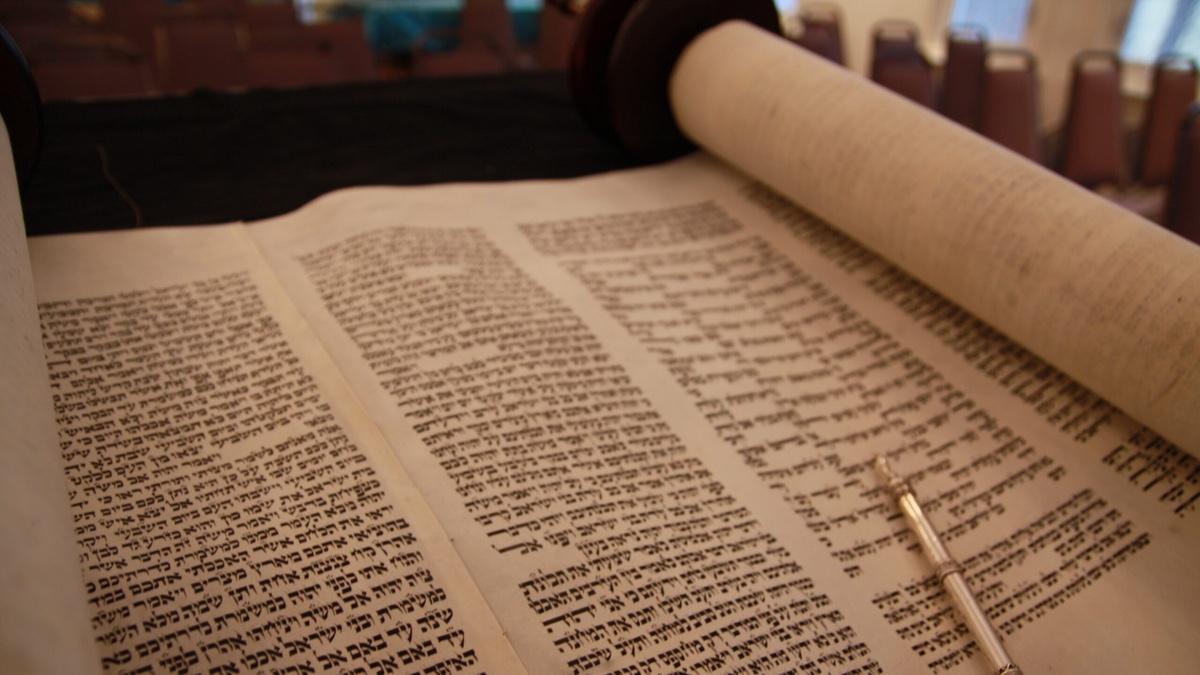
On the road to Emmaus, Yeshua met with two of His disciples and, beginning at Moses and all the Prophets, He expounded to them in all the Scriptures the things concerning Himself. (Luke 24:27). For our Torah studies this year, therefore, week by week we will seek to discover how all of Torah prepared the way for the coming Messiah.
14th March 2026 (25 Adar)
Vayakhel (And assembled) Exodus 35:1-38:20/Pekudei (Accountings of) Exodus 38:21-40:38
This week, our Bible study takes us to the end of Exodus. It is a wonderful passage to read. Much had happened since the crossing of the Red Sea, and now the Tabernacle is constructed, the Priestly ministry is about to begin and, most glorious of all, the presence of Almighty God came to fill the Tabernacle, which the artisans had made.
When the people of Israel look back over their history, and consider the best of times, this was it. A pilgrim people were about to walk with God across a wilderness to the Promised Land. Viewed retrospectively, life was far simpler then, than at any other time since, with complete dependence on God for daily food, protection and instruction.
Considering the rebellion that had recently occurred, what happened to bring order back to the nation and peace with God was equivalent to what we call revival in the Churches today – repentance, a new beginning and renewed purpose.
The call went out for everyone to bring articles of gold, silver, bronze, precious stones, animal skins, wood, the best of fabrics, coloured thread, oil and precious perfumes. Each one who was willing was moved to bring their contribution for the building of the Tabernacle, and all who were skilled gathered together to offer their talents. One can imagine, from among the hundreds of thousands of people, a groundswell of movement. From here and there among the crowds of people, one or another stirring, and each converging meaningfully towards the centre of the camp, as each brought what they had committed to Moses, for the use of Bezalel and Aholiab and other gifted artisans. Surely this was a movement of the Spirit of God, bringing response to repentant hearts. Among the simplest of gifts, which illustrate this truth, were the bronze mirrors from serving women, for the construction of the laver (Exodus 38:8). The washing vessel for the Priests was made from the mirrors which women had previously used to contemplate their outward appearance: focus on outer beauty was symbolically submitted to the means of inner cleansing and beauty – the result of the priestly ministry.
Let us pause and consider the potential of what was coming into being, for the ordering of the covenant people of God. The Tabernacle with all its beauty and purpose was constructed in the view of all the people. The Priestly garments were prepared in all their grandeur. The cloud of the Presence of God descended on the Tabernacle. From this time on, the daily experience of the Children of Israel was for God to be in their presence.
We read about the number of men over 20 years old in the community at that time– 603,550 (Exodus 30:14, 38:26). This gives an idea of the size of the camp that was set out in an ordered way with the Tabernacle at the centre. There must have been tens of thousands of tents for each of the Tribes. They were set out as ordered groups of tents, to the north, south, east and west. Around the Tabernacle, whenever the camp was set up, an immense community was established, in splendid array – in size, the equivalent of a city in our day – something that artists have sought to convey over the years: but it is hardly ever attained to convey the full magnificence of the scene that was the nation of Israel with God in their midst in those wilderness years.
Do we gain all that we can from this description of Israel at Sinai? We should meditate much on it, because it is a teaching related to who we are as the covenant people of God in our own day. The word shadow is used to describe what went before in contrast to the greater fulfilment of the New Covenant (Colossians 2, Hebrews 9, 10). Bear in mind that even though the word shadow is used, the imagery of the Old Covenant is not trivialised as if now meaningless. It was not only a shadow, but a model and teaching for what was to come in the New Covenant community. If we see magnificence in what Moses was shown on the mountain and what was made manifest through the wisdom of the artisans, we must expect an even greater and more glorious fulfilment through the ministry of Messiah in the covenant community today and into the future.
Ultimately, we can compare the camp of Israel in ordered array around the Tabernace of God’s presence in the wilderness, with the scene in Heaven which John saw:
After these things I looked, and behold, a door standing open in heaven. And the first voice which I heard was like a trumpet speaking with me, saying, “Come up here, and I will show you things which must take place after this.”
Immediately I was in the Spirit; and behold, a throne set in heaven, and One sat on the throne. And He who sat there was like a jasper and a sardius stone in appearance; and there was a rainbow around the throne, in appearance like an emerald. Around the throne were twenty-four thrones, and on the thrones I saw twenty-four elders sitting, clothed in white robes; and they had crowns of gold on their heads. And from the throne proceeded lightnings, thunderings, and voices. Seven lamps of fire were burning before the throne, which are the seven Spirits of God. Before the throne there was a sea of glass, like crystal. And in the midst of the throne, and around the throne, were four living creatures full of eyes in front and in back. The first living creature was like a lion, the second living creature like a calf, the third living creature had a face like a man, and the fourth living creature was like a flying eagle. The four living creatures, each having six wings, were full of eyes around and within. And they do not rest day or night, saying:
“Holy, holy, holy,
Lord God Almighty,
Who was and is and is to come!” (Revelation 4:1-8)
This is a vision of the heavenly reality to come that was represented on earth in the form of the Tabernacle, and also with direct relevance to today and into the eternal future.
Just as the Tribes of Israel surrounded the Tabernacle in the wilderness, so there will be an ordered community of 12,000 from each Tribe (Revelation 7:4-8) around the Throne in Heaven (a symbolic number denoting the redeemed community of Israel gathered for eternal life). These will be joined by multitudes from every other tribe of the earth, the final great fulfilment of Romans 11:
After these things I looked, and behold, a great multitude which no one could number, of all nations, tribes, peoples, and tongues, standing before the throne and before the Lamb, clothed with white robes, with palm branches in their hands, and crying out with a loud voice, saying, “Salvation belongs to our God who sits on the throne, and to the Lamb!” (Revelation 7:9-10)
After Israel settled in the Promised Land, Solomon’s glorious Temple replaced the Tabernacle, with a continued manifestation of God’s presence as in the wilderness (2 Chronicles 7:1-3). Later came the rebuilt Temple at the time of Zerubbabel, and later still the ornate Temple of Herod.
Then came Yeshua HaMashiach!
He spoke of the replacement of the physical Temple with His living body. At the time, He spoke provocatively to the religious leaders, as He ministered in the Temple courts prior to His sacrificial death:
Jesus answered and said to them, “Destroy this temple, and in three days I will raise it up.” Then the Jews said, “It has taken forty-six years to build this temple, and will You raise it up in three days?” But He was speaking of the temple of His body. (John 2:19-21)
The Temple did later fall, according to Yeshua’s prophecy from the Mount of Olives during the season leading up to Passover, recorded in Matthew 24:
Then Jesus went out and departed from the temple, and His disciples came up to show Him the buildings of the temple. And Jesus said to them, “Do you not see all these things? Assuredly, I say to you, not one stone shall be left here upon another, that shall not be thrown down.” (Matthew 24:1-2)
The reality is that after Yeshua gave Himself as our sacrifice for sin at that Passover, neither the Tabernacle nor the Temple would afterwards be adequate for the ministry of the worldwide community of His people. As He had said to the Samaritan woman at Jacob’s well:
Woman, believe Me, the hour is coming when you will neither on this mountain, nor in Jerusalem, worship the Father. You worship what you do not know; we know what we worship, for salvation is of the Jews. But the hour is coming, and now is, when the true worshipers will worship the Father in spirit and truth; for the Father is seeking such to worship Him. God is Spirit, and those who worship Him must worship in spirit and truth. (John 4:21-24)
The community of all God’s people worldwide is the New Covenant reality of the community of God’s people in their ordered array at Mount Sinai. When the Holy Spirit came to us at the first Shavuot after the Passover when Yeshua gave Himself as our sacrificial Lamb of God, it was in fulfilment of what happened at the dedication of the Tabernacle, when the Spirit of God came to earth. This was the time when the reality of the shadow of the Tabernacle and Temple began to be manifest as the body of Yeshua’s disciples, when they received the Spirit of God in their inner being. Later the Apostle Peter understood this more fully and wrote:
Coming to Him as to a living stone, rejected indeed by men, but chosen by God and precious, you also, as living stones, are being built up a spiritual house, a holy priesthood, to offer up spiritual sacrifices acceptable to God through Jesus Christ
……. you are a chosen generation, a royal priesthood, a holy nation, His own special people, that you may proclaim the praises of Him who called you out of darkness into His marvellous light; who once were not a people but are now the people of God, who had not obtained mercy but now have obtained mercy. (1 Peter 2:4-10)
Just as by the Spirit’s moving at the time of Moses when many people brought their contributions willingly for the building of the Tabernacle, so God moves us by the same Spirit to bring ourselves to Yeshua at the centre, and to the service of the living body of His people. Paul spoke much of the gifts and ministries of the Holy Spirit, especially in his letters to the Ephesians and Corinthians – a wide diversity of manifestations of the presence of God:
…..for the equipping of the saints for the work of ministry, for the edifying of the body of Christ, till we all come to the unity of the faith and of the knowledge of the Son of God, to a perfect man, to the measure of the stature of the fullness of Christ. (Ephesians 4:12-13)
We are in the intermediate stage between the Tabernacle in the wilderness and the eternal Kingdom, pictured in Revelation 7. Because God’s covenant community is now scattered all around the world and not concentrated in one place as it was at the time of Moses, we may sometimes forget that we are to be an even more glorious presence on the earth. The physical reality of what we are reading this week concerning the Tabernacle, therefore, must surely encourage us to turn more fully from the compromises of the world around and be the body that the Torah, the Prophets and the Writings of both the New and Old Covenants speak.