On the road to Emmaus, Yeshua met with two of His disciples and, beginning at Moses and all the Prophets, He expounded to them in all the Scriptures the things concerning Himself. (Luke 24:27). For our Torah studies this year, therefore, week by week we will seek to discover how all of Torah prepared the way for the coming Messiah.
21st March 2026 (3 Nisan)
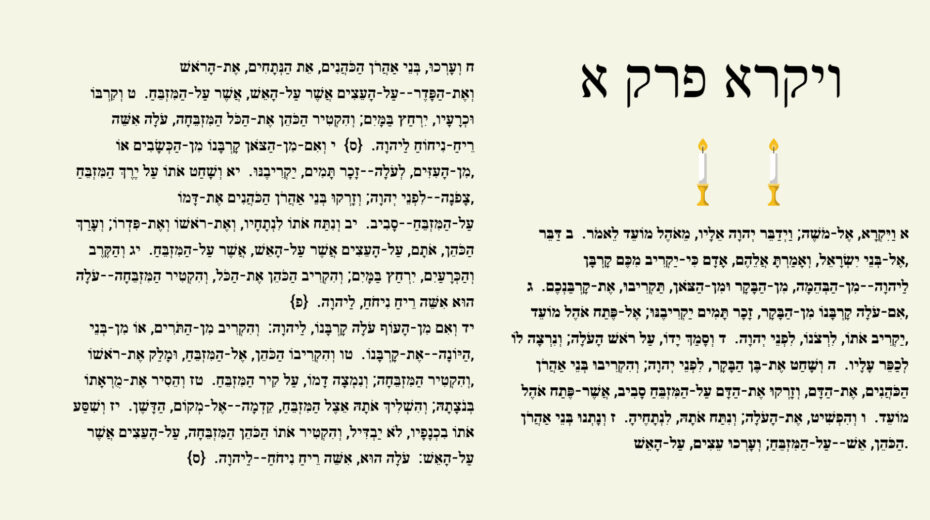
Vayikra (He called) Leviticus 1:1-6:7
There is a key word in this first portion of Leviticus, which opens the door to the needs of all mankind, and on which the purpose of all that follows depends. Indeed, one might say that it is a defining word for the history of redemption of all God’s people. The word is in the second sentence. It is also the first word of the second and third chapters. The word is, when. The key word is when not if.
The purpose of the Tabernacle is that the Priests, as representatives of the community of Israel, could enter the presence of God. The privilege is awesome, and is far from light or casual. From this time forward, it is clear to all Israel that it is a privilege, both necessary and costly, to come before the most Holy God.
Our passage reveals in clear detail that a need is to be met in coming to God. The when of verse two implies that the sacrifices and offerings will be needed. There will be times when the Children of Israel sin. They will sin, and when they come to realise that they have sinned, they will need a way back to God. Sin is transgression of the law of God – failing to do all that is required. At these times of need, the required sacrifice is described in our portion, whereby the sins may be covered.
These are chapters that we may prefer not to read, let alone do what is stipulated. The best of the herd or flock is methodically killed and cut up, its flesh burned and its blood scattered – it is a life given for the life of the one who sinned. Into Israel’s consciousness was placed the heartfelt need of a life to be given, that the sinner’s life could be spared. Sins against God are to be understood by comparison with the required sacrifice.
This is not how we conduct our human affairs outside knowledge of the Lord, when we do not understand the seriousness of breaking His laws. As an illustration, picture a child who has disobeyed its parents. At best, a child goes to its father or mother and says sorry, gains pity, receives forgiveness and the matter is over – a simple transaction of love, but at no great cost or depth of understanding. Picture the confessionary of some churches. A person relates what he considers to be wrong since the last visit, and obtains absolution with a brief penance of chanting some prayers. In both these cases, and a multitude of others, the knowledge of how deep sin can be is not present and a person may well sin again in the same way. Not so with our most Holy Father in Heaven. He certainly abounds in love for us but it is not superficial love. He requires us to be holy as He is holy, so that any unholy deed must be known for what it is – sin is a matter of life and death. Ultimately, it is eternal life that is in view through the lessons of temporal life. There can be no compromise.
Our need goes right back to the beginning of Creation, to the first time that mankind sinned. There was no use in Adam blaming Eve and Eve blaming the serpent: the nature of mankind was revealed and the first man and woman were cast out of God’s presence.
Until the time of Israel in the wilderness at Sinai, no remedy was available for the people of a nation to take the first steps towards redemption from the curse of the Fall. At no time before this had God established a means by which men and women could return to the fellowship lost in the Garden of Eden.
The awesomeness of the Covenant was made known to Abraham when animals were cut in two, a burning torch passing between the carcasses and deep darkness descending (Genesis 15). Surely Abraham knew the depth into which he was being drawn at the making of the Covenant. It took place only 3-400 years since the Great Flood at the time of Noah – God’s remedy for sin before the covenant with Abraham. 400 years is also roughly the time that Israel was in slavery in Egypt, where they experienced first-hand what it was like to live among a people bowing down to false gods. God’s teaching came step by step through history.
It is good to have all this in mind as we consider the necessary sacrifices and offerings that were to be at the centre of Israel’s pattern of life from then on, and for hundreds of years following.
Gruesome though this is, it presents us with a picture of mankind’s ongoing need. We also learn from the later history of Israel, that mankind’s need was helped but not cured by even this.
The practices of substitutionary sacrifice could so easily turn into religious ritual, so that the cry of the prophet Samuel could come as is if bringing fresh revelation (1 Samuel 15:22):
Has the Lord as great delight in burnt offerings and sacrifices,
As in obeying the voice of the Lord?
Behold, to obey is better than sacrifice,
And to heed than the fat of rams.
The thought that God had said through Moses, when not if you bring an offering, reminds us that we do not easily fully obey the ways of God. However, obedience is the issue, and if the prime focus shifts to the atoning sacrifices, then dry religion has taken over from the intended walk with God.
That same dry religion could also become slovenly as it did at the time of Malachi, when a blemished animal was presented to God, as if God could be fooled. The result was God’s distancing Himself from His people and the multiplication both of sin and difficulty for them:
For from the rising of the sun, even to its going down,
My name shall be great among the Gentiles;
In every place incense shall be offered to My name,
And a pure offering;
For My name shall be great among the nations,
Says the Lord of hosts.
But you profane it,
In that you say,
‘The table of the Lord is defiled;
And its fruit, its food, is contemptible.’
You also say,
‘Oh, what a weariness!’
And you sneer at it,
Says the Lord of hosts.
And you bring the stolen, the lame, and the sick;
Thus you bring an offering!
Should I accept this from your hand?
Says the Lord.
But cursed be the deceiver
Who has in his flock a male,
And takes a vow,
But sacrifices to the Lord what is blemished—
For I am a great King,
Says the Lord of hosts,
And My name is to be feared among the nations. (Malachi 1:11-14)
Our portion this week is the beginning of God’s making a way for mankind to be redeemed from the Fall at Eden. God can neither compromise nor will compromise.
Psalm 51 speaks to us across the years since David sinned greatly in both adultery and murder, and yet had a heart after God’s own heart. Sin is a matter of the heart. The Psalm is the cry of a repentant heart that knows that the religious acts of the Tabernacle sacrifices are for a purpose, but that the need goes even deeper:
Deliver me from the guilt of bloodshed, O God,
The God of my salvation,
And my tongue shall sing aloud of Your righteousness.
O Lord, open my lips,
And my mouth shall show forth Your praise.
For You do not desire sacrifice, or else I would give it;
You do not delight in burnt offering.
The sacrifices of God are a broken spirit,
A broken and a contrite heart—
These, O God, You will not despise. (Psalm 51:14-17)
David also wrote Psalm 19, where, in his desire to walk with God, looked out into the Creation to learn of Him. Then, whilst also meditating on God’s wonderful Torah, the fulness of his need of God reached down into his innermost need:
Who can understand his errors?
Cleanse me from secret faults.
Keep back Your servant also from presumptuous sins;
Let them not have dominion over me.
Then I shall be blameless,
And I shall be innocent of great transgression.
Let the words of my mouth and the meditation of my heart
Be acceptable in Your sight,
O Lord, my strength and my Redeemer. (Psalm 19:12-14)
Our Torah Portion this week helps us to understand the fulness of God’s intent in establishing the sacrificial system at Sinai. By reading further into our Bibles, we must admit that of itself it was not sufficient to meet the needs of fallen mankind to permanently return to fellowship with their Creator God.
The way was prepared for the greater sacrifice of which the sacrifices of the Tabernacle were a shadow.
The full balance of God’s love, holiness, righteous requirements and atoning sacrifice were embodied in the sacrifice of the Son of Man, Yeshua the Messiah.
The authors of the New Covenant writings dig deeply into their understanding of Yeshua’s sacrifice for us and the way that it was made permanent where daily sacrifices failed. The blood of animals was not sufficient for the needs of mankind. Following Yeshua’s atoning sacrifice, God sent His Holy Spirit to bring the change of character that these sacrifices could not bring. With the clear understanding that all have sinned and fall short of the glory of God (Romans 3:23), the Apostle Paul wrote clearly and analytically to bring understanding of the truth, especially in the masterpiece of his Letter to the Romans.
The Writer to the Hebrews, likewise, considers the greatness of the New Covenant in the shed blood of Yeshua, to which the animal sacrifices pointed, exhorting us all to come to the Father through Him by faith:
Seeing then that we have a great High Priest who has passed through the heavens, Jesus the Son of God, let us hold fast our confession. For we do not have a High Priest who cannot sympathize with our weaknesses, but was in all points tempted as we are, yet without sin. Let us therefore come boldly to the throne of grace, that we may obtain mercy and find grace to help in time of need. (Hebrews 4:14-16)
In a short while, we will come to the season of Pesach (Passover). Our portion this week, if considered in isolation, will be incomplete, awe-inspiring that it is, nevertheless. It was a simply a profound beginning of God’s providing a way back to Him for fallen mankind. Let us, therefore, also begin to search the Scriptures more meaningfully, to discover the fulfilment of His purpose, where, through His own Son, we might go beyond temporary forgiveness to a transformed character in preparation for eternal life with Him.