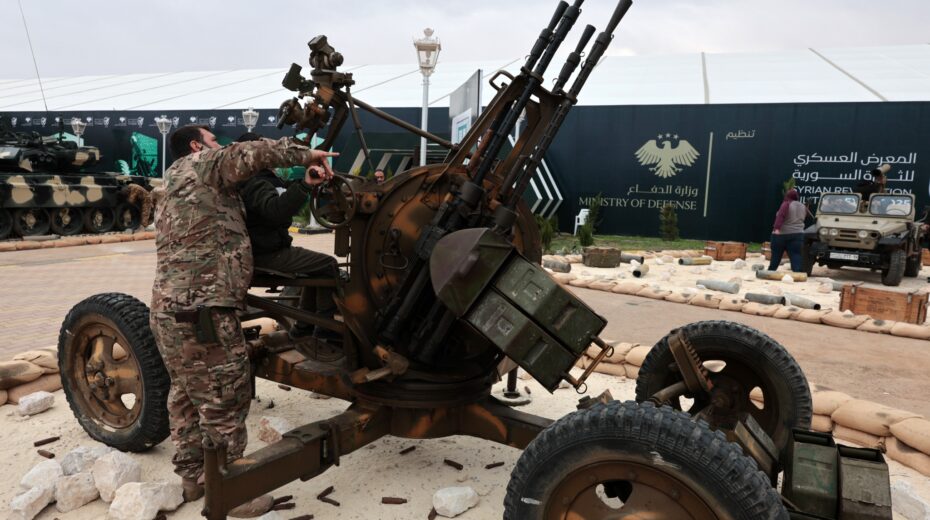
(JNS) A large-scale initiative to rebuild and modernize the Syrian Army is underway, a report by the Washington-based Institute for the Study of War think tank indicates.
The project is being led by President Ahmed al-Sharaa, as part of an attempt to consolidate his burgeoning control over Syria and reimpose Damascus as a player in Middle Eastern geopolitics.
Kelly Campa, an Institute for the Study of War analyst, explained that the project is in a critical stage but may take significant time to materialize.
“The Syrian government is still building the army, and it is currently in a highly formative stage,” she said. “The formation of a new army that is responsive to an institutionalized chain of command will be extremely challenging and will take years.”
The Syrian military was almost entirely destroyed during the fall of the Assad regime in December 2024, under the combined pressure of rebel armies, internal desertion and sweeping Israeli airstrikes. The collapse of the Syrian military followed 14 years of civil war, which significantly eroded Damascus’s military strength.
Following the 2024 revolution, al-Sharaa assumed the role of transitional president and moved to reestablish state authority under a centralized system based in Damascus. The current modernization project is being largely driven and influenced by al-Sharaa’s experiences with factionalism during the Syrian civil war, the Institute for the Study of War reported.
During the civil war, al-Sharaa was the leader of the Hayat Tahrir al-Sham Sunni Islamist terrorist group and found himself consistently bogged down by internal rivalries and a general lack of cohesion.
“Al-Sharaa sought to unify the Syrian opposition to overthrow [President Bashar] Assad and control Syria, an effort that naturally brought him into conflict with many other Syrian armed groups. Al-Sharaa and his contemporaries recognized the need for unity to defeat the Assad regime early in the civil war, but the opposition’s disparate goals and the diversity of its backers made unity difficult to achieve,” Brian Carter, a research manager at another Washington-based think tank, the American Enterprise Institute, explained.
“Al-Sharaa now aims to extend state control through the new army … over all Syrian factions, similar to the way in which he centralized control over [northwestern Syria] during the later years of the civil war,” Carter added.
The new Syrian Army
The new Syrian Army draws its core manpower from several armed groups that emerged as dominant actors during the final stages of the civil war.
A significant portion of fighters come from Hayat Tahrir al-Sham. Units aligned with Fateh al-Mubin, an umbrella group that coordinated several HTS-linked formations, are also incorporated into the force. Additional components have been absorbed from the Syrian National Army, a Turkish-backed coalition that operated across northern Syria.
Forces from the Southern Operations Command, including Druze factions, have also been folded into the fledgling army. In mid-October, the Syrian military got its largest boost with the integration of three Syrian Democratic Forces (SDF) divisions. The SDF is a Kurdish-led coalition of US-backed militias and rebel groups.
The Defense Ministry has organized the new Syrian Army through the reflagging of civil war–era militias. Reflagging replaced the original identities of these groups with formal military designations while retaining their personnel and internal structure. The ministry has continued to form new divisions and merge others since March 2025.
Together, the patchwork approach has resulted in unprecedented growth in the military’s manpower. As of November 2025, there are at least 23 fully integrated divisions in the Syrian army. Each division is estimated at approximately 2,400 to 3,600 personnel, making it the size of a small conventional brigade in a Western military.
Twenty-three divisions?
Brig. Gen. (res.) Assaf Orion, an expert at the Washington Institute for Near East Policy and a senior research fellow at Tel Aviv University’s Institute for National Security Studies, explained that the numbers being reported are most likely significantly exaggerated. “Twenty-three divisions are almost twice as many as Assad had at the height of Syria’s power. These are clearly inflated reports,” Orion told JNS.
“These are not real divisions. There is no capability of raising a maneuvering army of that size in such a short time,” he added.
Despite these manpower constraints, the new Syrian military, even at this early stage, already constitutes a far more significant threat than the Assad regime did, which, even at the height of its power before the civil war, could only support 13 divisions, most of which were considered unreliable as fighting formations.
Despite the surge in recruitment, early reports indicate consistent issues of professionalism in the new army. Campa explained that al-Sharaa faces a “long, politically challenging professionalization process that is required to build a disciplined army.” She added that “The army’s early deployments and combat experience have revealed a host of problems that longer-term professionalization efforts will need to address.”
Several units engaged in acts of extreme violence against Syrian minorities, including Druze, Kurds and Alawites, over old sectarian rivalries. These issues appeared most frequently in divisions formed from factions with limited experience operating under a centralized command system. Damascus claimed that these factions acted in opposition to explicit orders, although these assertions have been challenged.
Command and control gaps have also affected the army during its initial reorganization. Reflagged units have largely retained their internal leadership networks and informal practices that developed during the civil war, thereby reducing the effectiveness of formal oversight by the Defense Ministry.
To counteract this trend, standardized military procedures are being imposed across the army. “The Defense Ministry has begun limited early steps toward this end by issuing new directives aimed at improving discipline, including requiring all personnel to wear issued uniforms and requiring military academy attendance for civil war opposition commanders seeking promotion,” Carter explained.
Turkish influence
The hidden engine in the background of the sudden push to expand and modernize the Syrian military is Turkey. Ankara has positioned itself as Damascus’s principal military partner, openly providing training, advisory support and structural assistance. In July, Turkish Defense Minister Yaşar Güler said that Turkey had “started providing military training and consultancy services, while taking steps to increase Syria’s defense capacity.”
Ankara and Damascus formalized this patron status when they signed a memorandum of understanding in August outlining a comprehensive framework for military cooperation. “The memorandum aims to coordinate, plan military training and cooperation, provide consultancy, information and experience sharing, ensure the procurement of military equipment, weapon systems, logistical materials and related services,” the Turkish Defense Ministry explained.
Beyond military support, Ankara retains a significant armed presence in Syria and exercises significant control over multiple fighting factions, including ones that have already folded into the new army, such as the Syrian National Army.
With more than 20,000 Turkish troops deployed across northern Syria following years of cross-border operations, Ankara has signaled no immediate intention to withdraw.
Instead, Turkish officials link any future recalibration of their military posture to Syria achieving stability, removing security threats along the border and creating conditions for the safe return of displaced Syrians. These conditions all but guarantee a perpetual Turkish military presence as well as direct Turkish influence over the development of the Syrian Army in the near future.
Orion cautioned not to overinterpret the significance of the Turkish collaboration with Syria. “We should not be immediately concerned by everything Turkey provides. It really depends on the types of materials they give the Syrians. If they provide air defense, one must wonder whose air force they are thinking about. If they provide serious offensive weapons like missiles and drones, that must be a point of concern,” Orion said.
Implications for Israel
The initiative to rebuild the Syrian Army is winding up just as tensions have spiked on the Israeli-Syrian border.
Overnight on Nov. 28, fighting broke out near the Syrian border village of Beit Jinn after a raid by the IDF’s 55th Brigade to detain members of the Al-Jamaa al-Islamiya terror organization. Six soldiers were wounded in an ambush as they were extricating the captured terrorists from the village. According to the Syrian state media, 13 people were killed and 24 wounded in the ensuing IDF response, including several terrorists. According to a report by Kan, Israel’s public broadcaster, the ambush against the IDF was orchestrated by members of the al-Sharaa regime’s General Intelligence Service.
Aside from this incident, reports indicate that there has been a general buildup of terror proxies in the region adjacent to the Golan.
Defense Minister Israel Katz told the Knesset Foreign Affairs and Defense Committee on Nov. 26 that several terror groups, including Yemeni Houthis within Syria, are considering attacking the Golan Heights. According to Katz, the IDF is preparing for scenarios in which Syrian forces, or various militias within the country, attempt a ground incursion against Israeli communities or again threaten Syrian Druze communities.
Kan reported last week that due to the recent escalations, the Israel Air Force is likely to get increasingly involved in Syria as risky arrest operations are likely to get phased out in exchange for targeted airstrikes.
Despite the recent escalations, Orion said that the initiative to rebuild Syria’s army is unlikely to pose a conventional threat to Israel in the near future.
“The process of building a conventional army, let alone an air force or other advanced branches, is a very long and costly enterprise. Even modern advanced economies would strain financially to build a significant conventional army from scratch,” he explained. “The possibility of Syria presenting a conventional threat to Israel in the next 10 or even 20 years is not high.”
Orion further observed that even if Syria developed a functional conventional force, this would actually play to Israel’s advantage in some scenarios, as modern militaries are better-equipped to address such challenges. “Israel is well geared to deal with conventional threats,” he said.
“The Syrian force now being built might cause a lot more trouble as a nonconventional terror army launching missiles and drones into Israel than as a traditional army of tanks and divisions,” Orion said.
He added that the recent war has clearly shown that terror groups do not need conventional capabilities to inflict serious harm.
“A rapid light armed force on pickup trucks can create a significant impact, so even if they don’t have the mass of a large organized army, there is still a definite capability to inflict major damage. We saw this on Oct. 7, 2023,” Orion said.
Want more news from Israel?
Click Here to sign up for our FREE daily email updates