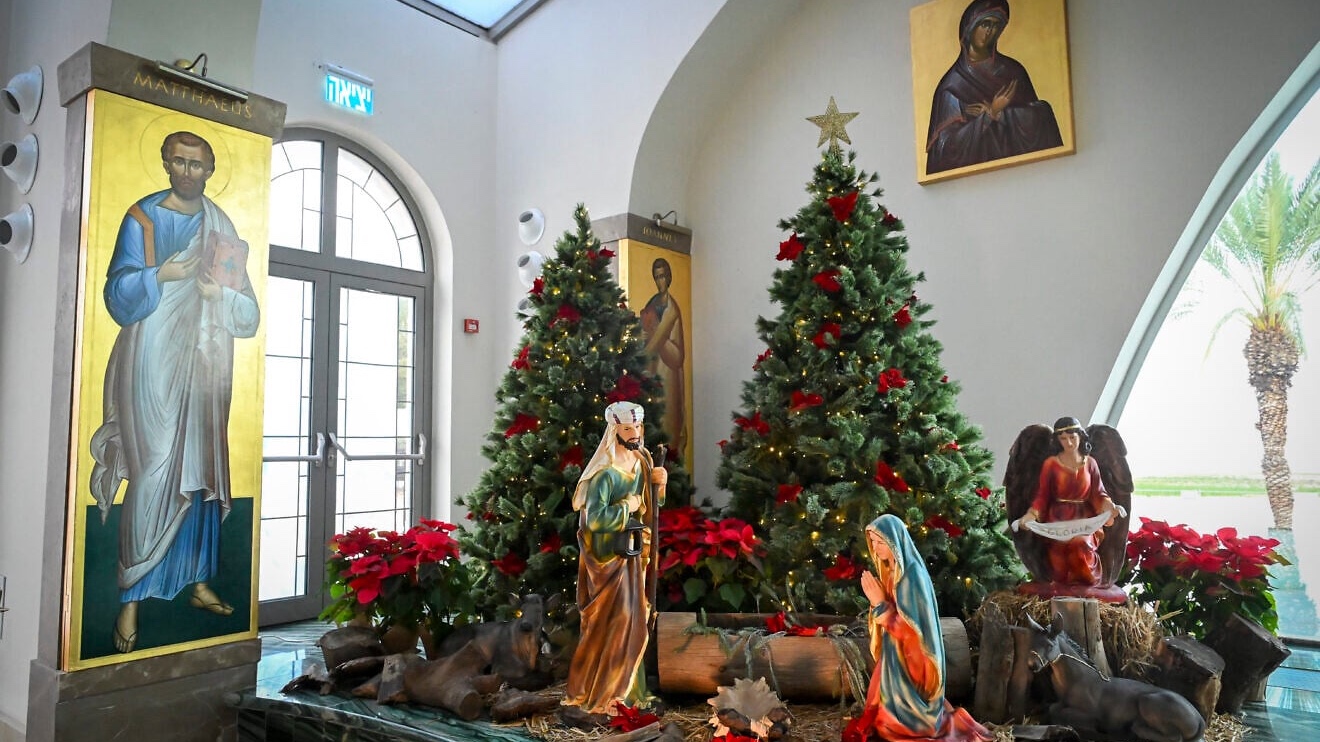

(JNS) In Bethlehem, the city Christians associate with the birth of Jesus, an image has taken hold in recent years that is rougher and more media-effective than the traditional nativity scene: “Jesus in the rubble.” The newborn lies in a heap of shattered concrete, often “decorated” with a Palestinian keffiyeh. The motif appeared as early as Christmas 2023 in Bethlehem’s Evangelical Lutheran Christmas Church; the local pastor, Munther Isaac, began spreading it as a symbol of “Christmas in wartime.”
In doing so, he offered not only a “powerful image,” but also a ready-made interpretation: He repeatedly claimed that “if Jesus were born today, he would be born under the rubble,” meaning beneath the ruins left by Israeli airstrikes.
The image is designed to hit you—believer or not—straight in the gut.
Compassion for civilians, especially children, is natural; empathy in itself is not the problem. The problem begins the moment compassion turns into a verdict. Rubble is elevated into the “definition of Christ in our time,” and the Christmas story is symbolically relocated from Judea to Gaza, as if the “real Bethlehem” were no longer the Church of the Nativity in Bethlehem but wherever the most ruins are.
As part of this logic, the image does not invite reflection; it functions as an emotional sledgehammer. Anyone who asks about causes and actors in the background is instantly portrayed as if they were “questioning the child.” And that is precisely why its impact is so strong—because what lies on the stage is not just any child, but the Christ Child.
Isaac did not leave “Jesus in the rubble” as just local installation. He turned it into a narrative that is easy to copy, project, share and replay endlessly.
His sermon, “Christ in the Rubble,” spread online and was picked up by virtually all major international media; later, it became the title and central theme of public appearances and discussions, including in academic settings, where he presented his book, Christ in the Rubble: Faith, the Bible and the Genocide in Gaza, framing the two-year war between Hamas and Israel as a theological and moral indictment of Israel. Some congregations in the United States have already announced that they are planning Christmas Day services or sermons explicitly under the title “Christ in the Rubble” (for example, St. Andrew’s Episcopal Church in Birmingham, Ala).
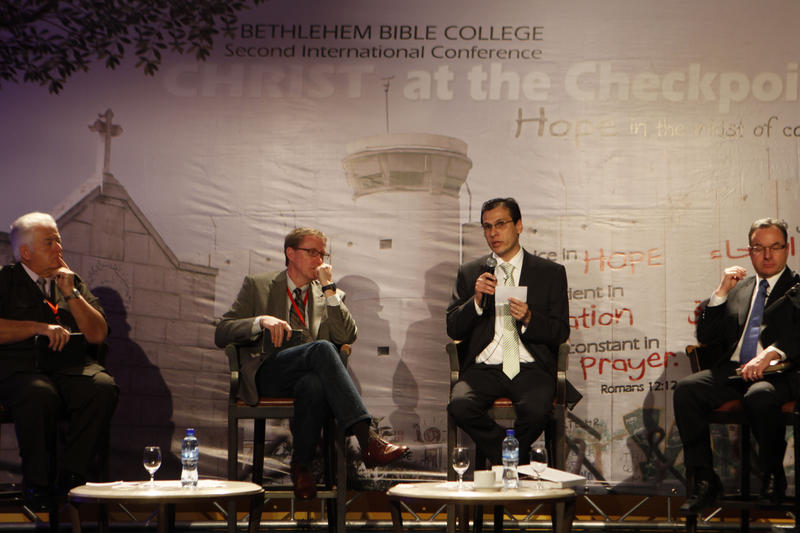
Munthar Isaac, second from right, leading the “Christ at the Checkpoint” conference in 2012. Sliman Khader/FLASH90
Pushed into a moral dilemma
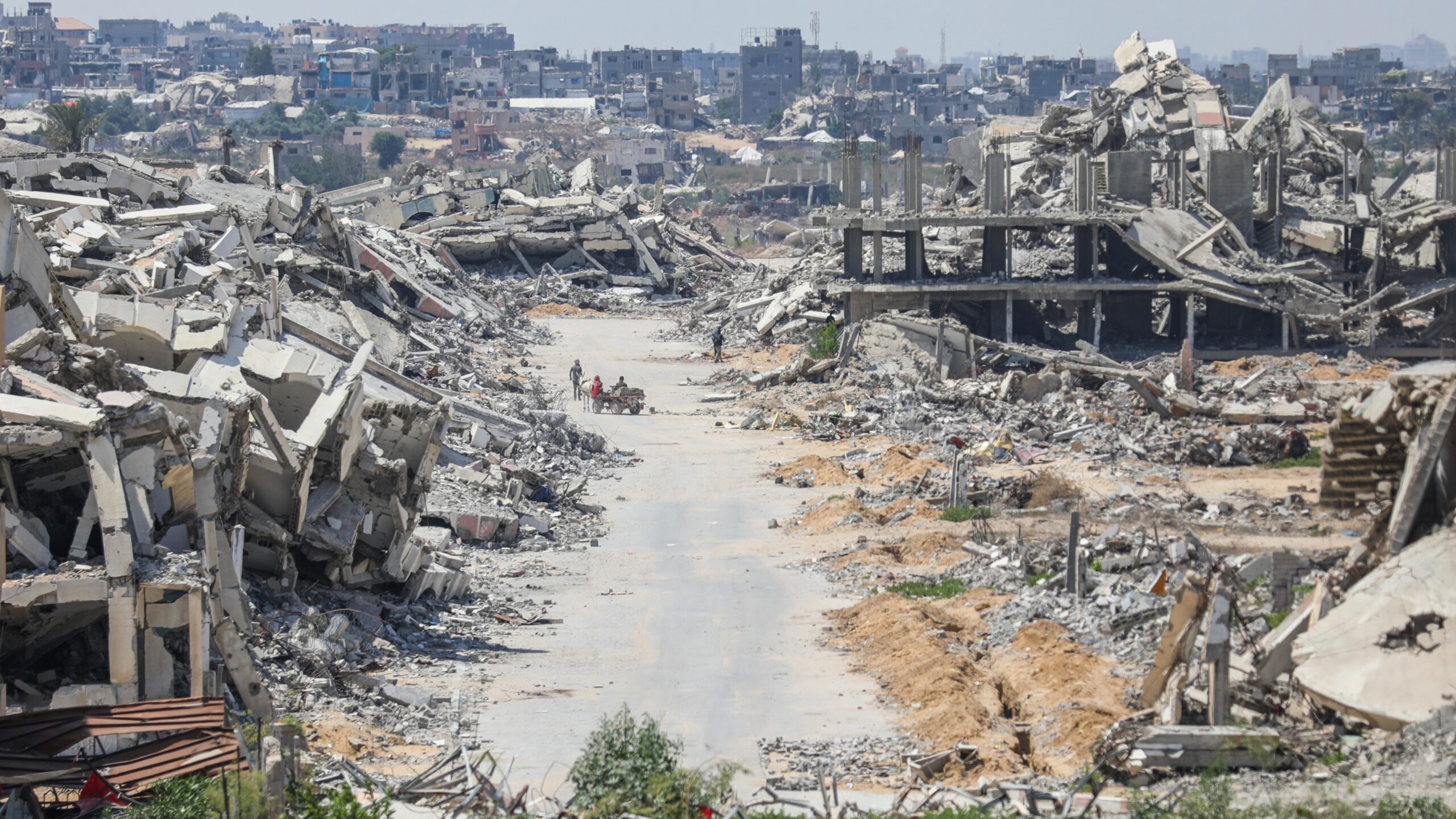
Propaganda does not need long manifestos. An iconic image is enough—instantly legible, universal, viral. A child found among rubble is a “perfect” medium: You don’t need to know the circumstances of the atrocities that occurred in Israel on Oct. 7, 2023, or who started the war and how it is being fought. A reflex is enough: innocence plus ruins equals culprit.
But for this story to remain coherent, the most uncomfortable actor has to disappear from the frame: Hamas, a genocidal jihadist terrorist movement. Either it is omitted entirely or reduced to a sentimental figure of the “desperate Palestinian,” who supposedly “had no other choice.” Yet the reality of the war in Gaza is precisely what the propaganda does not want in the picture: urban warfare, tunnel infrastructure, and the systematic blurring of military and civilian space.
This is not a detail; it is the core of Hamas’s tactic. Armed cells and military infrastructure are deliberately pushed into the civilian sphere. Residential neighborhoods, mosques, schools and hospitals become cover for command posts, logistical hubs, rocket-launch sites, and weapons and ammunition depots; humanitarian areas and civilian convoys are abused for moving terrorists and material; terror tunnels run directly beneath homes. Civilians thus become human shields—not as potential “collateral damage,” but as a consciously deployed strategy. The result is tragically predictable. When fighting takes place in the densest built-up areas, civilian casualties cannot be avoided entirely.
The cynicism lies in the fact that civilian losses here are not something Hamas wants to reduce. On the contrary, the more suffering and the more images of rubble circulate worldwide, the more propaganda can be manufactured against Israel.
The Jewish state is pushed into a moral dilemma. The Israeli army has a duty to protect its own civilians; it cannot accept a rule that a terrorist becomes untouchable simply because he hides among families. If the Israel Defense Forces strikes a terrorist embedded in civilian space, the risk to civilians rises; if it does not strike, it allows the same terrorist to prepare further attacks against Israeli civilians. This is the “double trap” that Hamas relies on. Either way, it sells the world the same slogan: “Israel does it deliberately.” It’s a slogan that erases context and blurs Hamas’s own responsibility for waging war in a way that makes civilians pay with their lives for its military immunity.
It is not surprising that many believe it. After all, it is the easiest story to consume and share, and in practice, it flips into distorted accusations of genocide. We live in a world in which the “human rights” NGO Amnesty International frequently pumps out reports and posts falsely claiming that “Israel is committing genocide in Gaza,” while issuing a report on Hamas’s glaring war crimes only hesitantly, more than two years after Oct. 7.
Then the most toxic shortcut flows into the propaganda: “Israel kills children.” The tragic death of children turns into an allegation of intent, as if Palestinian children were being targeted and systematically killed “as under King Herod.”
And this is where the manipulation works. In Christian memory, Herod is not merely a historical figure but a symbol of absolute evil—a ruler who responds, out of fear of a child (Jesus), with the “slaughter of the innocents,” commemorated in the Feast of the Holy Innocents. Once his name is invoked, explanation stops: It is no longer about war, but about the myth of “monster versus child.”
The result is not empathy but demonization. Israel is cast as the biblical child-murderer, and the Palestinians as flawless “Christ-like” victims, so that Israel’s very right to defend itself is declared illegitimate in advance. Because a “child-killer” is said to have no right to any defense.
This framing comes dangerously close to old European antisemitic archetypes that for centuries portrayed Jews as inherently immoral, up to and including the blood libel—the lie that Jews supposedly murder Christian children for “ritual” purposes. These days, nobody speaks of “ritual.” People speak of a “colonial state,” “apartheid” or “genocide.” But the logic is often disturbingly similar: the Jew, now in the form of the Jewish state, is depicted as someone who harms children “on principle.”
“Jesus in the rubble” also touches a deeper layer. It revives an old religious schema in which Jews are again portrayed as enemies of Jesus—as deicides, as those who stand “against Jesus.” This pattern had catastrophic consequences in European history; that is why Christian authorities in modern times had to correct it explicitly. The Second Vatican Council, in the declaration Nostra Aetate, rejected the logic of collective Jewish guilt for the death of Jesus, which is precisely the kind of thinking that fueled religious antisemitism for centuries.
Modern campaigns do not do this crudely (“Jews crucified Jesus Christ”). They do it through images. In an older version, it is the Christmas meme “Mary and Joseph at the wall.” They travel from Nazareth to Bethlehem, but are stopped by a security barrier and an Israeli soldier who searches them, sometimes even at gunpoint.
The punchline is always the same: “If Jesus were born today, Israel would block his way,” or he would be “born at the wall.” But this image rests on deliberately omitted context: If Mary, Joseph and Jesus were what they were then (Jews), their main problem would not be a security check on the road, but the fact that Israeli citizens’ entry into parts of territory under Palestinian authority is considered dangerous, and in the past, has ended in brutal murders of Israelis who wandered there by mistake. It also falls silent on why the security barrier was built in the first place—as a response to a wave of suicide bombings and other terror attacks against Israeli civilians (men, women, and yes, children).
In the newer version, the same logic is merely “updated”: Jesus is no longer “at the wall” but “under rubble.” The plot does not change. Only the scenery does. And an old religious conflict is rewritten into contemporary political symbols.
Yet this casting has one decisive weakness: The original story is inseparably anchored in the Jewish world. The Gospels emphasize this deliberately—not in a passing remark but in the entire structure of their narrative. Matthew, Jewish himself, opens his Gospel with the words “The genealogy of Jesus Christ, the son of David, the son of Abraham” and traces the line from Abraham through Isaac, Jacob, Judah, Boaz and Jesse to David, and onward to the kings of Judah. The point is clear: Jesus belongs to a specific Jewish lineage, to David’s royal line, not to some vague “Middle Eastern” anonymity, and certainly not to something “Palestinian.”
Bethlehem itself is not a neutral backdrop either, but a deeply Jewish place. Its name is Hebrew (Beit Lechem, “House of Bread”), and from the beginning the town is tied to David, the Israelite king who came from there. The prophet Micah points specifically to Bethlehem as the place from which a ruler over Israel will emerge—a descendant of David, not a ruler from a foreign dynasty. That is why Bethlehem has been called the “City of David” for centuries long before Jesus’s birth.
It is precisely this layer that pro-Palestinian propaganda tries to rewrite: to suppress the Jewish roots of the story, to empty Bethlehem of its Hebrew and Davidic meaning, and to turn the “City of David” into a featureless, exclusively “Palestinian” space. It even tries to “move” Bethlehem to Gaza. Only then can the Jewish family be cast as a “non-Jewish” victim and the “Jewish state” be made the main culprit in a simple moral fairy tale.
“Jesus in the rubble” can be a prayer, as long as it remains a prayer. When it becomes a political label that erases Hamas, imputes to Israel the intentional killing of children and recycles old schemas of “Jews versus Christ,” it is no longer theology. It becomes propaganda—a modern Christmas wrapping for old antisemitism.
Want more news from Israel?
Click Here to sign up for our FREE daily email updates