(JNS) The Israeli defense establishment and Israel Aerospace Industries (IAI) have significantly accelerated the development of its next-generation missile defense systems, with the Arrow 4 now in advanced stages and the Arrow 5 currently in research and development.
These systems are designed to counter the evolving threat from Iran, including targeting hypersonic missiles and decoy warheads.
Brig. Gen. (ret.) Daniel Gold, head of Defense Research and Development at the Israeli Defense Ministry, provided a detailed update on the strategic projects in recent days. Gold confirmed that the Arrow 4 is undergoing “massive development” and is scheduled for its first test flight in the coming months
“Arrow 4 is designed to replace Arrow 2,” Gold stated, noting that the older system was originally based on missile threats with ranges of 1,000 to 2,000 kilometers.
While specific altitudes of Arrow 4 remain classified, the new interceptor represents a leap in capability, intended to address the next generation of ballistic threats.
Simultaneously, the defense establishment is pushing forward with the Arrow 5. Gold revealed that this system is currently in the research and development phase, with full-scale development expected to commence soon.
“Arrow 5 will operate alongside Arrow 3 in space,” Gold said. The Arrow 3 is currently Israel’s primary exo-atmospheric interceptor, designed for intercepting ballistic missiles in space.
Gold emphasized that both the future Arrow 4 and Arrow 5 systems “will take on hypersonic and decoy warheads,” addressing the increasing sophistication of enemy payloads.
Gold recounted the significant experience Israel has gained in defending against Iranian threats over the past two years.
Oct. 1, 2024, saw 201 Iranian ballistic missiles fired. On April 14, 2025, over 300 threats were fired in total, including 120 ballistic missiles, 30 cruise missiles, and some 170 drones. The big majority of the threats were intercepted.
During “Operation Rising Lion” in June 2025 over 530 tactical ballistic missiles were launched at Israel, each carrying hundreds of kilograms of warheads.
Despite the sheer volume of fire, during the June conflict, Israeli systems maintained an 86% interception rate against tactical ballistic missiles, Gold said.
“We estimate 50 billion dollars saved, and many human lives,” he added.
Gold also addressed the cooperation with American forces, noting that two THAAD (Terminal High Altitude Area Defense) batteries assisted in the air defense missions during the June conflict.
Gold described the constant evolution of Israel’s multi-layered defense architecture, driven by real-time lessons from the battlefield.
He noted that the Iron Dome system, designed to shoot down rockets, cruise missiles, drones, and mortars, was changed 30 times during the past war to adapt to shifting threats. Similarly, the Arrow system was “changed many times to improve” throughout the hostilities.
Gold reported a 99% interception rate against Iranian UAVs during the June war, with only two hitting targets in Israel.
This success was achieved through a combination of air defense systems, electronic warfare (EW), fighter jets, the Rafael-made “Sea Dome” naval system, and IAI-made Barak 8 interceptors on ships.
Additionally, the Iron Dome was adapted specifically for drone and rocket threats, he added.
Gold also revealed the extent of Israel’s offensive actions during “Rising Lion,” stating that Israel conducted over 500 UAV strikes, targeting many Iranian launch capabilities.
Gold shared that 1,000 people in his administration are currently working on 1,800 projects. The testing process for strategic systems like the Arrow requires significant logistical coordination.
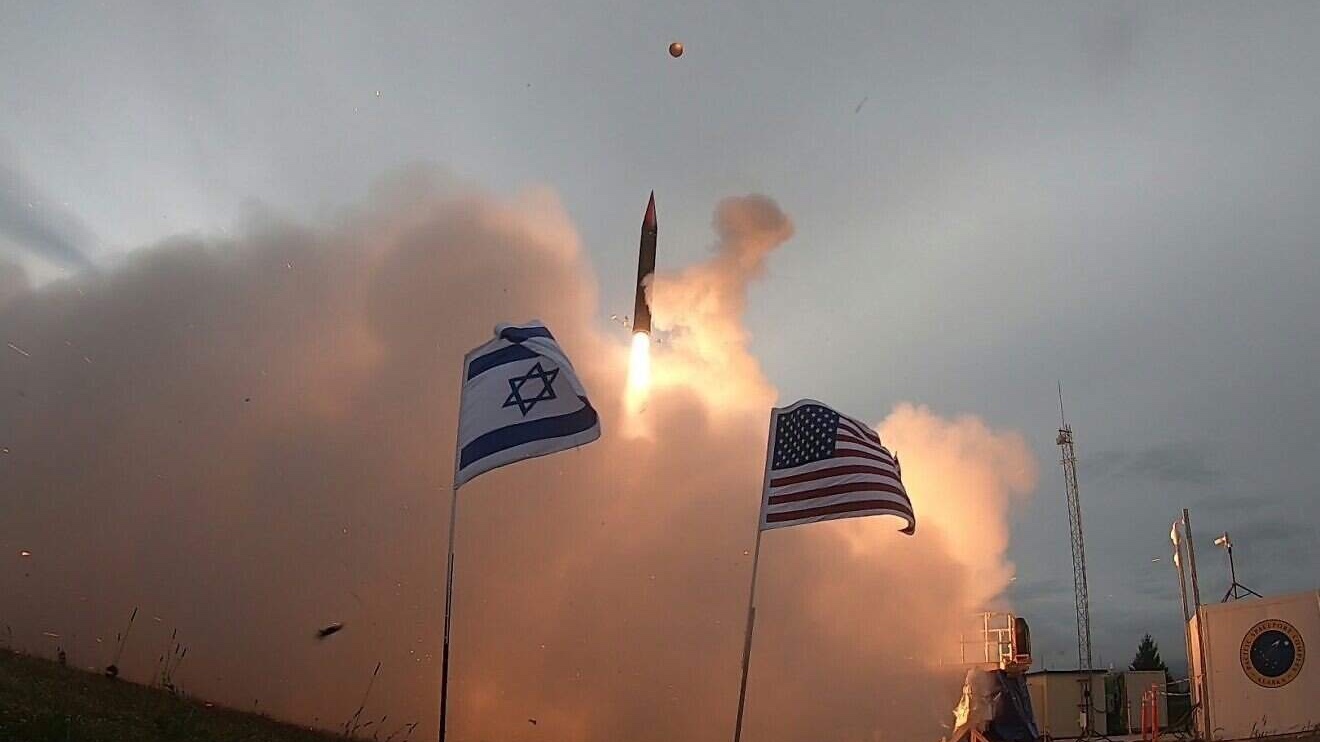
Gold noted that during tests, all commercial air traffic is rerouted and Ben-Gurion International Airport is shut down temporarily. He also recalled the successful testing of the Arrow 3 in Alaska in July 2019 as a precedent for the rigorous validation these systems undergo.
Dr. Uzi Rubin, a senior researcher at the Begin-Sadat Center for Strategic Studies and the founder and former director of the Arrow missile defense project at the Defense Ministry, told JNS that regarding the ballistic threat, “from a qualitative perspective there is no change in the situation – we are still head to head, and they are not preceding us.”
However, Rubin identified the industrial capacity of the adversary as the primary concern.
“The problem is the quantitative aspect: Their production capacity is very high, and it is reasonable that there is a challenge in coping with it,” Rubin warned.
Rubin pointed to the proliferation of unmanned aerial systems as a global warning sign that Israel must heed.
“Regarding the UAV threat there is a significant challenge, from a quantitative perspective. We only need to look at what is happening in Ukraine,” Rubin said.
Want more news from Israel?
Click Here to sign up for our FREE daily email updates