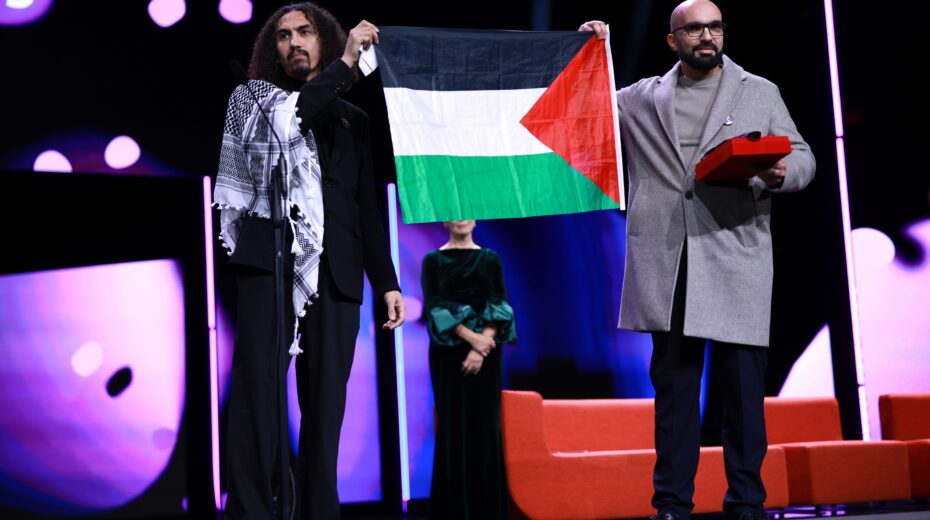

A political incident occurred on the sidelines of an awards ceremony at this year’s International Film Festival Berlin (Berlinale). Carsten Schneider (SPD) demonstratively left the hall after a director used his acceptance speech to level serious accusations against Israel and the German federal government.
The incident took place during an award presentation in one of the festival’s side sections. Syrian-Palestinian filmmaker Abdallah Al-Khatib used the stage to describe Israel’s actions in the Gaza Strip as “genocide” and to accuse Germany of shared responsibility.
According to sources from the ministry, Schneider considered the statements “unacceptable” and therefore decided to leave the event.

Federal Environment and Climate Protection Minister Carsten Schneider at the closing ceremony of the 76th Berlin International Film Festival. Berlin, February 21, 2026. Photo: EPA/Clemens Bilan.
Political accusations on a cultural stage
Al-Khatib had been honored for his film, which deals with living conditions in the Gaza Strip. In his speech, he spoke of a moral obligation to “speak the truth” and sharply criticized German policy toward Israel. Parts of the audience applauded, while others reacted with restraint or rejection.
The term “genocide” is highly sensitive in Germany both legally and politically. The federal government has repeatedly classified Israel’s military actions as self-defense against Hamas, while at the same time emphasizing humanitarian aid for the Palestinian population. Berlin officially rejects any classification of Israel’s actions as genocide.
🚨🇵🇸🇩🇪JUST IN: During his Berlinale speech, Palestinian filmmaker Abdallah Al-Khatib accused Germany of supporting Israel’s genocidal actions in Gaza. pic.twitter.com/CPaTpVY6hV
— The Saviour (@TheSaviour) February 22, 2026
Political reactions
Other German politicians also responded critically to the incident. Berlin’s Governing Mayor Kai Wegner (CDU) stated that an awards ceremony is not an appropriate venue for one-sided political accusations.
Within Germany’s cultural scene, however, artistic freedom was emphasized. Representatives from film circles pointed out that festivals traditionally provide space for political statements.
Tensions had already been evident ahead of the Berlinale. Jury president Wim Wenders had called for restraint on political issues and stressed the importance of artistic dialogue. Nevertheless, it was clear that the Middle East conflict would also be present at the festival.
Between national interest and freedom of expression
The affair touches on a central point of German politics: the special responsibility toward Israel. For years, governments of different political colors have described Israel’s security as part of Germany’s raison d’état, a core national interest.
At the same time, criticism of Israel’s actions in the Gaza Strip is growing in parts of European public opinion. On cultural stages, at universities, and at public events, this confrontation is increasingly conducted openly—often in pointed language.
The scandal at the Berlinale shows how strongly the Middle East conflict now polarizes even in Germany. While government representatives draw clear boundaries, others see sharp criticism as a legitimate expression of political freedom of opinion.
The Berlinale itself has so far responded cautiously, referring to the autonomy of the artists.
Want more news from Israel?
Click Here to sign up for our FREE daily email updates