(JNS) Hezbollah spent months rebuilding its stockpile of rockets and drones—drawing on Iranian support and its own weapons factories—in preparation for a new war with Israel.
The terror group concluded that another clash with Israel was inevitable and this time Israel could finish it off, Reuters reported on March 6, having spoken to six sources familiar with the group’s activities.
Hezbollah was certain that Israel would carry out a preemptive strike to “disable its ability to retaliate,” a Lebanese source told Reuters. A non-Lebanese source told the news outlet that the group feared Israel would eventually turn its attention from Iran to Hezbollah.
“They knew they were next on the list,” the official said.
The Israel Defense Forces had decapitated Hezbollah’s leadership in 2024, killing its longtime leader, Hassan Nasrallah, and many of its senior commanders, while destroying much of its infrastructure in southern Lebanon.
That retribution was a long time coming as Hezbollah began raining rockets down on Israel on Oct. 8, 2023, the day after Hamas attacked from the Gaza Strip.
But even after the IDF’s successful attack, starting in October 2024 and ending with a ceasefire eight weeks later, the group remained defiant. Since Nov. 27, 2024, the day the ceasefire went into effect, Hezbollah has attempted to reestablish itself in southern Lebanon. Israel has engaged in ongoing airstrikes to suppress the group’s activities.
Hezbollah remained silent for the first two days of the war against Iran. Then, on March 2, it launched rockets at Israel. It continued firing dozens of projectiles, and launched several drones at Israel’s northern border throughout the day on March 3 and 4.
On Sunday, Israeli media reported that Hezbollah rocket fire on Israel’s north has been continuous. The IDF has engaged in counterstrikes, warning Lebanese civilians to move out of harm’s way.
Youssef al-Zein, the head of Hezbollah’s media office, told Reuters that Hezbollah had decided to “fight to the last breath.”
One Lebanese source told Reuters that the group had been stockpiling since the Nov. 2024 ceasefire, drawing on a $50 million monthly budget, most of it supplied by Iran, which had been earmarked for paying terrorist salaries.
Hezbollah also rebuilt drone and rocket stockpiles locally. A foreign official Reuters spoke with said the group had placed new rockets in southern Lebanon before the firing started on March 2.
IDF spokesperson Lt. Col. Nadav Shoshani confirmed to Reuters that Hezbollah “had a lot of arms left” and was also working to rearm. “They were trying to smuggle and we were preventing that,” Shoshani said.
Last August, the Lebanese government instructed its military to prepare a plan to disarm all armed militias. Israel praised the decision as “momentous.”
“In light of this important development, Israel stands ready to support Lebanon in its efforts to disarm Hezbollah and to work together towards a more secure and stable future for both nations,” the Prime Minister’s Office said on Aug. 8, 2025.
However, Hezbollah rearmed faster than the Lebanese Armed Forces (LAF) could disarm it.
The pace of Hezbollah’s fire has been building, Reuters reported. On March 2, it launched 60 drones and rockets, and a similar number on March 3. On March 4, Hezbollah launched more than double that number, showing it succeeded in drawing from larger stashes, a foreign official who follows Hezbollah’s activities told the news outlet.
Lt. Col. (Res.) Sarit Zehavi, founder and president of the Alma Research and Education Center, an Israeli think tank focusing on security on Israel’s northern border, told JNS that it isn’t known exactly how many missiles remain in Hezbollah’s arsenal.
The IDF estimates that the group had 25,000 rockets and missiles before the start of its attack, of which the majority were shorter-range projectiles capable of reaching Israel’s north. A few could reach Tel Aviv, as has already been shown to be the case.
The IDF also estimates that Hezbollah has 1,000 drones, although Zehavi said she thinks the organization has more than that.
The numbers underscore the failure of the Lebanese government to disarm the group. Fearful that Hezbollah’s attack would drag his country into war with Israel, Lebanese Prime Minister Nawaf Salam said on March 2 that Lebanon rejects any military action launched from Lebanese territory not taken by legitimate state institutions.
He called Hezbollah’s actions “a violation of the will of the majority of the Lebanese people.”
“Hezbollah is not a Lebanese interest group,” Zehavi explained. “They attacked because this is who they are. This is what they were established for.”
“The whole mission statement of Hezbollah is to disseminate the values of the Islamic Revolution across the region, first in Lebanon and later elsewhere. It is completely loyal to Iran. So we would have been surprised if they wouldn’t have joined this campaign,” she said.
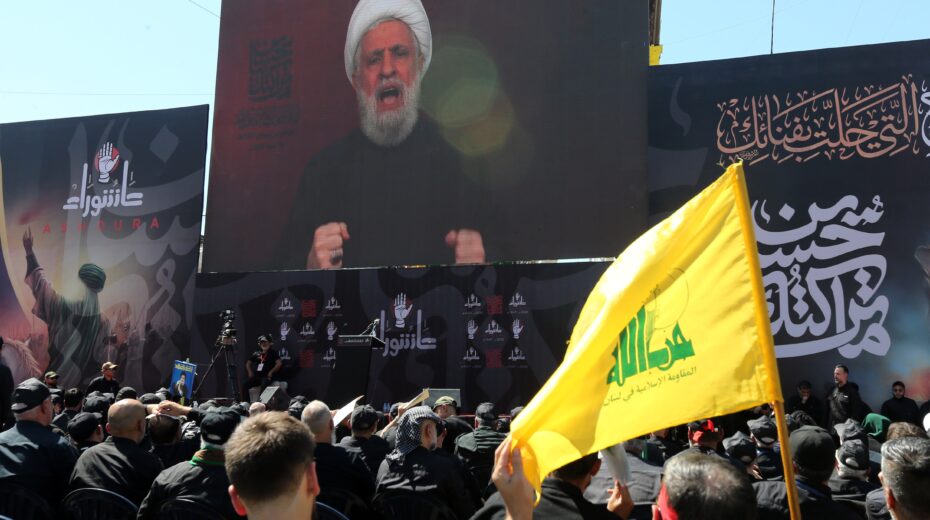
Iran put pressure on Hezbollah to take part, putting boots on the ground in the form of Islamic Revolutionary Guard Corps commanders and generals, Zehavi said. “They were in Lebanon making sure that [Hezbollah’s new Secretary-General] Naim Qassem would make the right decision.”
“So for all these reasons, Hezbollah joined the war. It doesn’t seem rational to us, but it completely makes sense to Naim Qassem because this is who he is. He believes in loyalty to the Islamic Revolution,” she said.