
Remember Gaza? All the attention is presently on Iran, but the conflict in the Hamas-ruled coastal enclave also remains unresolved. And Hamas is again signaling it has no intention of meeting Israeli and American demands.
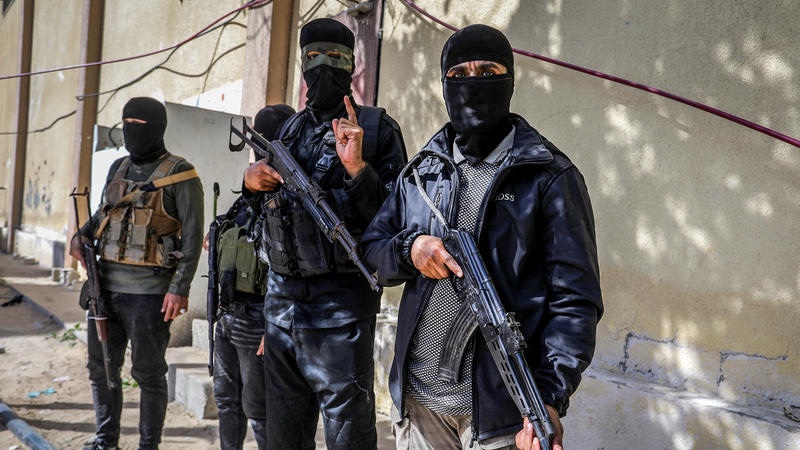
In a televised statement on Sunday, the Izz ad-Din al-Qassam Brigades, Hamas’s military force, rejected calls for disarmament under the US-backed ceasefire framework, describing the demand as “extremely dangerous.” And that phrasing is revealing, because for Israel and everyone else in the region, the disarmament of Hamas is the bare minimum condition for anything resembling stability.
But for Hamas, disarmament is dangerous for one simple reason: it threatens the only form of governance the group has ever truly believed in—armed control, tunnel infrastructure, and perpetual war marketed as “resistance.”
According to Reuters, Hamas spokesman Abu Obeida (a nom de guerre now used by any senior Hamas spokesman; the Abu Obeida was killed by Israel in September of last year) denounced efforts by mediators to raise the issue of demilitarization, calling it unacceptable and accusing Israel and the United States of trying to force the matter through indirect negotiations. He also claimed the proposal amounted to an attempt to continue what Hamas routinely labels “genocide,” a term the group deploys with predictable frequency whenever its own military capacity comes under pressure.
That inversion, so readily embraced by the international community, is now standard. Hamas stores weapons under civilian areas, embeds its command structure in urban environments, builds entire underground networks beneath Gaza, and then presents demands for disarmament as though the threat lies not in the arsenal, but in the suggestion that it should be dismantled.
The group’s actual position is straightforward. It reportedly told mediators it would not discuss giving up weapons before receiving guarantees of a full Israeli withdrawal from Gaza and implementation of the broader ceasefire plan. In other words: Hamas wants the benefits of de-escalation without surrendering the means to threaten Israel.
That is not a peace position. It is an operational pause strategy, one common to Islamists and known as hudna, which is effectively like saying, “Hey, things aren’t going well for me, let’s take a break while I figure out a better way to kill you.”
Why disarmament matters
Meetings in Cairo last week involving Egyptian, Qatari, and Turkish mediators reportedly produced Hamas’s first formal response to the disarmament proposal. According to the reported details, the group submitted amendments, demanded an end to Israeli “violations,” insisted on full implementation of the ceasefire framework, and refused to engage meaningfully on the issue of laying down arms.
Again, the pattern is familiar. Hamas does not treat weapons as a bargaining chip. It treats them as the core of its legitimacy. Hamas intends to remain in Gaza, to remain in control of Gaza, and to do that, it needs weapons. Remove the rockets, the launchers, the tunnel maps, and the militia infrastructure, and what remains is not a governing movement unjustly cornered. What remains is an exhausted ideological network stripped of the tools it uses to dominate Gaza and threaten Israel.
That is precisely why disarmament is the issue.
Nickolay Mladenov, identified as the Board of Peace’s high representative for Gaza, said this week that the framework has broad backing and that the focus now should be implementation. He also described a post-war Gaza that is reconstructed, secured by a transitional Palestinian administration, free of weapons and tunnels, and ultimately reunified with a reformed Palestinian Authority.
That vision, whatever its practical hurdles, rests on one indispensable premise: Hamas cannot remain armed.
Everything else is secondary. Reconstruction without disarmament is not reconstruction. It is rearmament with donor funding nearby. Transitional governance without disarmament is theater. A tunnel state does not become moderate because diplomats rename the process around it.
A node in the Iranian axis
NPR previously reported that the proposal presented to Hamas included surrendering heavy weapons and sharing maps of the group’s underground tunnel network. Unsurprisingly, that appears to be where the real resistance begins—not resistance to occupation, as the slogans insist, but resistance to transparency, accountability, and strategic defeat.
The group reportedly even delayed its response while watching for the outcome of the joint US-Israeli campaign against Iran, a detail that says rather a lot about the mythology of Palestinian independence so often projected onto Hamas. The organization presents itself as a local liberation movement. In practice, it behaves like an armed node within a broader regional axis, calibrating its posture in line with larger Islamist and Iranian interests.
Phony acceptance of Trump’s plan
Senior Hamas figures have for months been pretending to engage with US President Donald Trump’s Gaza peace plan, while systematically rejecting its core tenets. Khaled Mashaal and Musa Abu Marzouk have both openly rejected disarmament, despite previous indications of support for the broader framework. Mashaal, speaking in Istanbul in December, praised the weapons of the “resistance” in theological and civilizational terms, declaring that “a thousand statements are not worth a single projectile of iron.”
And there it is: the governing doctrine of Hamas in a single sentence.
Not institutions.
Not civil order.
Not economic recovery.
Not the protection of civilians.
The projectile comes first.
This is why every serious conversation about Gaza eventually returns to the same impolite but necessary conclusion. Hamas is not merely asking for guarantees. It is insisting on the preservation of its war-making capacity as the price of any deal. It wants Israel constrained, mediators engaged, aid flowing, and its weapons untouched.
Contrary to the picture pained by Trump and Mladenov, the current holdup in Gaza is not about sequencing or implementation details. It is about whether the region is willing, once again, to pretend that Hamas can be folded into a post-war order while keeping the instruments of war intact.
It cannot.
A Gaza with Hamas still armed is not a Gaza on the way to peace. It is simply the next round, waiting underground.
Want more news from Israel?
Click Here to sign up for our FREE daily email updates