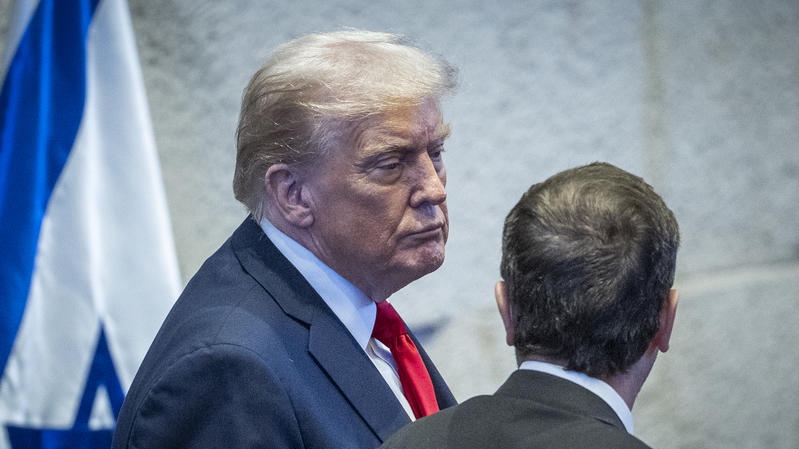

“Our expectations were much higher from President Trump,” lamented Bahraini television personality and former government spokesperson Ahdeya Ahmed. She and senior Saudi journalist Abdulaziz Al-Hameed provided participants in the “Eighth Front” summit with an insightful look at regional Arab perceptions of the recent US-Israel-Iran war and President Donald Trump’s Memorandum of Understanding.
The Eighth Front is an initiative of Israeli security researcher and former senior Mossad official Sagiv Asulin to encourage greater cooperation between Israeli authorities and the Christian Zionist world in fighting the narrative war targeting the Jewish state.
As things currently stand, both Al-Hameed and Ahmed said the narrative war in the Middle East has been all but won by Iran.
Al-Hameed said Tehran is already presenting itself as the winner because the regime survived, retained influence across the region, and now appears to hold de facto leverage over the Strait of Hormuz. He warned that Iran may use that position to pressure Gulf neighbors, demand concessions from world powers, and extract political or economic advantage.
“The Iranians are good at losing wars, but they are better at winning narratives,” he said.
Both speakers expressed deep disappointment in Trump.
Ahmed said that “a once in a lifetime chance to end the terrorism of the ayatollah regime” had been missed. Al-Hameed was even sharper in his message: “Mr. Trump, you did very badly.”
The deeper concern, however, was not merely Washington’s performance. It was the strategic lesson now facing the Arab world. Both commentators argued that peaceable Arab states can no longer afford illusions about the source of the region’s instability — or about who is willing to confront it.
Al-Hameed noted that Gulf states have endured decades of Iranian aggression, including ballistic missile and drone attacks. Yet many Arab leaders remain reluctant to stand openly with Israel because Iran is a Muslim country. That hesitation, he suggested, has become strategically incoherent. “We share the same threat and the same future. So why are we not working together?” he asked.
Ahmed made the same point more directly: “We got a chance to see that the missiles hitting our countries did not come from Israel.”
For both speakers, the implication was clear. The future of regional security lies not in appeasing Tehran, but in partnership with Israel — the only regional power that has shown both the capability and the will to take on Iran and its proxy network.
Al-Hameed argued that Iran had directed the outbreak of the current regional war that began on Oct. 7, 2023 in order to derail Saudi normalization with Israel. Riyadh, he said, should respond by doing precisely what Tehran fears most: joining the Abraham Accords.
“We should not give Iran a gift,” he said.
Al-Hameed prescribed backing for Israel’s military campaigns, insisting that the Jewish state was fighting not only for itself, but for everyone in the region who desires peace: “To Netanyahu and the Israeli army, continue your work. You’re doing very well.”
Ahmed likewise urged Arab states to move closer to Israel and called for the dismantling of Hezbollah and other Iranian-backed forces.
“This war must end with the elimination of the Iranian proxies,” she said, using Israel to “destroy Hezbollah. This is for the common good.”
Want more news from Israel?
Click Here to sign up for our FREE daily email updates