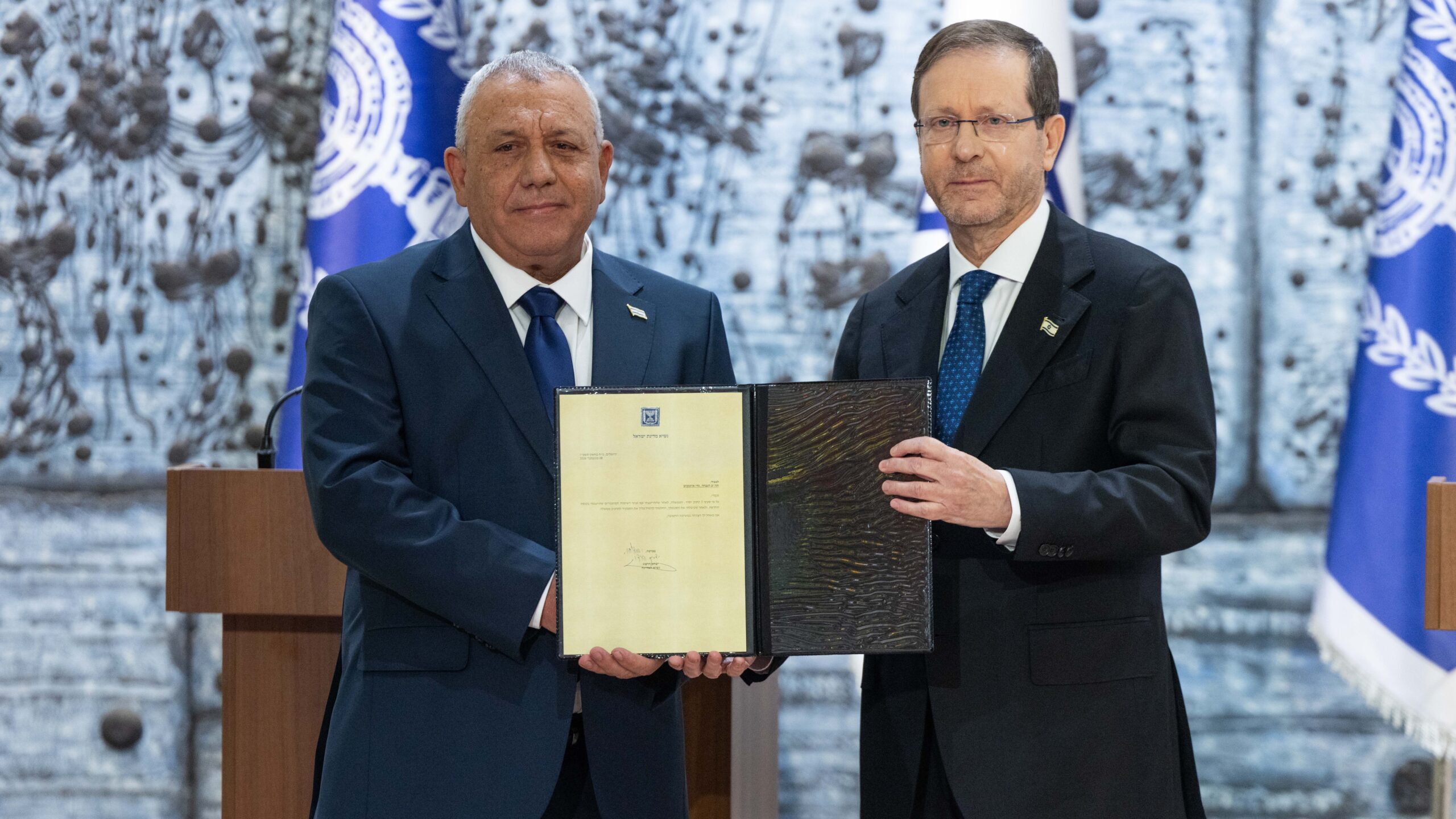
(JNS) President Isaac Herzog tasked Yashar party leader Gadi Eisenkot with forming Israel’s next government, following consultations with political parties elected to the 26th Knesset.
Factions totaling 67 Knesset members recommended Eisenkot, including his Yashar party (21), Naftali Bennett’s B’Yachad (12), Yousef Jabareen’s Joint List (11), Yair Golan’s The Democrats (8), Mansour Abbas’s Ra’am (8) and Avigdor Liberman’s Yisrael Beiteinu (7).
Factions totaling 46 lawmakers recommended Prime Minister Benjamin Netanyahu, including Likud (27), National Security Minister Itamar Ben-Gvir’s Otzma Yehudit (7), Finance Minister Bezalel Smotrich’s Religious Zionist-Zehut (6) and Aryeh Deri’s Shas (6).
Netanyahu’s bloc emerged from the election with 53 seats, compared with 48 for the Eisenkot-led opposition, while Arab parties secured a record-high 19 seats, spilt between the Joint List and Ra’am.
Under Basic Law: The Government, Eisenkot will have 28 days to form a coalition, with Herzog able to grant an extension of up to 14 additional days.
Martin Sherman, founder and executive director of the Israel Institute for Strategic Studies, told JNS that Eisenkot would be unable to form a government while honoring his campaign pledges.
Eisenkot’s conditions include recognizing Israel as a Jewish, democratic, liberal and egalitarian state; commitment to the values of the 1948 Declaration of Independence; mandatory military, national or civilian service for all Israeli citizens; and recognizing Hamas as a terrorist organization and the obligation to destroy its military and governing power in the Gaza Strip.
“Even if you look at [Ra’am leader] Mansour Abbas, the party platform still rejects Israel as a Jewish state and refuses to use its symbols or acknowledge its heritage,” Sherman said.
Further complicating matters, Sherman said, is Liberman’s staunch opposition to joining a minority government reliant on the support of Arab parties.
Sherman argued that such a government would be short-lived, given that Arab parties would be unable to support many government decisions, particularly on security matters. However, he said, it could remain in power long enough to pass legislation targeting Netanyahu and install an opposition-aligned Knesset speaker.
Sherman said Eisenkot would also face significant difficulties bringing ultra-Orthodox parties into his coalition because of their central demand for exemptions from military conscription.
Liberman signaled on Friday that he was prepared to compromise on legislation governing haredi military conscription, creating a mathematical path to a government without Netanyahu or the Arab parties.
Yashar’s 21 seats, B’Yachad’s 12, The Democrats’ eight and Yisrael Beiteinu’s seven, together with UTJ’s seven and Shas’s six, would produce exactly 61 seats—the minimum required for a Knesset majority.
United Torah Judaism chairman Yaakov Asher welcomed Liberman’s change of position but stressed that no agreement had been reached.
UTJ did not endorse a candidate for prime minister during Herzog’s consultations and has not expressed support for the proposed six-party coalition.
Shas, meanwhile, recommended Netanyahu to Herzog and has so far remained publicly committed to him.
The party on Saturday night vehemently rejected reports that it had agreed to join a coalition led by Eisenkot, labeling them “complete fake news.”
Shas is part of the right-wing bloc “which loves the Torah and Jewish tradition,” according to a party statement. “We reiterate that only official statements from Shas are authoritative, not reports by journalists or tweeters.”
For his part, Eisenkot reaffirmed his commitment on Friday to mandatory military service for all, potentially complicating negotiations.
“Mandatory service for all—military, national and civilian—to strengthen the IDF and expand its ranks,” he wrote on X.
Unity government?
On Saturday night, Netanyahu renewed his call for a unity government and warned that a coalition backed by “Islamists” would risk Israel’s survival, apparently referring to the 19 seats won by the Arab parties.
“As early as next week, there are those who intend to hastily swear in a government with supporters of terrorism,” Netanyahu said in an address delivered to the press in Hebrew.
Such a government would “dismantle the State of Israel from within, as is happening in European countries—and much worse,” he said.
Defense Minister Israel Katz on Sunday also called for unity, warning that the Iranian regime is renewing its efforts to obtain nuclear weapons.
“Regarding Iran, the mission is still not complete,” Katz said, adding that Tehran’s renewed nuclear push comes “alongside other serious efforts that put the State of Israel in real danger.”
When the security of the nation is at stake, he said, “we must know how to rise above our disagreements.
“This is a time of unity, of responsibility and of mutual solidarity,” Katz concluded.
Dan Diker, president of the Jerusalem Center for Security and Foreign Affairs, told JNS that Iran makes no distinction between Netanyahu, Eisenkot or even Yair Golan in its determination to destroy Israel. He said a unity government would therefore serve Israel’s interests as it confronts the formidable challenges ahead.
“President Trump very clearly wants to work with Netanyahu. He has said it twice. That puts Eisenkot at a personal disadvantage,” Diker said.
“If Eisenkot cobbles together a minority government backed by Arab parties, Trump would not favor such an arrangement in Israel. I believe it would create political and media obstacles and put pressure on Israel,” he added.
Diker said that, in such a scenario, Israel would have a government reliant on Arab-party support that would oppose Israeli military action against the Islamic Republic.
With Trump facing significant pressure following his party’s midterm election losses, which some Republicans have partly blamed on the war against Iran, Diker said the U.S. president could not afford to start from scratch with an unfamiliar Israeli leader if he were to launch another military operation.
“Netanyahu has mastered the approach to Trump. From Trump’s point of view, he could act alone. Eisenkot has not been in the room for most of the past two years, when we have undertaken secret and highly complex operations against the regime and its proxies. He has a very steep learning curve,” he added.
Want more news from Israel?
Click Here to sign up for our FREE daily email updates