

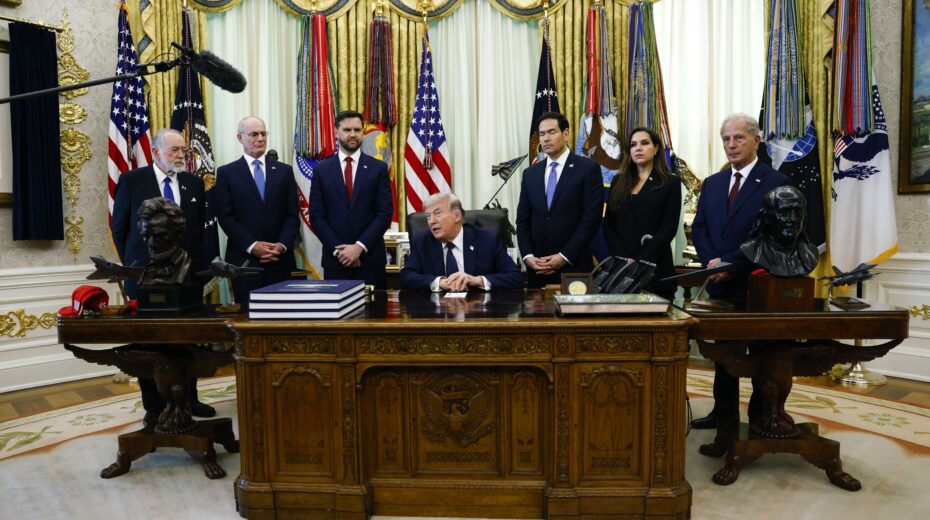

In practical terms, this means the eventual disarmament of Hezbollah, even though the Shi’ite terrorist organization is never mentioned by name. There is no doubt that the agreement is a major diplomatic achievement.
However, its real-world viability faces an immediate and potentially existential challenge.
The contrast between the ceremonial optimism in Washington and the military reality on the ground underscores the high-stakes gamble undertaken by all parties.
The situation became even more volatile when Hezbollah swiftly rejected the agreement, followed by several Lebanese political factions that declared their opposition and warned of renewed domestic conflict.
The starkest warning came from Nabih Berri, speaker of parliament and leader of Amal, Lebanon’s second-largest Shi’ite militia, who declared that Lebanon is on the brink of civil war.
The framework’s fundamental weakness is that it relies on a sequential process that its primary target, Hezbollah, has already rejected.
Within minutes of the signing ceremony, Hezbollah MP Hassan Fadlallah dismissed the agreement, declaring that the organization would oppose its implementation and “hold more firmly to its weapons.”
In effect, the agreement requires the Lebanese government to enforce a policy against a heavily armed organization that is deeply embedded within the Lebanese state.
Under the agreement, Israel will withdraw its forces from the southern security zone only after the Lebanese Armed Forces (LAF) verify that Hezbollah and other non-state armed groups have been disarmed and their military infrastructure has been dismantled.
President Joseph Aoun, Prime Minister Nawaf Salam and their political allies fully understand the risks. While they seek to restore the state’s sovereign authority as envisioned in the agreement, they lack both the military capability and the political capital necessary to impose it without risking national collapse.
The warnings that the agreement could trigger civil war reflect Lebanon’s fragile sectarian balance. For the LAF to implement Point 4 of the agreement—the state’s exclusive monopoly on the use of force—and dismantle Hezbollah’s military infrastructure would require it to engage in a direct and bloody internal confrontation. Ordering the army to forcibly disarm Hezbollah could fracture its ranks along sectarian lines, precisely the dynamic that ignited the Lebanese Civil War in 1975.
Faced with what Hezbollah views as a humiliating strategic setback, all bridges between Aoun and the Shi’ite “duo”—Hezbollah and Amal—appear to have been severed.
Hezbollah is likely to seek first to topple the government by compelling Shi’ite ministers to resign. At the same time, it may intensify attacks on Israeli forces operating within the southern security zone, and possibly beyond, in an effort to provoke a large-scale Israeli military response.
Such an escalation could pressure Washington to restrain Israel out of concern that wider fighting would jeopardize the US-Iran Memorandum of Understanding, ultimately forcing Israel to withdraw from its positions in Southern Lebanon.
As US Secretary of State Marco Rubio observed, the Washington agreement represents “the beginning of the beginning.”
It outlines an ideal postwar vision but provides no credible mechanism for implementation that avoids plunging Lebanon into internal conflict.
Unless the international community can find a way to neutralize Hezbollah’s political and military veto without fracturing the Lebanese state, the agreement’s 14 points are likely to remain a diplomatic blueprint rather than an operational reality.
Originally published by the Jerusalem Center for Security and Foreign Affairs.






The scripture says Israel will spend seven months burying the remains of those who attack her, it is becoming easier to see who those attackers will be.2