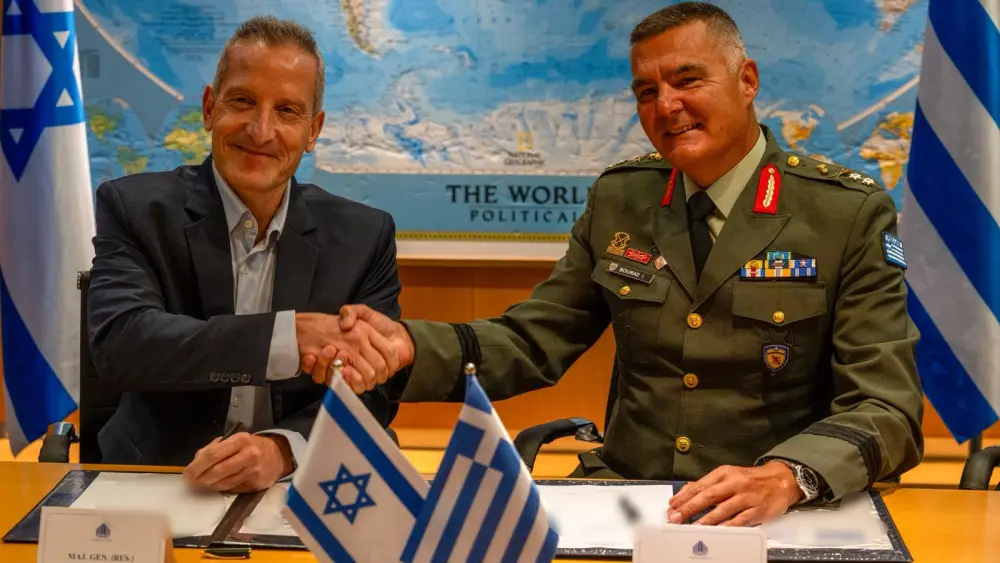
(JNS) Israel’s €3 billion ($3.5 billion) “Achilles Shield” defense-export agreement with Greece deepens Jerusalem’s long-standing security partnership with Athens and Nicosia, anchoring Israeli defense technology more firmly in the region, Eastern Mediterranean observers told JNS.
“It’s not directed especially toward Turkey, but of course the main threat that Greece faces is from Turkey,” Brig. Gen. (res.) Yossi Kuperwasser, director of the Jerusalem Institute for Strategy and Security, said. He called the export agreement “the biggest and most important step forward” in the Israel-Greece-Cyprus security partnership.
“It shows the commitment of Israel to Greek security,” said Kuperwasser, a former head of the Israel Defense Forces Military Intelligence Directorate’s Research Division and former director general of Israel’s Ministry of Strategic Affairs. “Obviously, it is a reflection of the concerns both countries have with the attempts, especially of Turkey, to become a prominent power in the Eastern Mediterranean.”
Israel and Greece signed the agreement on Aug. 31 at the Israeli Defense Ministry in Tel Aviv. Defense Ministry Director General Maj. Gen. (res.) Amir Baram and his Greek counterpart, Maj. Gen. Ioannis Bouras, led the signing ceremony.
Israel will build Greece a multilayered air-defense array that includes David’s Sling missile-defense systems; Rafael Advanced Defense Systems’ SPYDER mobile air-defense systems; Israel Aerospace Industries’ Barak MX modular air- and missile-defense system; multi-mission radars produced by IAI subsidiary ELTA Systems; and a national command-and-control system to be developed by Rafael.
The countries also signed a separate €26 million ($30 million) agreement for Rafael’s Drone Dome counter-drone systems.
The overall program is the largest defense-export agreement in the history of Israeli-Greek relations and among the largest in Israeli history, according to the Israeli Defense Ministry.
Gallia Lindenstrauss, a senior research fellow at the Institute for National Security Studies in Tel Aviv who specializes in Turkish foreign policy, said that while defense exports are central to Israel’s military-industrial sector, the more revealing question is why Athens chose to make the purchase.
“It is less of a surprise that Israel is selling the weapons; the question is why Greece is buying them,” Lindenstrauss told JNS. “Specifically, of course, Greece is concerned because of its longstanding tensions with Turkey and Turkey’s growing capabilities, both in the UAV field and in Turkey’s building up of its missile capabilities.”
Broader European security concerns also helped drive Greece’s decision, she said. “One element is the more general fear in Europe today because of the war in Ukraine, the massive use there of UAVs and also the growing missile threats.”
Deterrence by denial
Cyprus is another Eastern Mediterranean country that has turned to Israeli defense technology amid mounting regional threats. The island country has taken delivery of at least two Israeli-made Barak MX air-defense systems, according to Cypriot media reports, marking a significant modernization of its air-defense network.
The late Hezbollah chief, Hassan Nasrallah, killed in an Israeli airstrike in Beirut in September 2024, directly threatened the island earlier that year, warning Cyprus against assisting Israel in a future war.
In March this year, a suspected Iranian-made Shahed-type drone struck RAF Akrotiri, causing limited damage, and two others headed for the British base were intercepted. Officials said Hezbollah likely launched the attack from Lebanon, though attribution was not definitive.
“As Middle Eastern instability spreads, the security fallout extends beyond the immediate Levant into the broader Eastern Mediterranean,” Lindenstrauss said.
Turkey also remains a constant security concern. Turkish forces have occupied roughly 37% of Cyprus since Ankara’s 1974 invasion, and the self-declared “Turkish Republic of Northern Cyprus” is recognized only by Ankara.
Israel has also faced escalating rhetoric from Turkish President Recep Tayyip Erdoğan, whose government—often characterized by critics as Islamist and neo-Ottoman—has intensified its hostility toward the Jewish state since the Hamas-led Oct. 7, 2023, massacre and the ensuing multi-front war against Iran and its terrorist proxies. Greece and Cyprus have likewise remained in Erdoğan’s crosshairs. Ankara regularly challenges the maritime-boundary and energy-rights claims of Greece and Cyprus in the Eastern Mediterranean.
In late December 2025, Israel, Greece and Cyprus signed a trilateral 2026 military cooperation plan and separate bilateral IDF agreements covering joint exercises, training, working groups and strategic dialogue, which the IDF said would strengthen stability, security and peace in the Eastern Mediterranean.
“Acquiring defensive capabilities contributes to deterrence by denial,” Lindenstrauss said. “If an adversary faces reduced capacity to inflict damage, then that also makes it harder for it to voice threats toward you, so it has a deterrence-by-denial component.”
However, she noted, this dynamic unfolds against a broader regional build-up: “We’re in a classical security dilemma, where what you do for your own defense is seen as offensive and vice versa. So while I think it does contribute to deterrence, the equation is complicated because also the other side is building up their capabilities,” she said.
Kuperwasser agreed that air-defense parity is fundamental to neutralizing Ankara’s aerial advantage, particularly in unmanned aerial vehicles and missile development.
“It’s going to provide not only deterrence; it’s going to provide the capability for Greece to protect itself and defend itself against all kinds of threats from the air,” Kuperwasser said. “Most of the threats that are relevant are coming from Turkey, both in the sense that they have a lot of drones—a major issue in this deal is protection against drones—and also missiles.”
A deepening strategic axis
Beyond bolstering Aegean defenses, the landmark transaction reflects the mutual industrial benefits anchoring the trilateral partnership, with Greek defense firms slated to co-produce several system components. Greek news outlet ProtoThema reported that the agreement includes at least a 25% Greek industrial participation component, involving local defense companies in production, maintenance and technological development.
For Jerusalem, the contract could support production scale, supply chains and further investment in its defense-industrial base.
“We are speaking a lot about enlarging our defense industrial base, and deals like that provide the opportunity to enlarge our military industry considerably,” Kuperwasser said. “We have the advantage of putting all these products into action, learning the lessons and implementing them immediately.”
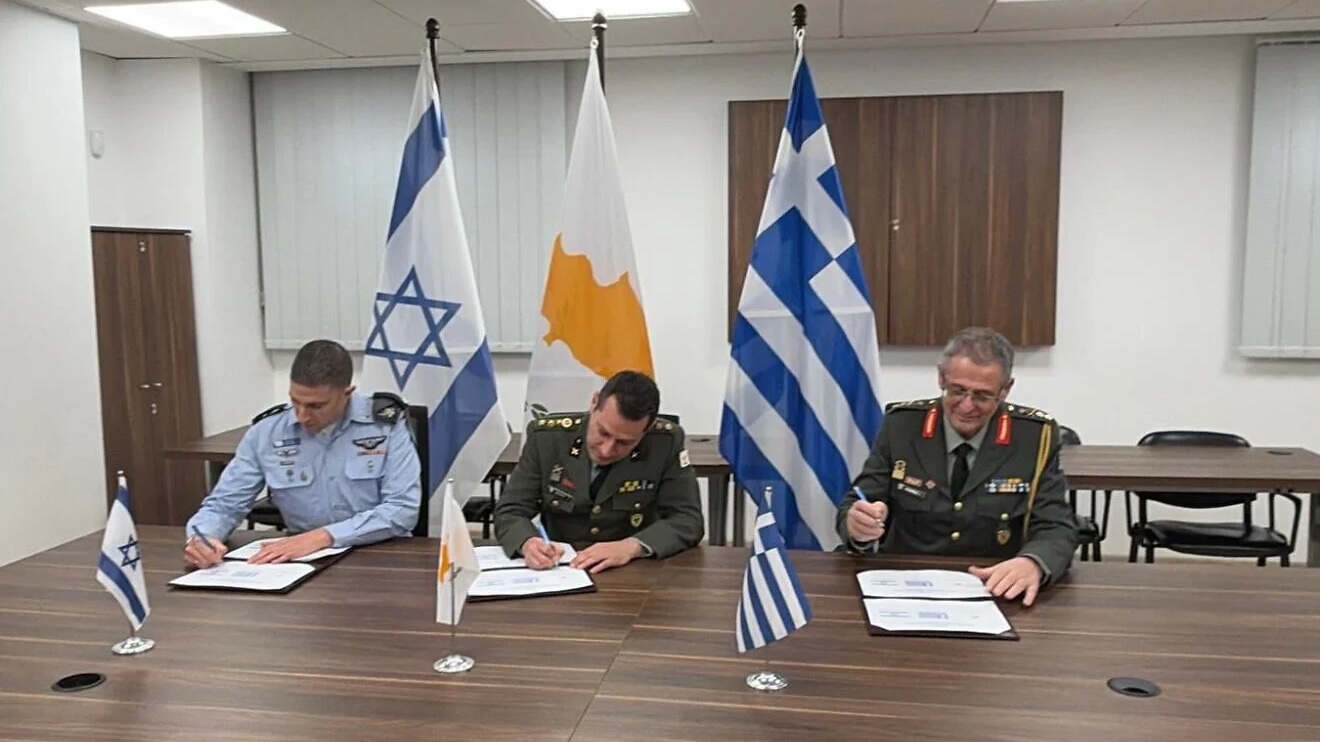
Brig. Gen. Amit Adler (left), head of the IDF International Cooperation Division, at a signing ceremony in Nicosia, Cyprus, for trilateral military cooperation agreements between Israel, Greece and Cyprus, Dec. 23, 2025. Credit: IDF.
While the trilateral alignment between Jerusalem, Athens and Nicosia lacks a formal collective-defense clause—such as the recent mutual-defense pact signed in Mecca between Turkey, Saudi Arabia and Pakistan—the “Achilles Shield” sale could deepen interoperability and reinforce the emerging Eastern Mediterranean security architecture.
“I think this is a very strong alliance because it reflects the real strategic interests of the members in this alliance,” Kuperwasser said. “Although it’s not as formal as the Mecca pact that was signed recently, we are all definitely interested in the capability of each of us to protect itself and are ready to see what can be done in order to assist each other within reasonable limits. I don’t think that anybody expects any of the parties to fight for the other like is stated in the Mecca pact.”
He concluded: “In this respect, I think that it is a major contribution to the stability of the area, knowing that we help each other and feel more confident in facing threats. We also share the same analysis of the threats and opportunities that we have to look at when we speak about the Middle East and the Eastern Mediterranean. It goes beyond just military cooperation—it goes to economics, infrastructure, and so on and so forth. I think this is a reflection of a strong alliance.”
Want more news from Israel?
Click Here to sign up for our FREE daily email updates