(JNS) The Israeli military has significantly expanded its operations against Hezbollah in Lebanon, launching deep waves of targeted strikes and carrying out focused eliminations of senior operatives.
The escalation follows Hezbollah’s March 2 decision to fire at Haifa, acting under what IDF sources say was heavy Iranian pressure to join the conflict.
In response, Israel has launched hundreds of strikes across Lebanon and positioned extra ground troops in key locations in southern Lebanon to prevent infiltrations and protect northern communities from anti-tank missile and mortar attacks.
Defense Minister Israel Katz issued a stark warning to Lebanese President Michel Aoun on Saturday during a situational assessment with the military’s top brass at the IDF’s underground control center in Tel Aviv.
“You [Lebanon] committed to uphold the agreement and disarm Hezbollah of its weapons and these things are not happening,” Katz stated. “If the choice will be the defense of our citizens and the peace of our soldiers or the State of Lebanon – we will choose the defense of our citizens and our soldiers, and the government of Lebanon and Lebanon will pay a very heavy price.”
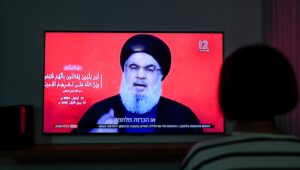
Katz emphasized that Israel has no territorial claims on Lebanon but will not tolerate a return to the reality of constant fire. “If [Hassan] Nasrallah destroyed Lebanon then Naim Qassem [the current Hezbollah chairman] in this way will also ruin it,” he warned.
The warning coincided with reports from MTV Lebanon that a one-year ultimatum given to the Lebanese state to enforce its sovereignty has expired as far as Washington is concerned, granting Israel the freedom to dismantle Hezbollah.
Col. (res.) Dr. Hanan Shai, a research associate at the Misgav Institute for National Security and Zionist Strategy and a former investigator for the IDF’s commission evaluating the 2006 Second Lebanon War, said that Hezbollah made a grave strategic error by renewing the war against Israel.
“The organization found itself disconnected from its Iranian patron, which itself is fighting for its existence after severe blows in the war with Israel and the United States,” Shai assessed.
He pointed out that the regional environment has changed dramatically; Syria, under a new Sunni regime, has reinforced its border with Lebanon and essentially closed the corridors for civilian movement and weapons smuggling. Turkey has not opened alternative transit routes, and Israel maintains full control over Lebanon’s airspace and maritime border.
“Thus, a situation was created in which the borders of Lebanon were essentially sealed from all sides: from the north and east by Syria, and from the south and west by Israel,” Shai argued. “In this reality, Lebanon becomes a closed arena—and Hezbollah finds itself isolated, weak and much more vulnerable than it was in the past.”
Shai proposed that the political goal of the campaign should be similar to that of Israel’s 1982 Operation Peace for Galilee in Lebanon against the PLO: returning security to the residents of the north and creating conditions for a peace agreement between Israel and Lebanon.
To achieve this, he said, the military mission must be the decisive defeat and submission of Hezbollah to the extent that it cannot function as an independent, effective military-terrorist force within Lebanon.
Given the reluctance for a large-scale ground maneuver deep into Lebanon, Shai suggested the strategy could rely primarily on standoff [long range] fire, utilizing the full aerial, naval, and artillery power available to the IDF, potentially with American reinforcement. However, he warned against a war of attrition aimed solely at deterrence without a decisive victory, calling such a goal fundamentally flawed.
Shai outlined a strategy he termed the “simultaneous stripping of Hezbollah from its human shield.” This involves separating the Shi’ite Lebanese population, Hezbollah’s base, from the terrorist-military force operating within it, similar to what is occurring in southern Lebanon following the mass evacuation of civilians from there, but implemented simultaneously across all major Shi’ite Lebanese concentrations: southern Lebanon, the Beqaa Valley, the Dahiyeh area in Beirut, and the Shi’ite areas in Mount Lebanon.
He argued that the enemy, “due to its mistakes that Israel exploits, is trapped in the arena it chose for himself,” Shai explained. The destruction of homes used as military infrastructure by Hezbollah creates an irreversible reality of prolonged displacement for many evacuees.
If this pressure mechanism does not lead Hezbollah to cease hostilities, Shai suggested moving to the second stage: the simultaneous, systematic destruction of Hezbollah’s combat infrastructure and military force across all its centers of activity until it surrenders or is mostly destroyed.
“Only a combination of clear military victory… together with a rapid political move… may dismantle Hezbollah’s military power, restore sovereignty to the Lebanese government—and create conditions for a stable diplomatic arrangement between the two countries,” Shai concluded.
On Saturday, the Israeli Air Force completed its 26th wave of strikes on the southern Dahiyeh Hezbollah-dominated suburb of Beirut, striking over 100 targets, including Hezbollah command rooms and Radwan force infrastructure, according to the IDF.
Since the start of Operation Roaring Lion, over 500 targets have been attacked in Lebanon, including Islamic Revolutionary Guard Corps (IRGC) headquarters utilized by Hezbollah’s Naval Unit, Executive Council, and Financial Unit, the military said. At least 60 members of Hezbollah’s elite Radwan force were reportedly eliminated by Israel over a 24-hour period.
IDF Chief of Staff Lt. Gen. Eyal Zamir confirmed on Dec. 5, 2026, that the military had eliminated the head of Hezbollah’s firepower array, known by the alias “Fidaa.” Zamir stated that Fidaa was personally responsible for commanding the anti-tank fire in the 2015 Har Dov incident that killed an IDF soldier and officer.
“I instructed IDF forces to move forward and deepen the line of control along the border, while establishing positions at key points in southern Lebanon,” Zamir noted.
Hezbollah operatives ambushed IDF ground troops who had been reportedly airdropped from four helicopters near Nabi Chit in the Beqaa Valley in eastern Lebanon to search for the body of MIA navigator Ron Arad, who was kidnapped in October 1986. The IDF reportedly launched 40 airstrikes and released flares to secure the forces’ withdrawal.
Eight soldiers from the Givati infantry Brigade were injured by mortar fire on Friday in southern Lebanon near the Israeli border—five seriously and three lightly. On March 5, two IDF soldiers were injured in Southern Lebanon by anti-tank missile fire.
IDF International Spokesperson Lt. Col. Nadav Shoshani explained on March 4 that the defensive positioning in southern Lebanon is precisely to prevent such attacks from reaching Israeli civilians.
“Our soldiers are standing sadly today with a price. But our soldiers are standing between those terrorists and our civilians,” Shoshani stated on March 4. “That’s our mission, to make sure that they’re unable to reach our civilians and we’ll make sure to find those who fire the anti tank missile to make sure that we remove that threat.”
He noted that the remaining senior officials in the Iranian regime put “immense amounts of pressure on Hezbollah leadership to open fire.” Shoshani also clarified the necessity of the immediate evacuation of Lebanese civilians from southern Lebanon up to the Litani River, stating it allows the IDF to target terrorists while keeping civilians out of the line of fire.
Want more news from Israel?
Click Here to sign up for our FREE daily email updates