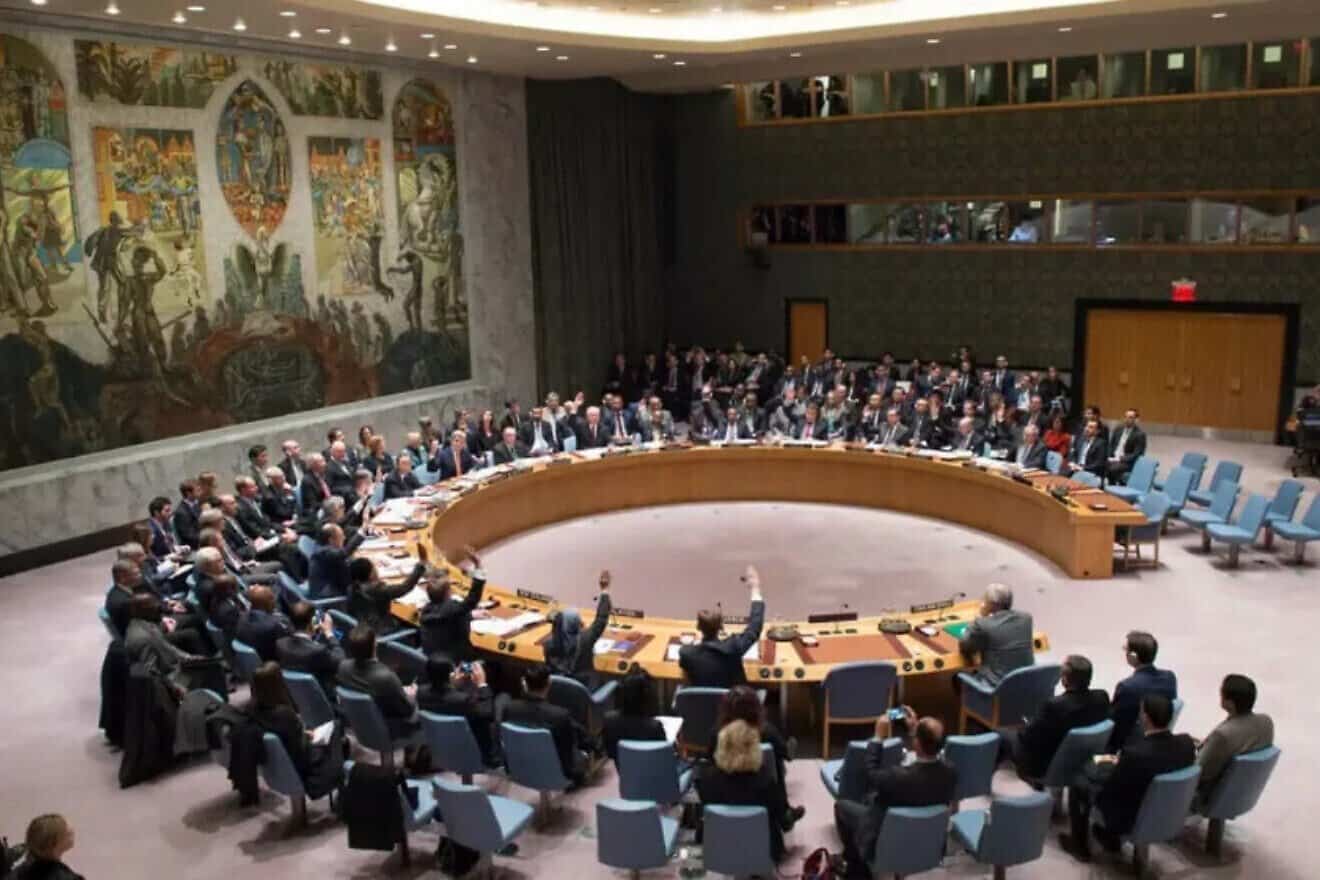

A United Nations Security Council resolution on Gaza explicitly conditioned any future Palestinian statehood on significant reforms and developments, implicitly affirming that no Palestinian state currently exists.
Shortly afterward, the International Criminal Court proceeded on the assumption that a State of Palestine does exist and can grant the court jurisdiction, despite not meeting established criteria for statehood and Israel not being an ICC member.
This contradiction is attributed to a flawed interpretation of a U.N. General Assembly decision, which granted political observer status without legal recognition of statehood.
The situation is characterized as a misuse of international legal mechanisms for political purposes, undermining their credibility.
To a great extent, recent events encapsulate and epitomize the shameful bias and double standards of the U.N. and other associated international fora against Israel. While the phenomenon has its deep roots in the 1970s at the height of the Cold War, it is not often that the decisions adopted by the U.N. demonstrate so clearly the depths to which it is willing to sink.
On Nov. 17, 2025, the Security Council adopted Resolution 2803, often referred to as the “Gaza peace plan.” The resolution focused on ending the war that started when Hamas and other genocidal Gazan terrorists invaded Israel and carried out the Oct. 7, 2023, massacre.
When addressing the future of the Gaza Strip, the resolution clearly stated that, “After the P.A. [Palestinian Authority] reform program is faithfully carried out and Gaza redevelopment has advanced, the conditions may finally be in place for a credible pathway to Palestinian self-determination and statehood [emphasis added].”
Thus, according to the unequivocal language of the resolution, only once certain conditions are fulfilled will there potentially be a possibility to consider Palestinian statehood. In other words, when the resolution was adopted, the position of the Security Council was that no “State of Palestine” already existed.
This statement was neither novel nor particularly controversial. Any honest observer knows that no “State of Palestine” actually exists. For such a state to exist, it would have needed to meet internationally agreed criteria, which the fictional “State of Palestine” has never met.
In stark contrast to the clear reality, on Dec. 15, 2025, the International Criminal Court issued another decision regarding the “Situation in Palestine.”
The decision was outrageous on multiple levels, but one stands out for the purpose of this discussion.
Membership in the ICC is limited to states that actually exist and can delegate their jurisdiction to the court. States that may potentially exist in the future, subject to meeting various conditions, cannot join the court. Additionally, states that may exist in the future cannot delegate the jurisdiction they do not possess to the court. Israel never joined the court.
While the ICC is not an organ of the U.N., the two bodies are intrinsically intertwined, and the U.N. secretary-general serves as the “Depositary” for states to join the court.
Herein lies the fallacy of the jurisdiction of the ICC over the “situation in Palestine.”
In 2014, the U.N. secretary-general accepted the request of the “State of Palestine” to join the court. His decision was based on a fundamentally flawed understanding of the resolution adopted by the U.N. General Assembly in late 2012. In that resolution, the UNGA decided to upgrade the political representation of the Palestinians to that of a “Non-Member Observer State.”
The fundamental mistake was to attribute any legal force to the political decision of the UNGA, or to see it as an indication that the “State of Palestine” actually exists. In reality, however, resolutions adopted by the UNGA are not worth the paper on which they are written and have no legal force. They certainly cannot will into existence a nonexistent state. In fact, the U.N. has an entirely separate procedure—requiring the approval of the Security Council—for recognizing new and emerging states.
Thus, within a period of weeks, two entirely contradictory narratives were running in parallel. On the one hand, the Security Council, the body that controls the procedure through which new states are recognized, clearly acknowledged that no “State of Palestine” exists. On the other hand, the ICC continued with the fallacy that not only does the fictional state exist, but that it could then delegate its nonexistent jurisdiction to the ICC.
The proceedings against Israel in the ICC are nothing but a shameful disgrace. Instead of meeting the lofty goals for which the court was established, the court, including the Office of the Prosecutor and the different Court Chambers, is allowing itself to be used and abused as a political weapon to persecute and delegitimize Israel. In doing so, the court, with the assistance of the U.N. secretary-general, defiles the very foundations on which it was established.
Originally published by the Jerusalem Center for Security and Foreign Affairs.