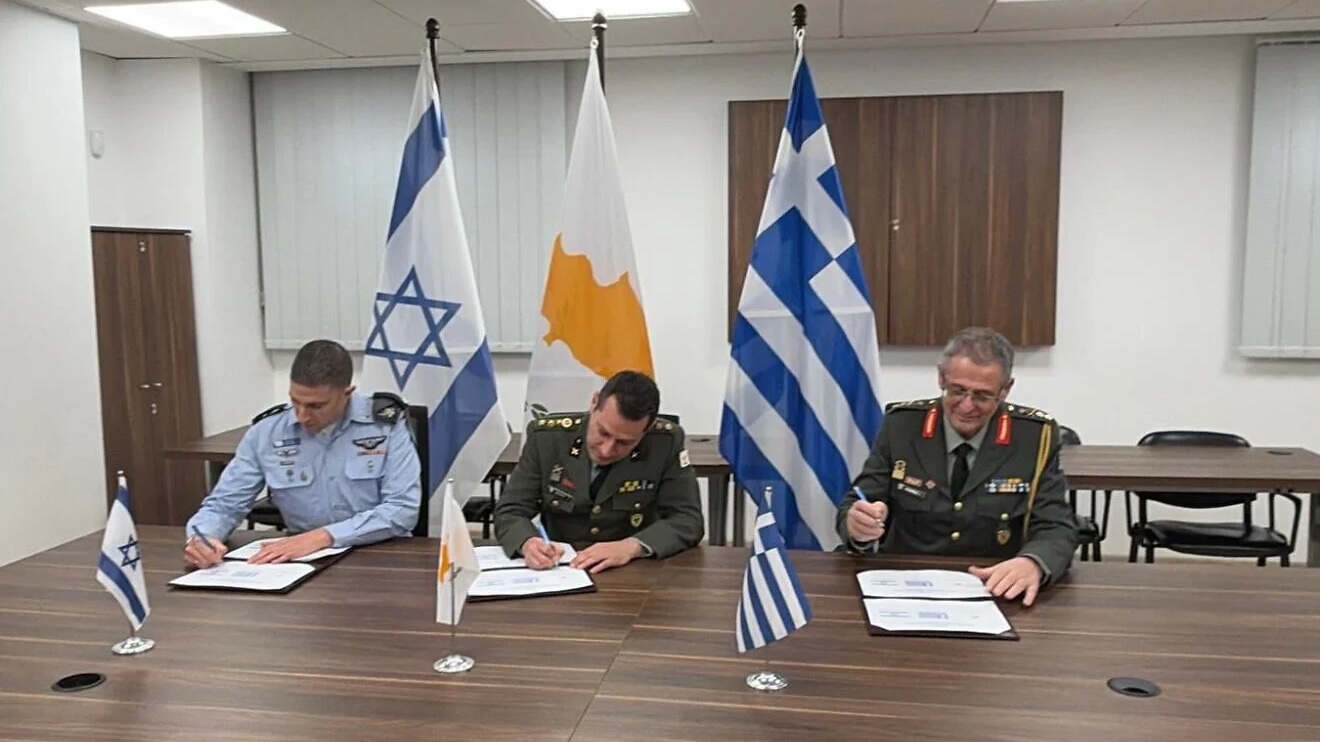
(JNS) The trilateral alliance between Israel, Greece and Cyprus took another significant step forward recently with the signing of a new military cooperation work plan for 2026.
On Dec. 28, 2025, the Israel Defense Forces announced that the head of its International Cooperation Division, Brig. Gen. Amit Adler, had traveled to Nicosia to sign the “Trilateral Work Plan for Military Cooperation.”
According to the military, the agreement includes “joint exercises and training, working groups across a range of fields, and strategic military dialogue on issues of shared interest.”
The signing took place just days after a high-level summit in Jerusalem on Dec. 22, in which Israeli Prime Minister Benjamin Netanyahu met with Greek Prime Minister Kyriakos Mitsotakis and Cypriot President Nikos Christodoulides in Jerusalem to discuss expanding security and economic ties.
The IDF declined to provide further details on the new agreement.
Dr. Hay Eytan Cohen Yanarocak, an expert on Turkey-Israel relations at the Moshe Dayan Center at Tel Aviv University, told JNS that the tightening of this alliance is a direct result of Ankara’s aggressive foreign policy.
“We must sharpen the following point: Despite all the tension between Israel and Turkey, the two countries have not declared hostility against one another,” Yanarocak said. “However, just as Turkey makes various strategic moves in the Eastern Mediterranean, in Libya, in Somalia, and in Syria to improve its international standing, the State of Israel is also allowed to get closer to other countries. It is also allowed to expand its sphere of influence.”
Yanarocak argued that Turkey’s complaints about the Hellenic-Israeli pact are hypocritical given its own expansionist maneuvering.
“Turkey and Israel view one another as central rivals,” he noted. “And if we see a chessboard here, it is fitting that when we see Turkish moves, we also see counter-moves.”
According to Yanarocak, the deterioration in relations was not initiated by Jerusalem. “The decision to degrade relations was made via unilateral Turkish steps. Israel is here responding to developments on the ground.”
In a stark assessment, Yanarocak identified Turkish President Recep Tayyip Erdoğan as the unwitting father of the current Mediterranean partnership.
“When we look at it, we see that the main architect of this alliance, between Israel and the Hellenic states, is the Turkish president himself, Erdoğan,” Yanarocak stated. “He pushed Israel with his own hands into the arms of the Hellenic states. It started with the Mavi Marmara flotilla in 2010 and went north from there.”
He said Ankara’s current posture is a self-inflicted strategic wound.
“The Turks should not complain about this; it is essentially the result of a pro-Palestinian foreign policy that contributes absolutely nothing to Turkish national security,” Yanarocak said. “They achieve no gain other than in internal politics … but if we speak practically, the Palestinians have no ‘added value’ for Turkey’s security or status. It is only ideology.”
While security dominates the immediate agenda, the long-discussed Eastern Mediterranean gas pipeline (East Med) continues to be a conceptual feature of the relationship.
Yanarocak offered a skeptical view of the pipeline’s physical viability, suggesting its true value is diplomatic rather than economic.
“From what I have been able to gather in all the studies I have read over the years, the engineering feasibility of this project … is both expensive and geopolitically problematic due to Turkey’s claims,” Yanarocak said.
Instead, he described the energy project as a form of “tourism” for diplomats—a useful mechanism to ensure constant engagement.
“I think the three countries—Greece, Cyprus, and Israel—are using natural gas, and this East Med project, as a type of ‘excuse’ that allows the three countries to come together, to convene, and to discuss,” he said. “It also challenges the Turkish version of events in the Eastern Mediterranean. It allows them a perfect excuse to sit together and advance other things without needing to justify it from the start.”
Yanarocak highlighted that while Israel will not intervene directly in Greek-Turkish disputes, its defense exports are altering the equation.
“I don’t see a significant escalation at the moment, other than the purchase of [Israeli] air defense systems by Greece and Cyprus,” Yanarocak said. “This is a Greek and Cypriot decision. Israel focuses only on whether to sell or not.”
Because Israel views these nations as allies, and because air defense is inherently defensive, Jerusalem sees no issue with the sales. However, for Ankara, this is perceived as a provocation.
“From a Turkish point of view, this strengthens the hands of Greece and Cyprus, who have not seen such a thing before,” Yanarocak explained. “One can say that Greece and Cyprus will stand before Turkey with much more self-confidence compared to the past.”
The view from Athens
Dr. George N. Tzogopoulos, a lecturer at the European Institute of Nice (CIFE) and a senior fellow at the Hellenic Foundation for European and Foreign Policy, assessed that while political will is high for partnership, operational realities on the ground are complex.
“Even the discussion about the deployment of a joint rapid force itself can outline the strategic depth of Israeli-Greek-Cypriot relations,” Tzogopoulos told JNS. “The operational scenario for Greek and Cypriot forces to deploy troops together with the IDF does not seem likely, however, at least for now. The IDF has other urgent priorities, while the potential mission of such a joint rapid force remains unclear.”
Tzogopoulos suggested that the alliance is still in the process of maturing. “Israel, Greece, and Cyprus are expanding their collaboration, but they are still lacking a common perception of threat to materialize the reported plan. Training and intelligence sharing are more realistic scenarios. It is through this process that more trust could be gained for new ideas to be explored.”
Regarding energy, Tzogopoulos noted that Israel remains the undisputed heavyweight in the eastern Mediterranean triangle.
He stated that Israel is by far the most important energy actor in the Eastern Mediterranean, noting that while Cyprus struggles to produce due to the unresolved ‘Cyprus Question’ and Greece focuses on re-exporting, Israel holds the keys to the region’s energy future.
“The construction of the so-called ‘East Med’ pipeline could be the optimal scenario for Cyprus and Greece,” Tzogopoulos said, noting that the project’s revival might depend on the Trump administration. “It depends on how President Trump might value this pipeline. If market calculations allow it, and if, for example, US companies estimate they could extract good quantities of natural gas in Greek waters … the discussion about the East Med will be revitalized under President Trump’s aegis.”
He acknowledged, though, that Israel has “more comfortable alternatives to sell its gas to other markets beyond Egypt and Jordan.”
The deepening ties are being closely watched in Ankara. Tzogopoulos noted that Turkey “suspiciously views the Israeli-Greek-Cypriot cooperation,” adding that Turkey’s next steps depend on how the Israeli natural gas will be transported to Europe.
If Egyptian liquefied natural gas facilities are used to do this, Turkey will “keep a neutral attitude,” he said, while doing everything to prevent the construction of the East Med Pipeline.
Turkey could still try to cooperate with Israel on energy matters, he assessed, despite the severe clashes between the countries in other areas. Cyprus and Greece, meanwhile, are seriously concerned about energy agreements between Turkey and Syria, which could include an Exclusive Economic Zone this year, while Cyprus itself is not recognized by Turkey, impacting its energy options.
Turkey and Libya have signed a maritime deal that Greece, Cyprus, and Egypt all reject, he noted. “Israel is not involved in this obscure delimitation chaos—and is only looking for some regional certainty to export,” said Tzogopoulos.
Want more news from Israel?
Click Here to sign up for our FREE daily email updates