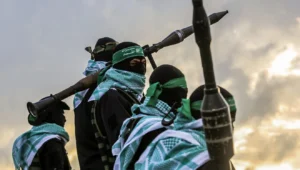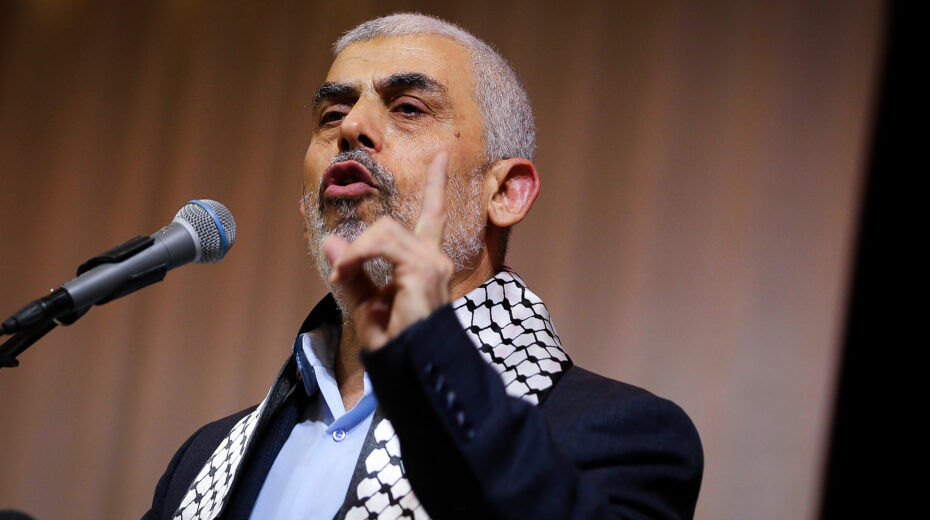

Internal Hamas documents captured by Israeli forces and subsequently analyzed indicate that October 7 was planned as “day zero” of a regional, multi-front war. Yahya Sinwar reportedly described Israel internally as “weaker than a spider’s web” and believed that Israel’s domestic divisions—particularly the protests against judicial reform in 2022 and 2023—would cause the country to collapse rapidly under a coordinated attack.
As early as 2019, Sinwar’s office outlined a “joint defense alliance” with the IRGC Quds Force and Hezbollah in an internal working paper, with the stated aim of “activating all fronts simultaneously against the common enemy, Israel.” During that period, Sinwar and Hamas military chief Mohammed Deif requested $20 million per month from the Quds Force—a total of $500 million over two years—to finance the goal of eliminating Israel. According to Defense Minister Israel Katz, the amount was in fact approved.
Saudi Arabia as the trigger: Sinwar’s calculation against normalization
On October 2, 2023—just five days before the attack—Sinwar convened the Hamas leadership and declared that, in light of the looming normalization agreement between Israel and Saudi Arabia, an “extraordinary action” had become unavoidable. Hamas, he said, could “derail the normalization plans, just as we played a role during Oslo.”
Sinwar developed three possible war scenarios. The first envisioned a coordinated surprise attack by Hamas, Hezbollah, and allied forces from Iraq, Yemen, Syria, and Jordan. Hassan Nasrallah is said to have regarded this first scenario as realistic and as a possible path toward Israel’s destruction.
Iran and Hezbollah hesitated—Sinwar confronted them with a fait accompli
Perhaps the most revealing aspect of the leaked documents is Sinwar’s own assessment of his allies. In a June 2022 telegram to Ismail Haniyeh, Sinwar wrote openly: “I do not believe they will join so quickly.” He understood that the calculations of Iran and Hezbollah were “completely different from ours” and were focused primarily on protecting Iran’s nuclear program.
The research points to a critical miscalculation in Sinwar’s strategy: although Iran and Hezbollah shared the same ideology, they did not necessarily share his sense of urgency. The evidence suggests that Iran and Hezbollah were “deeply surprised” by both the timing and scale of the October 7 attack. Hamas had drawn its allies into an existential war by presenting them with a fait accompli.
The letter sent to Nasrallah in the early hours of October 7 also included instructions for the political and media strategy. The operation was to be presented internationally as an act of “self-defense” under international law.
It was a cynical public-relations strategy whose influence can still be seen today in Western media coverage and within United Nations bodies.
Want more news from Israel?
Click Here to sign up for our FREE daily email updates