

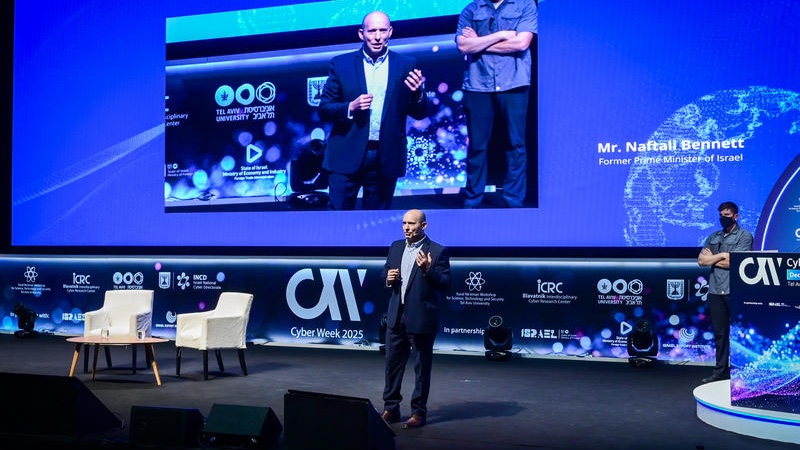
(JNS) “The fact that Israel is in a good situation in the worldwide AI race does not say anything about the future,” warned Dror Bin, CEO of the Israel Innovation Authority, at AI Week 2025, currently taking place at Tel Aviv University.
“We need to make sure that we remain in the forefront of this race—in industry, among entrepreneurs, investors, companies, as well as the government,” he said.
Investors, government agencies and start-ups gathered in Israel for AI Week, now in its sixth year, an annual conference that celebrates the country’s AI sector. Held in parallel with CyberWeek and Quantum Day, the event highlights the growing significance of Generative AI and Israel’s position in the global ecosystem.
(Generative artificial intelligence, a subfield of artificial intelligence, uses generative models—a type of machine learning model that learns the underlying patterns and probability distribution of training data—to generate text, images, videos, audio, software code or other forms of data.)
Despite record-breaking funding and significant growth in the tech sector, experts from the private and public sectors outlined at AI Week 2025 how Israel must overcome long-term challenges to remain a relevant player in the worldwide AI race.
The Israel Innovation Authority is a government agency whose role is to maintain and strengthen the leadership of the country’s tech hub. It does this in two ways: by managing $500 million of direct investments of state funds into companies each year, and by advising the government on policy. Its mandate spans encouraging innovation, developing talent and ensuring that citizens are protected from harm.
“In many places, regulation is actually slowing down AI, and you want to create the right balance between regulation that is protecting people, but on the other hand, allowing innovation as well,” said Bin.
Nir Yanovsky Dagan, head of the Innovation, Data and AI Department at the Israel National Digital Agency, echoed concerns that Israel may miss the opportunity to remain a leader due to ongoing geopolitical distractions. “After the 1973 war, Israel had a lost financial decade: a total decade in which the whole world had financial growth, and we didn’t,” he said. “If we do not ride the AI revolution, we might find ourselves at the beginning of another lost decade.”
The AI tech engine in Israel
In 2025, AI funding in Israel saw a jump to $7.9 billion, up from almost $5 billion last year. While the news validates Israel’s position as a leading tech hub, the conference outlined five challenges that could affect its ranking going forward—infrastructure weaknesses, slowing human-capital growth, low data availability, insufficient regulatory sandboxes and the need for responsible regulation.
An internal government committee cited by Dagan suggested that Israel needs to invest 25 billion shekels ($7.7 billion) in AI over the next five years to remain a top player worldwide, including a boost in R&D and improvements in commuting infrastructure.
The concern for seeking talent speaks to the sheer size of the global AI ecosystem and its demand, considering that Israel leads the world in AI human capital concentration—the clustering of valuable knowledge, skills and talent—within the workforce at approximately 1.13%. According to an April 2025 report on AI from the Innovation, Science and Technology Ministry, Israel ranks fifth in the relative penetration of those skills, suggesting a gap that needs closing.
“Regulation should be an enabler, not a showstopper. And to have innovative regulation here, we need a lot of investment,” Dagan added, highlighting the need for transparency to regain public trust.
While looking for a talented team of founders and entrepreneurs is important, Israel’s shortage of 1,500 AI experts—cited by the Innovation Authority—may hinder the creation of future giants. “Our responsibility as investors is to work with the Minister of Education. Because if we do not create this next wave of talent, then we’ll have no one to invest in,” said Blumberg Capital Managing Director Yodfat Harel Buchris.
Drawing on the Israel Defense Forces’ role in producing cybersecurity expertise that later flows into academia and industry, Harel Buchris suggests reversing the funnel. “We have to take the AI to high school and then move it forward to academia and to the market. The army is not yet playing a role in the AI world. But together, I think we can actually make a difference.”
Alongside the main plenary of talks and fireside chats, AI Week was host to several side tracks dedicated to AI & Health, Ethics & Policy, Signal Processing, and Creativity in the Age of AI.
AI Week was hosted by Tel Aviv University’s Blavatnik Interdisciplinary Cyber Research Center, the TAU Center for AI and Data Science (TAD) and the university’s Yuval Ne’eman Workshop for Science, Technology and Security. Sponsors included Check Point Software Technologies, Elbit Systems, Google and Mobileye.
Want more news from Israel?
Click Here to sign up for our FREE daily email updates







Maybe I have a vivid imagination, but, some of the things l have read in prophecies concerning the end times, specifically, the tribulation, reflect AI. All who enter that realm should keep the scriptures close at hand.