
(JNS) In late October 2023, Israeli writer and analyst Shany Mor wrote that “many would think that an atrocity like Hamas’s Oct. 7 massacre in Israel would lead opponents of the Jewish state to temper their attacks.” Instead, he observed, “from college campuses to mainstream media outlets, elite left-wing circles responded to the terror group’s barbarism by intensifying their denunciations of Israel.”
Mor argued that this behavior is “an example of cognitive dissonance reduction, the process by which people reconcile new information that contradicts their firmly held priors.”
“Western activists for Palestinians,” he added, “are dedicated to two nearly theological precepts: that Israel is evil, and that no Palestinian action is ever connected to any Palestinian outcome.”
Hamas’s gruesome attack, he concluded, “posed a threat to this worldview, and the only way to resolve it was by heightening Israel’s imagined malevolence. The terrorist atrocities didn’t trigger a recoiling from the cause in whose name they were carried out; they led to an even greater revulsion at the victim.”
However, in the immediate aftermath of Oct. 7, one would have at least hoped that there would be some soul-searching among supporters of the Palestinian cause and a reaction along the lines of “this is not how we imagined Palestinian resistance” or a “not in my name” campaign.
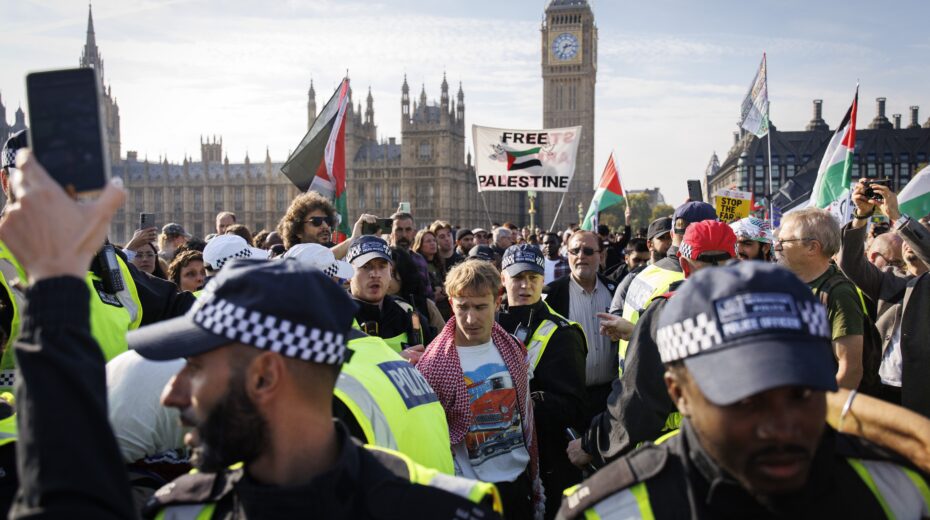
Neither distancing nor clarity was not to be. Indeed, the first pro-Palestinian march in London and other British cities took place on Oct. 9, two days after the massacre—a march that was organized on Oct. 7 while the massacre was taking place. Further, as Dave Rich of the Community Security Trust (CST) clarified, the crowd in London on that Monday was jubilant and joyful. They weren’t there to protest Israel but to celebrate the mass murder of Jews.
At these marches, participants held banners reading “Manchester Supports the Palestinian Resistance” and “Glory to the Freedom Fighters.”
“It was so beautiful and inspiring to see,” said one speaker at a rally in Brighton, a seaside resort about 45 miles south of London. “We are supporting all sorts of resistance,” said a speaker at the Birmingham protest. Palestine Solidarity Campaign branches and student Palestine Societies posted their solidarity with this “resistance.”
Dozens of self-declared “leading members of the British Muslim community” announced their support for “armed struggle” and called for Israel to be “dismantled.”
“We reject the use of the word terrorism” to describe Palestinian acts of resistance,” some said.
While British media outlets like The Guardian didn’t celebrate Hamas’s atrocities, almost immediately after the Oct. 7, CAMERA documented how many outlets began framing the story not as one about the brutality of the pogrom itself, but about Israel’s alleged “disproportionate response,” which, within days of the massacre, began to be characterized as “ethnic cleansing” or “genocide.”
By the first anniversary of Oct. 7, those in Israel who had been murdered, raped, tortured, brutalized or taken hostage had become merely a footnote in the increasingly common revisionist narrative of Israeli “genocide.”
Unlike Holocaust revisionists in the decades since World War II, who generally lurked in the political fringes, the whitewashing, obfuscation and inversion of Oct. 7 is not only common in the West, but is arguably the most socially acceptable view on the attacks and their aftermath.
What we’ve seen continually since Oct. 7 is antisemitism atrocity inversion, revisionism and erasure that are redolent of attempts after World War II—by the Arab and Muslim world, the extreme left and the extreme right—to deny and distort Holocaust history and its memory.
There are four main themes in this abuse of Oct. 7 memory:
Inversion: This refers to framing the Oct. 7 massacre as a footnote while centering the genocide libel, or other such libels such as the accusation that Israel intentionally targets children, against Israel as the main takeaway from Oct. 7.
Unsurprisingly, no British media outlet demonstrated this pathology more frequently, or promoted the narrative earlier, than The Guardian. Since the massacre, torture and mutilation of 1,200 people in Jewish communities in southern Israel, which included systematic rape and murder (even of children and babies in cold blood), the news outlet has published countless pieces accusing not Hamas, but Israel, of genocide or ethnic cleansing.
In fact, 11 pieces were published by Guardian editors in the span of only 13 days—from Oct. 14 to Oct. 27, 2023—accusing Israel of carrying out or planning to carry out ethnic cleansing or genocide. Crucially, this was before Israel’s ground invasion of Gaza. Since then, the libel has become ubiquitous at The Guardian and other mainstream outlets in the United Kingdom, with journalists subjecting the accusation to little, if any, critical scrutiny.
Disappearing Hamas: This erasure of the role the mass murderers play in the story takes place in the dearth of coverage of Hamas’s decisions in the war that followed Oct. 7, in avoiding holding the group morally responsible for the massacre itself and for the fact that their leaders knew that the invasion would result in a war causing untold suffering for Gazan civilians.
Indeed, one of the major takeaways from the media’s post-Oct. 7 moral and professional failures is that, even after Hamas carried out the worst antisemitic massacre since the Holocaust, Palestinians have not been taken seriously as agents of their own fate. The story they insist on telling mandates that Palestinians exist as passive victims of Israel, the party that matters.
Hamas’s cruel, destructive and fanatical decisions in the last 33 months, including the terror organization’s illegal use of human shields and hospitals, and decision not to surrender despite the horrible toll their unwinnable war has exacted on the civilian population, are ignored.
The Hamas Charter, for example, calls not just for Israel’s destruction but for the murder of Jews. It blames Jews for engineering the French and Russian revolutions, as well as both world wars. Never is this mentioned in coverage, despite its centrality in understanding both the Oct. 7 attacks and the ongoing war with Israel and the West.
Soft Justification: This pattern contextualizes Oct. 7 by citing a “78 years of occupation” lie or by repeating the mantra that “Oct. 7 didn’t happen in a vacuum,” which are mealy-mouthed ways of implicitly justifying the massacre.
Indeed, Alan Rusbridger, The Guardian’s chief editor from 1995 to 2015, published a column in the Independent titled “The horrors of 7 October did not happen in a vacuum.”
Edward Luce, the US national editor and columnist at the Financial Times, effectively argued, in a piece on Oct. 11, 2023, that though Hamas “plumbed new depths of bestial cruelty on Oct. 7,” terrorists nonetheless had “few other choices” than to embark on the mass murder of Jews.
Luce’s colleague, Kim Ghattas, opined at the outlet that what occurred on Oct. 7 was, at its core, about “the longest occupation in modern history.”
In fact, one of the earliest op-eds at The Guardian after Oct. 7 was written by Daphna Baram days later on Oct. 11. While she sympathized with friends and family she has in Israel, she didn’t use the word “Hamas” even once and referred to Gaza as a “concentration camp.”
Guardian columnist Moustafa Bayoumi suggested on Oct. 11 that Israel “provoked” the massacre, in part, by storming the Al-Aqsa mosque in Jerusalem on Oct. 5.
Accusing Jews or Israel of exploiting Oct. 7 to garner sympathy or further oppress Palestinians:
This narrative is consistent with one of the main tropes of antisemitism: that Jews must be up to something and that whatever Jews say and do can’t be taken at face value: They must have some ulterior motive or hidden agenda.
In fact, The Guardian ran a piece by Canadian author and social activist Naomi Klein on the first anniversary of the massacre titled, “How Israel has made trauma a weapon of war.”
We return to Shany Mor, who argued that the secular theology of anti-Israel advocacy demands that no Palestinian action can ever be connected to any Palestinian outcome. The medieval cruelty and barbarism inflicted upon Jewish babies by Palestinians must, according to their precepts, have a Jewish root cause.
Indeed, The Guardian and like-minded outlets did not and will not allow the story to be about the Jewish victims of unimaginable Hamas cruelty and barbarism.
In the immediate aftermath of Oct. 7, one would have hoped that there would be some soul-searching among supporters of the Palestinian cause and a reaction along the lines of a “not in my name” campaign.
Such media institutions invested too much in the Palestinian cause. They spent too many years opining on the righteousness of the Palestinians and their supporters in the United Kingdom that the conflict’s root cause is Zionist malevolence and that Israel’s fears of the threat posed by terror groups on its borders are exaggerated to adjust their reporting, let alone abandon their faith in Palestinianism.
The significance of the widespread abuse of Oct. 7 memory to those who study and combat antisemitism cannot be overstated.
On the practical level, the inversion of what happened on the dark Shabbat day led to a tsunami of antisemitic incidents against Diaspora communities in the United States, the United Kingdom and much of the West, where Jews and Zionists were abused, often called genocide supporters and baby killers, based on libels against Israel stemming from the moral inversion of Oct. 7.
The climate has deteriorated to the point where, if you’re Jewish, you’re often asked to pass an ideological litmus test to be accepted into the social or political “communities of the good.” Only those Jews willing to condemn “Israeli genocide” can pass.
On the intellectual and academic front: Whereas there is substantial and well-established body of academic literature on Holocaust revisionism and other forms of the abuse of Holocaust memory, scholarship that focuses on it as a form of antisemitism and a weapon of extremist propaganda, the abuse of Oct. 7 memory needs to be added to the cannon of antisemitism and anti-Zionist studies, engaging in research, scholarship and teaching on this extremist propaganda.
Why is this needed?
Because, unlike the Holocaust, which became widely understood as the embodiment of antisemitic evil and the Nazis as the perpetrators of that evil—thus serving as a moral bulwark by which antisemitism became, to some degree, taboo—the ubiquitous Oct. 7 revisionism and genocide inversion, in addition to fueling antisemitism in the short term, portends a much longer and more dangerous trend for Jews.
If media outlets, historians and public figures internalize the lessons of Oct. 7 not as the worst antisemitic massacre since the Holocaust and as an illustration of the danger Jews face from Islamist extremists but as the threat posed by the “genocidal ideology of Zionism,” and if Jewish identity itself in any form or expression becomes morally suspect due to its putative moral proximity to Zionism, then the future for Jews looks hauntingly grim.
Make no mistake: This is nothing short of an existential fight for the future of world Jewry.
This is a revised version of a talk Adam Levick gave on July 7 at the 2026 Haifa Contemporary Antisemitism Conference.