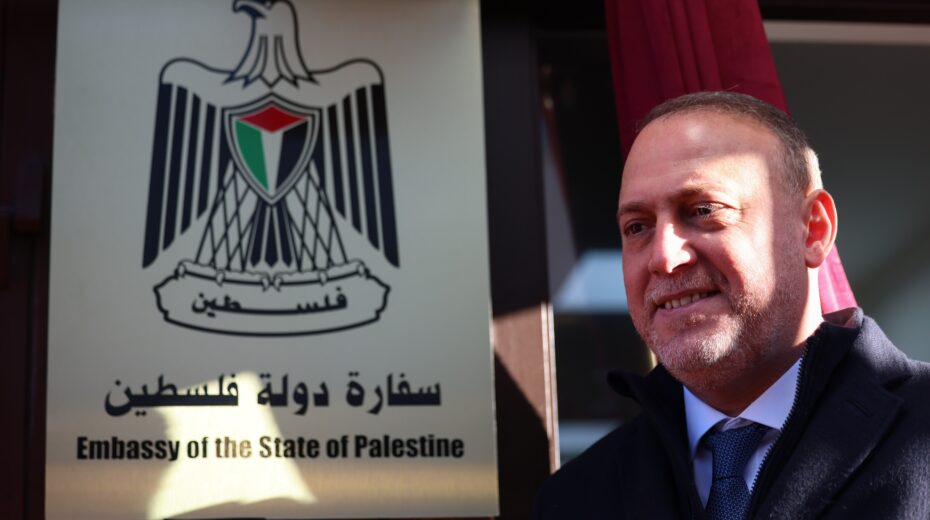

With an official ceremony in West London on Monday, the Palestinian mission in the United Kingdom was upgraded to full embassy status. The previous mission status was transformed into a fully-fledged diplomatic representation with diplomatic privileges. Palestinian Ambassador Husam Zomlot described the move as a “profound milestone” in British-Palestinian relations.
The upgrade follows the UK’s decision to officially recognize the so-called “State of Palestine” in September 2025. London joined Australia and Canada in carrying out a foreign policy shift that attracted international attention. The new embassy is the most visible sign to date of this recognition policy.
From the Palestinian perspective, the step marks a further advance on the path to internationally-recognized statehood. Zomlot emphasized that it is not merely a formal change of status, but a political directional decision. The Palestinian leadership views the diplomatic upgrade as confirmation of its strategy to increasingly advance state recognition outside direct negotiations with Israel.
Today, the Embassy of the State of #Palestine to the United Kingdom is officially inaugurated — a piece of Palestine on British soil; a symbol of peace, Sumud, dignity, and our people’s enduring pursuit of justice and freedom.
Palestine is here. Palestine endures. Palestine will… pic.twitter.com/PHXXFr5V9A— Husam Zomlot (@hzomlot) January 5, 2026
Political signal from London
The UK also deliberately framed the decision in political terms. British diplomat Alistair Harrison spoke of “the beginning of a new phase” in bilateral relations. The UK government sees the recognition of “Palestine” and the opening of the embassy as a contribution to a long-term political solution to the conflict.
It remains open, however, whether the UK plans, in return, to open its own embassy in Ramallah, which serves as the de facto administrative capital of the Palestinian Authority. The Foreign Office in London has not yet commented on this. Observers interpret this restraint as an indication that there is still uncertainty within British diplomacy about the practical consequences of the move.
Widespread rejection in Israel
In Israel, the international upgrading of Palestinian statehood currently meets with broad rejection. Since the Hamas terror invasion of October 7, the idea of a Palestinian state is no longer seen in large parts of politics and society as a means to achieve peace, but as a security risk.
Government representatives, as well as voices from the opposition, point out that previous territorial concessions did not lead to stability. In particular, Israel’s withdrawal from the Gaza Strip and the subsequent takeover by Hamas are regarded in the political debate as a central warning. Against this backdrop, Palestinian statehood is currently not viewed as a solution to the conflict, but as a potential factor in further escalation.
This assessment is also reflected in recent polls. As early as the beginning of 2025, a survey showed that 64 percent of Jewish Israelis fundamentally reject the establishment of a Palestinian state, while 23 percent would support such statehood only under certain conditions. Overall, 52 percent of respondents opposed a Palestinian state.
US position remains unchanged
The United States continues not to recognize Palestine as a sovereign state. In Washington, it is emphasized that state recognition without viable political, institutional, and security-policy prerequisites could further destabilize the situation in the Middle East. The US government continues to insist that central issues—including security, borders, and political responsibilities—cannot be resolved through unilateral diplomatic steps.
At the same time, international pressure on Washington is growing to join the recognition policy of other Western states. So far, however, the US position remains unchanged—not least in view of the security-policy consequences for Israel.
Symbolism with open outcome
International observers point out that by opening the Palestinian embassy in London, the UK is joining a broader Western movement that is increasingly relying on diplomatic symbolism. Critics, however, doubt that this approach will contribute to rapprochement between the conflict parties. Rather, there is a risk that central conflict issues will be preempted without a corresponding change in the security reality on the ground.
Thus, the opening of the Palestinian embassy in London is above all a political signal. From Israel’s perspective, Palestinian statehood is currently not seen as a contribution to a solution, but as a step that ignores security realities and bypasses central conflict issues. International recognitions outside direct negotiations create new diplomatic facts without addressing the causes of the conflict—and thereby tend to exacerbate existing contradictions rather than overcome them.
Want more news from Israel?
Click Here to sign up for our FREE daily email updates