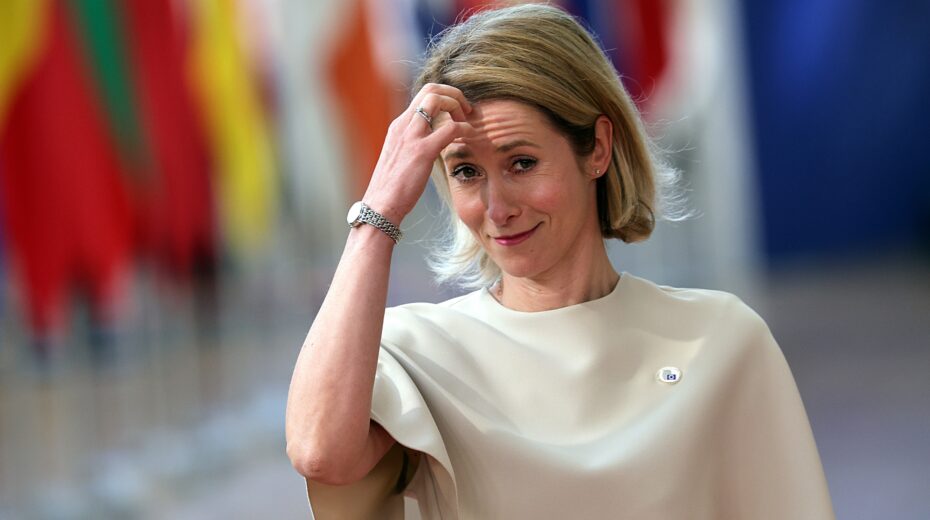
(JNS) Before Israel announced on Thursday a freeze in direct talks with EU foreign policy chief Kaja Kallas, her 2024 nomination to the post was greeted with relief and optimism by the Jewish state and its allies.
A center-right politician from the former Soviet republic of Estonia, her appointment to the post promised a break from her vocally anti-Israel predecessor, the Spanish Socialist Josep Borrell, who accused Israel of starving Gaza.
But last week, amid a months-long effort by Kallas to promote sanctions on Israel, reports said she called the Jewish state an “apartheid” regime, triggering Thursday’s unprecedented move by Israeli Foreign Minister Gideon Sa’ar. He said Israel would “sever all contact with Ms. Kallas until she retracts the blood libel.”
Madam,
With all due respect, even in your remarks here you refrain from denying or condemning what has been attributed to you and published publicly. That speaks for itself.
To the best of my knowledge, the statements attributed to you regarding “apartheid” do not reflect the… https://t.co/kETNPXTZK8
— Gideon Sa’ar | גדעון סער (@gidonsaar) June 18, 2026
Analysts of EU-Israel relations identified several factors that led to the current crisis, including a power struggle in Brussels, the upcoming elections in Israel, and the diplomatic toxicity of the terminology that Kallas is said to have used.
“Once the ‘apartheid’ accusation is put on the table, Israel’s Foreign Ministry will react very forcefully, up to and including shutting out the accuser unless they retract. A strong rebuke would’ve happened under any government,” Maya Sion-Tzidkiyahu, a lecturer at the European Forum of the Hebrew University, told JNS.
Israel’s Foreign Ministry is operating under the assumption that it can afford to suspend relations with Kallas because it has independent levers within the EU in friendly members states, Sion-Tzidkiyahu said. Those allies have so far proven effective in blocking EU-wide sanctions.
The report attributing the apartheid term to Kallas appeared on June 12 in Euractiv. It did not offer direct quotes of what she allegedly said, saying only that it was about Israel’s treatment of Palestinians in Judea, Samaria and Gaza, and that it was said during a closed meeting in Mexico City last month. Kallas’s office neither confirmed or denied the reports, answering a JNS query with a text that only outlined the EU position in favor of a Palestinian state.
Kallas replied to Sa’ar’s announcement generally and without addressing his allegations, writing to him on X that “Dialogue is the foundation of diplomacy,” and that the EU supports the two-state solution.
Calling Israel an apartheid state is “antisemitic and exceeds legitimate criticism on policy, so suspending ties with her was the right move, if that’s indeed what she said,” Yitzhak Eldan, a former Israeli ambassador to Denmark and ex-head of protocol for the Foreign Ministry in Jerusalem, told JNS. He added that suspension should have happened only after Kallas had time to retract and clarify her words.
A former Estonian prime minister with a neutral record on Israel, Kallas in 2024 looked like a certain improvement over her Borrell. That year, then-Israeli Foreign Minister Israel Katz called Borrell “an antisemite and Israel-hater who consistently tries to pass resolutions and sanctions against Israel in the EU only to be blocked by most member states.”
Though he doesn’t appear to have leveled the apartheid accusation publicly, Borrell accused Israel of committing war crimes, promoted sanctions against Israel and claimed it appeared to be using starvation as a weapon in Gaza. Borrell also accused Israel of perpetrating genocide, but only after Kallas had replaced him as the EU top diplomat. Israel condemned Borrell and refused to arrange meetings with him at several occasions, but had never announced a break in relations with Borrell while he was in office.
The “apartheid” label followed months in which Kallas promoted sanctions against Israel, mainly in connection with its policies of increasing the Jewish-Israeli population of Judea and Samaria. In his statement of a break in relations, Sa’ar said Kallas has “been acting obsessively and with blatant unfairness” toward Israel.
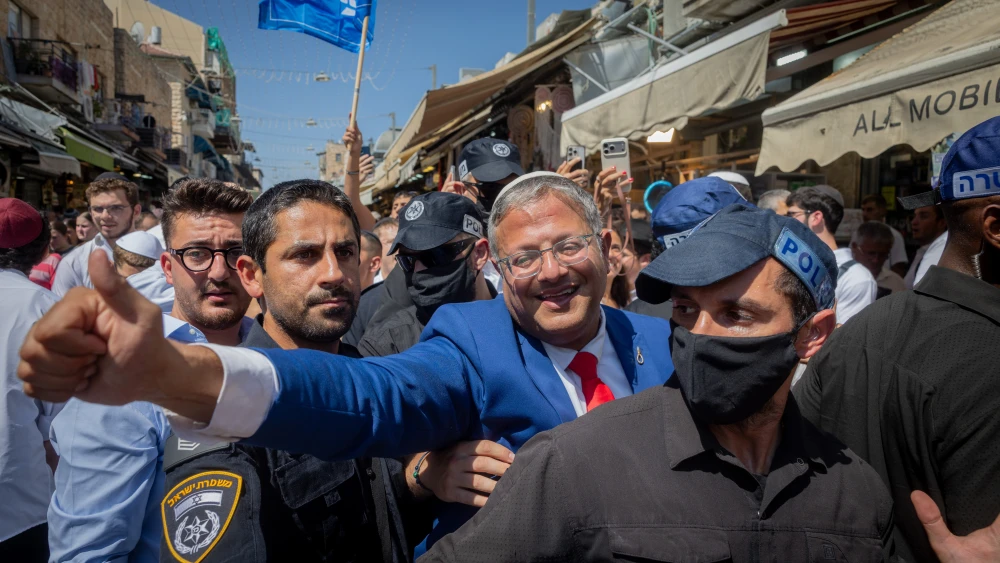
This week alone, Kallas said she would promote trade restrictions with Israel over “illegal settlements,” shortly after a bid she presented at the European Council to pass EU-wide sanctions against Israeli National Security Minister Itamar Ben-Gvir failed due to opposition by the Czech Republic.
Sion-Tzidkiyahu, who is also the director of the Israel-Europe Relations Program at Mitvim—The Israeli Institute for Regional Foreign Policies, said that whereas Kallas has been consistent in advancing sanctions against Israel, this was the result of political necessity rather than an ideological directive.
“I believe that Kallas’s policy on Israel is mostly realpolitik,” Sion-Tzidkiyahu said, noting that Israel as an issue is currently eclipsed in the EU by the conflict with Russia.
Kallas, a centrist liberal, gradually became a political rival of Ursula von der Leyen, the president of the European Commission, who belongs to the more conservative Christian Democratic Union of Germany and is generally viewed as an ally of Israel.
Both women are staunchly opposed to Russian expansion, but going also after Israel when it is deeply unpopular among European elites helps distinguish Kallas from von der Leyen and rally support for Kallas in Europe, Sion-Tzidkiyahu said.
Kallas is facing pressure from Spain, France, Ireland and other member states with anti-Israel governments, and acquiescing to their demands adds to her political capital, Sion-Tzidkiyahu continued.
Israel’s allies in Europe have protested Kallas’s alleged apartheid slur. MEP Hildegard Bentele, chief whip of the Christian Democratic Union/Christian Social Union faction within the European Parliament and chair of the parliament’s Delegation for relations with Israel, wrote on X, “Comparing Israel to apartheid South Africa is not only factually wrong, but also completely unacceptable for someone speaking on behalf of the EU,” adding that it “further undermine[s] trust in Europe’s foreign policy apparatus.”
As for Sa’ar’s announcement of a break in relations with Kallas, “this is an election year [in Israel],” Sion-Tzidkiyahu said. “As foreign minister, Sa’ar has always taken a firm line, sometimes crossing over to abrasiveness. Kallas’s alleged ‘apartheid’ accusation gave him an opportunity to flex. He took it.”
Want more news from Israel?
Click Here to sign up for our FREE daily email updates