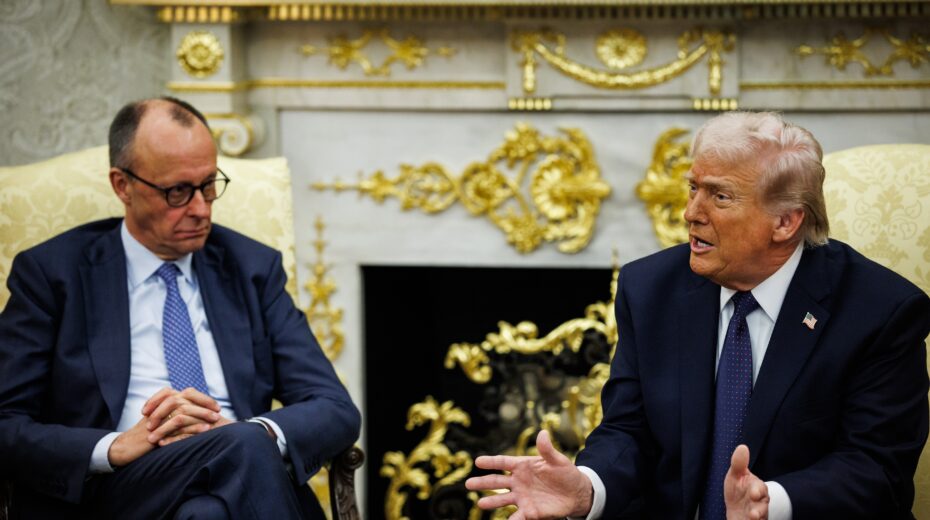

An unusually sharp tone from Washington is creating new tensions between the United States and Germany. US President Donald Trump has publicly criticized German Chancellor Friedrich Merz and rejected his comments on Iran policy.
“He doesn’t know what he’s talking about,” Trump said. The remark followed statements by the chancellor questioning the strategic direction of US policy toward Iran. Trump responded particularly forcefully, stressing that Germany does not take the danger of a nuclear-armed Iran seriously enough. If Tehran were to possess a nuclear bomb, “the whole world would be held hostage,” the president said.
President Trump on Truth Social: The Chancellor of Germany, Friedrich Merz, thinks it’s OK for Iran to have a Nuclear Weapon.
He doesn’t know what he’s talking about! If Iran had a Nuclear Weapon, the whole World would be held hostage. I am doing something with Iran, right now,… pic.twitter.com/6T5qHR8hYN
— Donald J Trump Posts TruthSocial (@TruthTrumpPost) April 28, 2026
Criticism from Berlin
Merz had previously said that he currently sees no clear strategic way out for the United States. Iran’s leadership, he argued, is acting skillfully by delaying or avoiding negotiations, while American initiatives have so far produced no tangible results. He also said that the United States was being “humiliated” in the process.
At the same time, the chancellor pointed to the economic consequences of the conflict for Germany and was critical of the way the confrontation has unfolded so far.
International reactions
International media have assessed the dispute in different ways. American reports describe growing tensions within the Western alliance.
President Trump responded with unusual sharpness and publicly called Germany’s position into question.
The dispute has now taken on concrete political dimensions as well. According to reports, the United States is even considering a possible reduction of its troop presence in Germany.
German media outlets such as Die Welt, by contrast, have emphasized above all the economic consequences of the conflict and the risks of further escalation, including rising energy prices and effects on global trade routes.
The exchange makes clear just how different the perspectives have become.
Under Trump, the United States continues to rely on pressure and deterrence, with the goal of permanently preventing Iran from developing military nuclear capabilities. This line also corresponds with Israel’s security assessment.
Germany, by contrast, places greater emphasis on diplomatic solutions and the stabilization of economic conditions. Its focus is less on the immediate military threat than on the consequences of further escalation.
These differences are not new, but they are becoming more visible in the current situation.
The European approach often rests on the assumption that conflicts can be eased through negotiations, economic incentives and long-term processes. In the Middle East, however, these tools have only limited effectiveness.
There, credibility, deterrence and the ability to respond quickly play a central role. When resolve is called into question, the security consequences can be immediate.
Implications for Israel
Against this backdrop, the debate also has immediate significance for Israel. Iran’s leadership has represented a concrete threat for years — both through its missile program and through its support for regional proxies.
Israel is therefore watching closely to see how united the West remains and whether the prevention of an Iranian nuclear program is truly being pursued with one voice.
The conflict between Washington and Berlin therefore goes beyond personal differences. It points to a deeper strategic uncertainty within the West.
The question is not only how Iran can be stopped — but whether there is still a common answer at all.
Want more news from Israel?
Click Here to sign up for our FREE daily email updates