

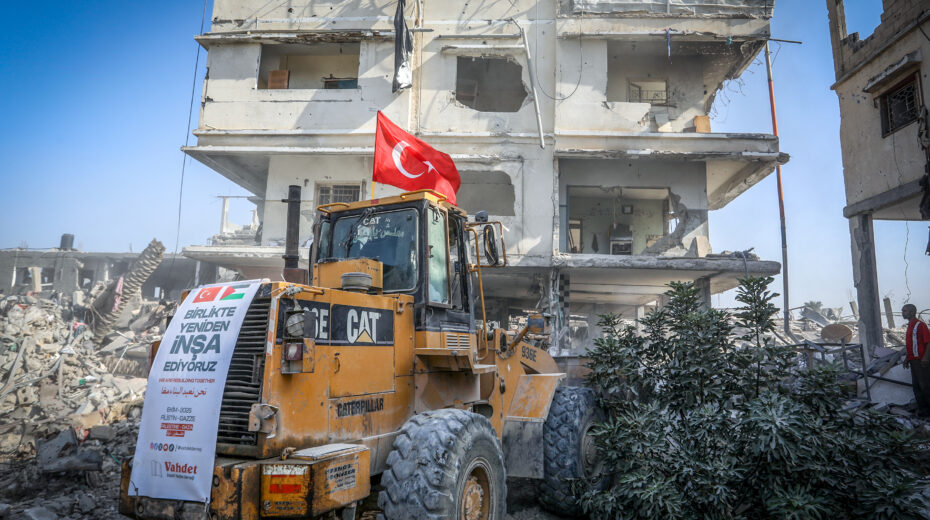

Turkey has inaugurated a mosque in Gaza City named after Abdullah Yusuf Azzam—a figure frequently described in security analyses as the “father of global jihad.” The dedication was carried out by Turkey’s Directorate of Religious Affairs (Diyanet), which reports directly to the presidency in Ankara.
Officially, this is part of a reconstruction project within the framework of humanitarian support for the Gaza Strip. In addition to the Abdullah Azzam Mosque, two other mosques were newly built or restored. Ankara emphasizes the religious and social character of the initiative.
Yet the choice of name is anything but neutral.
The ideological background
Abdullah Yusuf Azzam played a central role in the 1980s in mobilizing Islamist fighters during the war in Afghanistan. He is regarded as a mentor to Osama bin Laden and as a co-founder of the movements from which al-Qaeda later emerged.
His teachings defined armed jihad as an individual duty for Muslims worldwide. This idea marked an ideological turning point: from regionally limited conflicts arose a global mobilization concept.
Naming a mosque after such a thinker is therefore not merely a historical reference, but a symbolic act with political weight.
Reaction from Jerusalem
In Israel, the honoring of Azzam is understood as a political signal. Israel’s Minister for Diaspora Affairs, Amichai Chikli, reacted publicly on the platform X, writing:
“What a ‘gesture’ from Turkey: to finance a mosque in Gaza named after Abdullah Azzam—the man who mentored Osama bin Laden and co-founded al-Qaeda.
“Erdoğan’s Turkey is a dangerous Trojan horse and actively promotes al-Qaeda-linked networks in Gaza, Syria, and Mogadishu, Somalia.
“The continued blindness of the West to Erdoğan’s game is extremely dangerous. Wake up before it’s too late.”
What a “gesture” from Turkey: Funding a mosque in Gaza named after Abdullah Azzam – the man who mentored Osama bin Laden and co-founded Al-Qaeda.
Erdogan’s Turkey is a dangerous Trojan horse, actively advancing Al-Qaeda-linked networks in Gaza, Syria, and Mogadishu, Somalia.… pic.twitter.com/TJMwh226d0
— עמיחי שיקלי – Amichai Chikli (@AmichaiChikli) February 15, 2026
The choice of words makes it clear that Jerusalem does not interpret this decision as a religious humanitarian measure, but as an ideologically charged message.
Religious policy as a geopolitical instrument
The Diyanet—officially the “Presidency of Religious Affairs”—is a state authority in Turkey that manages mosques, deploys imams, and sets religious guidelines. It reports directly to the president and commands a billion-dollar budget as well as tens of thousands of employees.
Under President Recep Tayyip Erdoğan, the Diyanet has increasingly developed into a strategic instrument of Turkish foreign policy. Mosque constructions abroad—from Europe through Africa to the Middle East—serve not only spiritual purposes. They create networks, cultural ties, and political influence.
Especially in the Gaza Strip, where religious narratives are closely intertwined with political power, symbolic politics is never incidental.
More than a construction project
Today the Gaza Strip is not only a humanitarian crisis area, but also an ideological space. Whoever builds infrastructure there creates influence. Whoever sets names there sets signals.
The decision to name a new house of worship after a theoretician of global jihad fits into a larger picture of Turkish ambitions in the Middle East—religiously legitimized, politically calculated, and strategically long-term.
This mosque is therefore more than a building. It is a signal.
Want more news from Israel?
Click Here to sign up for our FREE daily email updates





Israel should bomb the Turkish footholds in Gaza. They are as dangerous as Iran’s weapons!