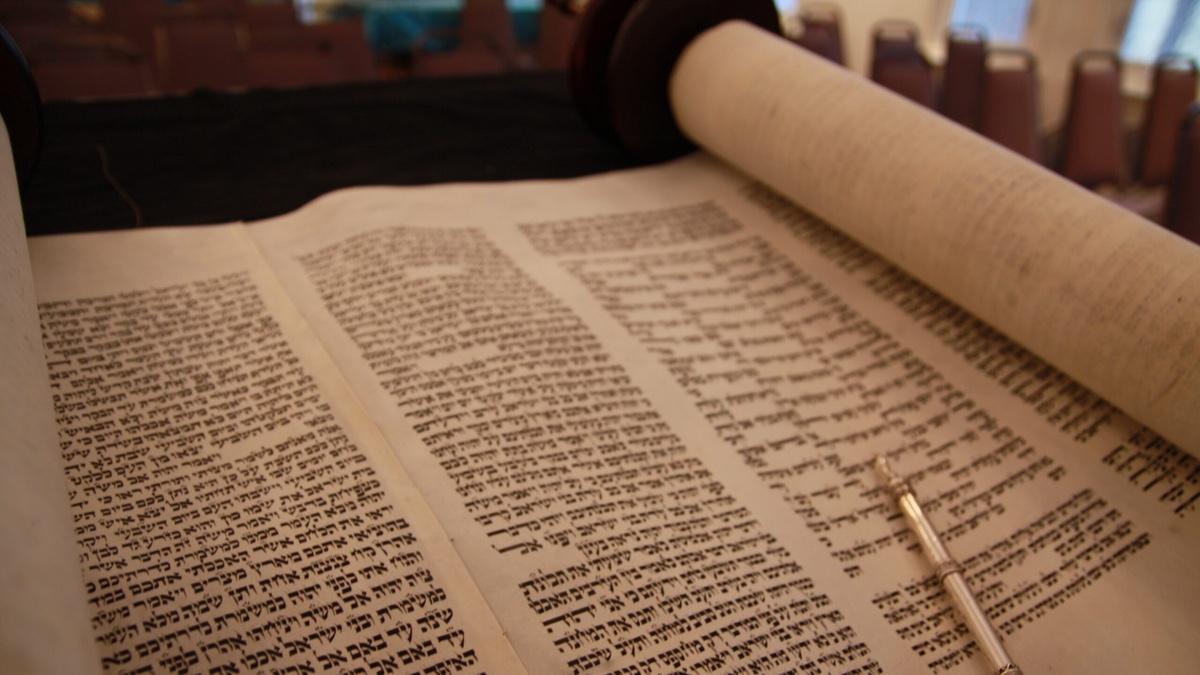
On the road to Emmaus, Yeshua met with two of His disciples and, beginning at Moses and all the Prophets, He expounded to them in all the Scriptures the things concerning Himself. (Luke 24:27). For our Torah studies this year, therefore, week by week we will seek to discover how all of Torah prepared the way for the coming Messiah.
6th June 2026 (21 Sivan)
Shelach Lecha (send for yourselves), Numbers 13:1-15:41
When Almighty God created human beings, He made us so that we could choose to love Him, so much as to desire to perfectly do His will and to be with Him forever. To have the ability to choose and respond to His love for us, also allowed us to fall short. The history of mankind from the day that Adam was formed from the dust of the ground until now, is that we have fallen short of perfection. The Kingdom of Heaven is not fully manifest on the earth.
From time to time, God has drawn those close to Himself through whom His covenant purposes could progress but, time and again, we have fallen short. When Abraham was appointed as the father of faith, in human terms, and the custodian of God’s eternal promises, he would surely have been full of expectation for a great work of God to draw together a family from all nations in a most magnificent way. He died many years before the events of this week’s Torah portion took place. He would surely have wept to see his physical descendants fail to have faith in God to conquer the land which he himself had been promised. This surely could not be the climax of God’s purposes through him and promised to him. Even after all the Children of Israel had known of God in their journey from Egypt, they were still full of fear of the enemies whom the Lord had promised to drive out of the Land.
In future portions, we will go on to read about the conquest of Canaan through the leadership of Joshua and the settling of the land through the strength of faith and purpose of those who could emulate Caleb. Even so, we will still discover that the history of all God’s people is tainted through failure, often through disobedience and always through lack of the fulness of faith in God. The time of the Judges confirms that life in Canaan, the Land of promise – the Land of Israel – did not become the Kingdom of Heaven on earth. Likewise through the times of the Kings of Israel and Judah and until now, there have been high times as well as low, but never the fulness of the Kingdom of Heaven.
In later times, the Writer to the Hebrews could meditate on those who achieved a good testimony of faith. In Hebrews Chapter 11, names are mentioned that punctuate the history of the earth: Abel, who brought a right offering to God; Enoch, who walked with God; Noah, who prepared the Ark; Abraham and Sarah, who by faith begot Isaac; Moses, of whom we read in our Torah portions, leading a multitude to the borders of Canaan, and innumerable others of which it could be said, that they:
….through faith subdued kingdoms, worked righteousness, obtained promises, stopped the mouths of lions, quenched the violence of fire, escaped the edge of the sword, out of weakness were made strong, became valiant in battle, turned to flight the armies of the aliens. Women received their dead raised to life again.
Others were tortured, not accepting deliverance, that they might obtain a better resurrection. Still others had trial of mockings and scourgings, yes, and of chains and imprisonment. They were stoned, they were sawn in two, were tempted, were slain with the sword. They wandered about in sheepskins and goatskins, being destitute, afflicted, tormented – of whom the world was not worthy. They wandered in deserts and mountains, in dens and caves of the earth. (Hebrews 11:33-38)
Such testimonies bring hope and also shame to many others who did not achieve the goal of their faith, particularly those of whom we read today in the Book of Numbers. They did not trust God to help them subdue the evil powers that dominated the Promised Land, that it might be cleansed and prosper as an eternal dwelling place for God’s people with Him.
Yet, where do we read that it was the promise of God to transform this earth to be an expression of Heaven itself, where God dwells in complete purity? The Children of Israel were only looking for a homeland where they could be safe on this earth to live and prosper.
However, the Writer to the Hebrews, in reviewing the great journey in time from Creation to his day, realised that those individuals who did live by faith in a special way, saw something in vision beyond this world. Of Abraham it was said:
By faith he dwelt in the land of promise as in a foreign country, dwelling in tents with Isaac and Jacob, the heirs with him of the same promise; for he waited for the city which has foundations, whose builder and maker is God. (Hebrews 11:9-10)
Again, of them and others who saw into a distant future in faith:
These all died in faith, not having received the promises, but having seen them afar off were assured of them, embraced them and confessed that they were strangers and pilgrims on the earth. For those who say such things declare plainly that they seek a homeland. And truly if they had called to mind that country from which they had come out, they would have had opportunity to return. But now they desire a better, that is, a heavenly country. Therefore God is not ashamed to be called their God, for He has prepared a city for them. (Hebrews 11:13-16)
And all these, having obtained a good testimony through faith, did not receive the promise, God having provided something better for us, that they should not be made perfect apart from us. (Hebrews 11:39-40)
In our portion, this week, therefore, we must put the failure of the Children of Israel into perspective, and realise that we are learning not only about their failure, but also the nature of human beings. The Israelites had come out of Egypt with great signs and wonders, but still fell short on faith. Their extra time of forty years in the wilderness is our lesson as well as theirs. We read again, in Chapter 15, that God still gave them a way for unintentional sin to be covered through the sacrifice of animals. The grace of God allowed a covering for sin into the future, when all could be fulfilled in His covenant purposes.
So, let’s bring these lessons forward into our circumstances today. We are still on the pilgrimage, but our vision is now more clearly set on the heavenly Kingdom rather than journeying to a physical land of promise. Our atonement for sin is now more magnificently through the shed blood of Yeshua. Yet, the heavenly Kingdom is not yet established as it was declared by God to Moses and reaffirmed through other Prophets:
Truly, as I live, all the earth shall be filled with the glory of the Lord. (Numbers 14:21)
For the earth shall be full of the knowledge of the Lord as the waters cover the sea. (Isaiah 11:9)
For the earth will be filled with the knowledge of the glory of the Lord, as the waters cover the sea. (Habakkuk 2:14)
We are very close to the fulfilment of God’s Covenant promises and can, in some ways, compare this last part of our journey to the Children of Israel’s journey to Canaan. Love of God and faith in Him is still to be the hallmark of our lives. Indeed, there are battles ahead which will test our faith, just as theirs was tested.
The battles in Joshua’s day were against a physical enemy. Nevertheless, they were against an enemy taken over by the powers of satan. The nations inhabiting Canaan were entrenched in the worship of false gods and of idols. Abraham was told that his descendants would not return to Canaan until the sin of the Amorites had reached its height:
But in the fourth generation they shall return here, for the iniquity of the Amorites is not yet complete. (Genesis 15:16)
Israel faced seven demonised nations –the Hittites, Girgashites, Amorites, Canaanites, Perizzites, Hivites and Jebusites – of which the Amorites were just one.
Paul the Apostle, with the insight of the history of his people and of the higher purposes now revealed in Yeshua, realised that the struggle of God’s people can come in human form but the real enemy is spiritual:
For we do not wrestle against flesh and blood, but against principalities, against powers, against the rulers of the darkness of this age, against spiritual hosts of wickedness in the heavenly places. (Ephesians 6:12)
Yeshua spoke clearly about the struggle that would take place prior to His return to bring the Kingdom of God fully in. This struggle against the spiritual powers of darkness will be manifested in many ways, as we see in the world today. What He said in answer to His disciples’ question as to the signs of His coming, is repeated in graphic detail in the Book of Revelation, with the same imagery that was given to Daniel and other Prophets, including Ezekiel and Zechariah:
“Tell us, when will these things be? And what will be the sign of Your coming, and of the end of the age?”
And Jesus answered and said to them: “Take heed that no one deceives you. For many will come in My name, saying, ‘I am the Christ,’ and will deceive many. And you will hear of wars and rumours of wars. See that you are not troubled; for all these things must come to pass, but the end is not yet. For nation will rise against nation, and kingdom against kingdom. And there will be famines, pestilences, and earthquakes in various places. All these are the beginning of sorrows.
“Then they will deliver you up to tribulation and kill you, and you will be hated by all nations for My name’s sake. And then many will be offended, will betray one another, and will hate one another. Then many false prophets will rise up and deceive many. And because lawlessness will abound, the love of many will grow cold. But he who endures to the end shall be saved. And this gospel of the kingdom will be preached in all the world as a witness to all the nations, and then the end will come. (Matthew 24:3-14)
As these events increase on the earth, we should ask ourselves whether we are really as strong and full of love and faith in God as is required. The Christian Church is fragmented and there is some falling away, when unity should be our hallmark for strength and the blessing of God – not unity through compromise, but unity in both Spirit and truth. Barely do we find Church leaders studying the Scriptures together to search out the deeper place of unity in the Israel of God as described by Paul in Romans 11. Instead, it can often be likened to the Tribes of Israel in the times of the Judges: In those days there was no king in Israel; everyone did what was right in his own eyes. (Judges 17:16)
If we read the Scriptures carefully concerning the times ahead, we must prepare for those battles for the souls of men that is highlighted as coming with the rule of the antichrist (Revelation18:3). There is no real justification for a widely held and growing idea that Christians are soon to be raptured out of the earth before greater troubles beset the world. Instead, we are to be no less warriors in the spiritual battle than the Children of Israel were to be in the physical battles.
Our call is to live by the faith that typified the strongest of God’s people through the ages, as His Bride making herself ready for Him (Revelation 19:7). A telling question was posed by Yeshua, despite all that He has done for us to raise our expectation from an earthly kingdom to an eternal life with Him in His Heavenly Kingdom. Using a parable He showed the way to walk in faithful, persistent, expectant prayer to God, yet warning of the reality that faces many in times of trouble, the challenge to our faith:
Then He spoke a parable to them, that men always ought to pray and not lose heart, saying: “There was in a certain city a judge who did not fear God nor regard man. Now there was a widow in that city; and she came to him, saying, ‘Get justice for me from my adversary.’ And he would not for a while; but afterward he said within himself, ‘Though I do not fear God nor regard man, yet because this widow troubles me I will avenge her, lest by her continual coming she weary me.’ ” Then the Lord said, “Hear what the unjust judge said. And shall God not avenge His own elect who cry out day and night to Him, though He bears long with them? I tell you that He will avenge them speedily. Nevertheless, when the Son of Man comes, will He really find faith on the earth?” (Luke 18:1-8)
It is easy to consider the generation of the Israelites on the border of Canaan as failures and think that we are by the Spirit, in the Lord, much stronger than they. Yet the weakness of our fallen nature is still an enemy to weaken us, so let us learn our lessons anew as we too face battles which require faith to the end. But what an end it is that coming in the purposes of God!
And I saw something like a sea of glass mingled with fire, and those who have the victory over the beast, over his image and over his mark and over the number of his name, standing on the sea of glass, having harps of God. They sing the song of Moses, the servant of God, and the song of the Lamb, saying:
“Great and marvellous are Your works,
Lord God Almighty!
Just and true are Your ways,
O King of the saints!
Who shall not fear You, O Lord, and glorify Your name?
For You alone are holy.
For all nations shall come and worship before You,
For Your judgments have been manifested.” (Revelations 15:2-4)