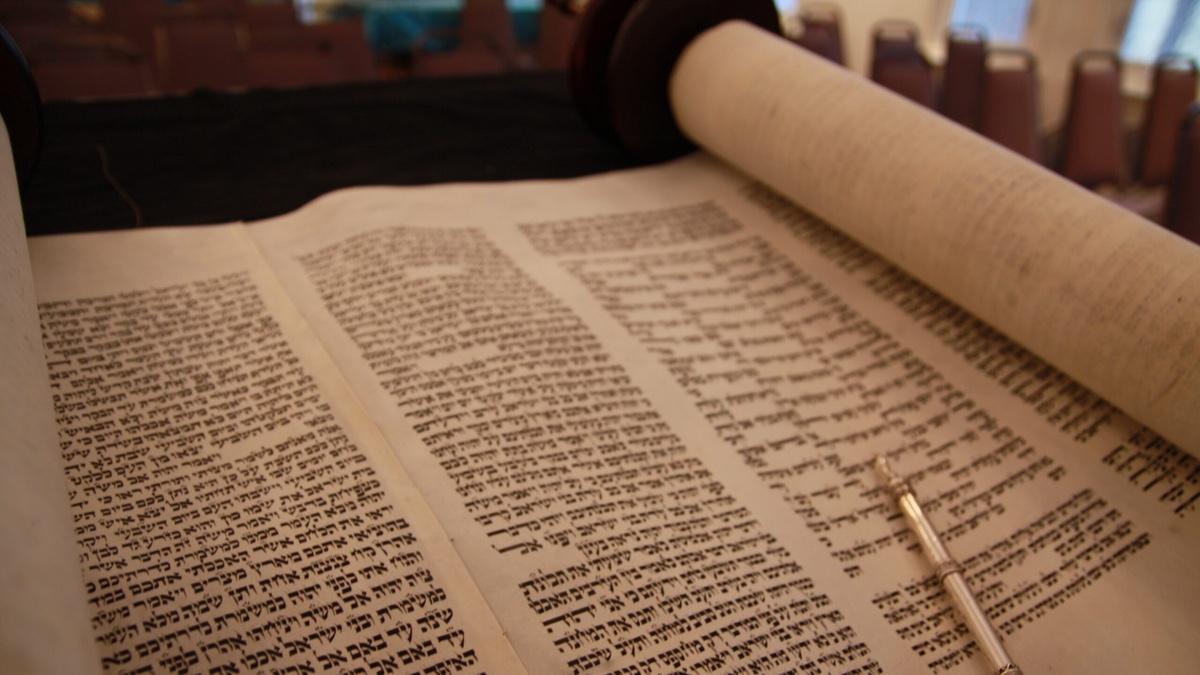
On the road to Emmaus, Yeshua met with two of His disciples and, beginning at Moses and all the Prophets, He expounded to them in all the Scriptures the things concerning Himself. (Luke 24:27). For our Torah studies this year, therefore, week by week we will seek to discover how all of Torah prepared the way for the coming Messiah.
10th January 2026 (21 Tevet)
Sh’mot (Names): Exodus 1:1-6:1
In our Torah portion this week, we begin to study one of the most significant events that have taken place in the history of the world. We can put it in the same context as the Creation of the world, the banishing of Adam and Eve from the Garden of Eden, the Flood at the time of Noah, and the Covenant given to Abraham. This is why the descendants of Jacob (the Children of Israel) are instructed to remember the deliverance of their people from Egypt each year at Pesach, looking back in order to have faith in the present and for the future.
To raise our study to this level is to lift it away from mere theological perspectives. How easy it is for us to read our Bibles, analyse the stories philosophically and bind our thoughts into books of theology, as if we have uncovered some of the mysteries about the God of Abraham, Isaac and Jacob as a sufficient purpose for Bible study. In doing this we so easily separate the deeds of God into sermons for our congregational meetings rather than live in the relevance of them for all people every day, whether we be a farmer, a carer, a monarch, a president, a cleaner, a politician, lawmaker, teacher, businessman, craftsman, entertainer, artist or a person pursuing anything else, great or small, in our everyday lives together. What happened in Egypt is as relevant today as it was at the time of Moses. While the world moves on to the next great thing in God’s covenant purposes, we must live in the light of that which has gone before, or we will misinterpret what is happening all around us today.
Why did Israel go down to Egypt and live there in increasingly difficult times for over 400 years? God made a great promise to Abraham (Genesis 15) that his descendants, uncountable as the stars in the heavens, would be given the Land of Canaan as their homeland, but they must be strangers in a land that was not theirs (verse 13) until evil in the nations inhabiting Canaan was at its height (verse 16) and therefore ripe for judgement.
This seems to be sufficient information to answer the question. Experience, however, also shows that God teaches us through contrasts. Israel was being prepared to forever compare life in the world of Egypt with life in the Kingdom of God.
Egypt was a prosperous nation where one could live in comfort, but this was not the permanent place for God’s covenant people. Also, Canaan until then, was a land where God’s people could have assimilated and lived in peace, but this too was contrary to God’s purposes. Both Egypt and Canaan were ruled by false gods.
In Egypt, God was preparing His own people to live apart from all other nations and their gods, in their own land. The process of bringing them out of Egypt demonstrated this, and the preparation for living in the Promised Land was that that they would always remember the experience of living under the rule of false gods. Despite hard labour under the Egyptians, the seductive pull to the possible comforts of life in Egypt was to be forever resisted. When the Israelites came out of Egypt they were never to return. They were to be a nation under the Hand of the God of Abraham, Isaac and Jacob and a light to all other nations.
Notice how God raised up Moses as a deliverer of his people. This was not announced nor was Moses like other leaders before him, except that God always chooses human beings to take His covenant plans forward. Even Moses did not understand God’s purpose for him, except that when he slew the Egyptian (Exodus 2:11-12) his concern for the burdens of his people was growing in him. It took many years in the Land of Midian before he was ready, but then he felt unable to do what God required (Exodus 4:10). Indeed, it seemed that he and his older brother Aaron, now appointed as his spokesman, faced an impossible task. Pharaoh rejected them on their first visit to him (Exodus 5:1-2) and the children of Israel despised them (Exodus 5:20-21). This has been a pattern with all of God’s prophets.
Remember that we are studying the outworking of God’s covenant purposes. It was so for Moses when he was reminded of the Covenant with Abraham (Exodus 6:1-4). We must always live in the light of His covenant purposes or we too will be so taken up with daily affairs that we are not ready for the time of the next stage of covenant completion. At the time of God’s taking the next step, there are often times of difficulty all around, with such pressure that we could be so intent on getting through each day that our eyes are more earthwards than heavenwards.
It was like this at the time of the coming of Yeshua. Israel was dominated by the Roman Empire which was under the rule of the Caesars who followed their own gods. The contrasts that were to be learned in Egypt had encroached on the Land of Israel in the form of another worldly empire. Life was hard labour again.
The context of the birth of Yeshua has parallels with the birth of Moses. For example, Pharaoh ordered the killing of innocent babies, and Herod ordered the killing of young children in Bethlehem when he heard from the Magi about the birth of Yeshua (Matthew 2:16). Another similarity is that Yeshua was taken to Egypt for safety (Matthew 2:13-15), so that He too would come out of Egypt.
Yeshua was to fully identify with his people, just as Moses had done before Him. He was to be a deliverer in different circumstances, but in continuation and completion of what was begun through Moses and the wilderness journey. For example, we read in one of the wonderful passages in John’s Gospel that Yeshua said of Himself:
I am the true vine, and My Father is the vinedresser. (John 15:1)
If we are awake to Yeshua speaking of Himself as God’s chosen deliverer, just as Moses did in his day, we would understand how Moses was a preparation for Yeshua. He was inferring that what we read in Psalm 80 must now be read as fulfilled in Him:
Restore us, O God of hosts;
Cause Your face to shine,
And we shall be saved!
You have brought a vine out of Egypt;
You have cast out the nations, and planted it.
You prepared room for it,
And caused it to take deep root,
And it filled the land. (Psalm 80:7-9)
Yeshua identified with His people and asked that they identify with Him. The vine out of Egypt was to be interpreted in Him.
It was said that Moses was the humblest man on earth. Likewise, Yeshua spoke out of love and humility in order that, through our response to His invitation to be grafted into Him the true vine, we might follow Him through the next stages of God’s Covenant purposes for His people. This began in His earthly ministry and His great sacrifice on the Roman Cross. We will find many parallels in Yeshua’s life as we travel in future weeks through the wilderness journey to the Promised Land. Moses led his people to the Promised Land; Yeshua leads us to the eternal Kingdom of Heaven.
Let us, therefore, remember the “big picture” of redemption. Since the Fall of Adam and Eve, there has been need of redemption from this world of sin to an eternal homeland where we are reunited with God. Moses was the great leader to take the covenant plan forward from Egypt to the Promised Land, where Israel would live as the people of God. But the Land of Israel is not the Garden of Eden and more is needed. Whilst God will not forget all His covenant promises to Israel, He will complete what He started when He gave Abraham the Covenant for all people who are called to live by the same faith as he had.
Yeshua presented Himself to His people as the deliverer to complete God’s purposes to fully restore us to the eternal Kingdom – the greater fulfilment of the journey to the Promised Land. He made it clear that this greater purpose was to be fulfilled in Him, when He said to Pilate:
“My kingdom is not of this world … now My kingdom is not from here.” (John 18:36)
Just as pressure increased on Pharaoh to let the Israelites go out of the land of Egypt and for them to believe that God appointed Moses as their deliverer, so pressures will mount again on this entire world as the time comes for the fulness of Yeshua’s Kingdom to be manifest for all who will follow Him.
This truth is not held sufficiently in books of theology. It is the truth that we are compelled to live by each day.
Israel, while in Egypt, were to live in the light of a promise given to Abraham. 400 years is a long time to wait for deliverance: though the promise was sure and true, but could sadly be forgotten over centuries of waiting. It is the same with Yeshua. We must wait in the light of God’s promises through Him, as we study them in the entire Bible. We must read the New Testament as founded on Torah and abide in the truth. Light does shine on that truth when we read and pray with an open heart. Abraham, through the Covenant, foresaw the physical Promised Land but also knew that there was a greater and higher meaning to the Covenant. The Writer to the Hebrews understood this clearly in the light of Yeshua. In the summary of the faith of those from Abel to Moses, in Chapter 11, it is said of Abraham:
By faith Abraham obeyed when he was called to go out to the place which he would receive as an inheritance. And he went out, not knowing where he was going. By faith he dwelt in the land of promise as in a foreign country, dwelling in tents with Isaac and Jacob, the heirs with him of the same promise; for he waited for the city which has foundations, whose builder and maker is God. (Verses 8-10)
Abraham was promised the Land of Canaan as the physical homeland for his descendants, but also knew that the Covenant with God would be fully complete in the eternal home, away from this world of sin. As we read our Torah portion this week, let us begin to dig deeply below the surface of what God did long ago, so that we find the fulness of understanding for our own day. Surely, we live in days as momentous as when Israel was in Egypt, with God’s promises still being fulfilled.