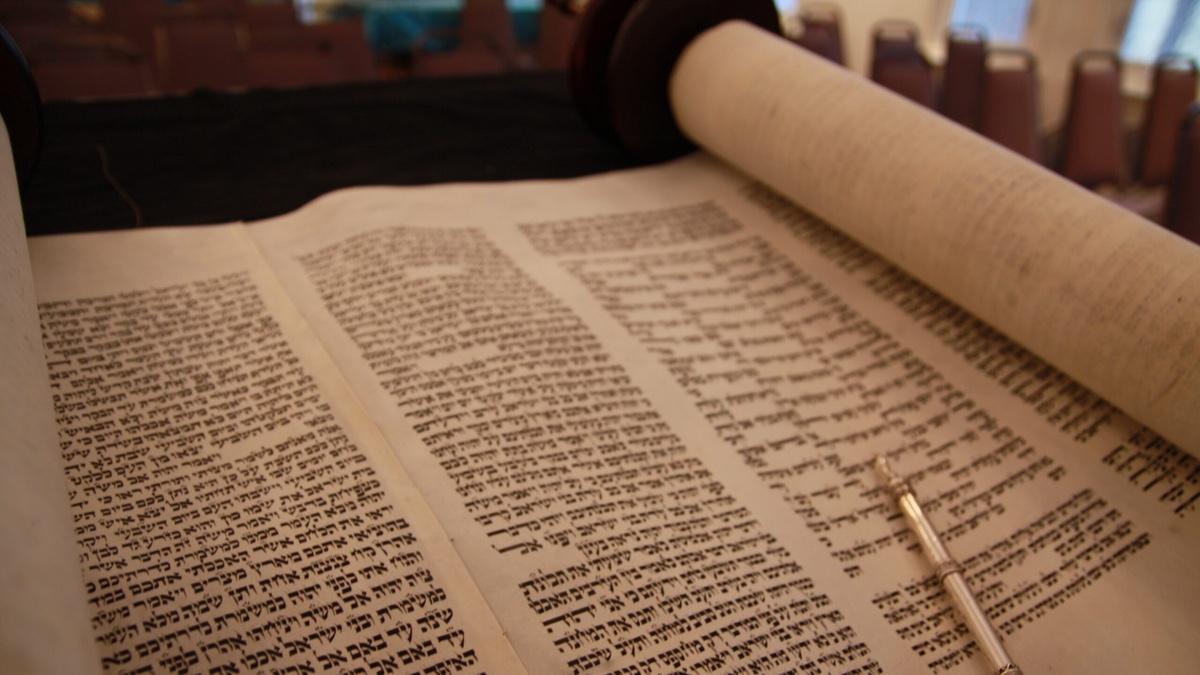
On the road to Emmaus, Yeshua met with two of His disciples and, beginning at Moses and all the Prophets, He expounded to them in all the Scriptures the things concerning Himself. (Luke 24:27). For our Torah studies this year, therefore, week by week we will seek to discover how all of Torah prepared the way for the coming Messiah.
13th December 2025 (23 Kislev)
Vayeshev (And settled): Genesis 37:1-40:23
Abraham is the father of all who live by faith in the One True God. He was the first Hebrew, ivri (עברי), one who “crossed over”, avar ( עָבַר) in the Hebrew language. The two Hebrew words are linked. He crossed over, physically, from the land of the Chaldeans, to Canaan, the land of promise. He crossed over, spiritually, from a life of self-reliance to dependency on God, which he was willing to learn on his life’s journey. His son Isaac, his grandson Jacob and Jacob’s family were called to the same life of faith. What does this life of faith involve? The Hebrew language is a great influence on the way life it is to be lived.
The Hebraic life is typified in the verb tenses of the Hebrew language. Rather than past, present and future, the Hebrew verb tenses are perceived as completed action, present action and uncompleted action. Life is seen as the ever present, the events of life coming to us and we going through them, typified by the phrase that occurs many times in the Bible, “and it came to pass”. This is quite different from the modern-day concept of time, and planning more for tomorrow than living today in all its fulness. The Hebraic way of life is to live in each moment of each day, neither dwelling overmuch on the past nor overplanning the future. To be mature in this is to live the life of faith, as God taught us through Abraham, making the best of every opportunity, concentrating on and enjoying the present task and responsibility, sharing each moment with others and trusting God for the rest. It is a life that has found rest in God. It is discovered naturally rather than by scientific method.
Yeshua confirmed this as the way to live, when He taught:
Therefore do not worry, saying, ‘What shall we eat?’ or ‘What shall we drink?’ or ‘What shall we wear?’ for after all these things the Gentiles seek. For your heavenly Father knows that you need all these things. But seek first the kingdom of God and His righteousness, and all these things shall be added to you. Therefore do not worry about tomorrow, for tomorrow will worry about its own things. Sufficient for the day is its own trouble. (Matthew 6:31-34)
The Hebraic principle of living day by day was also included in the simple phrase, give us today our daily bread, a part of The Lord’s Prayer, that we are encouraged to pray in full (Matthew 6:5-15).
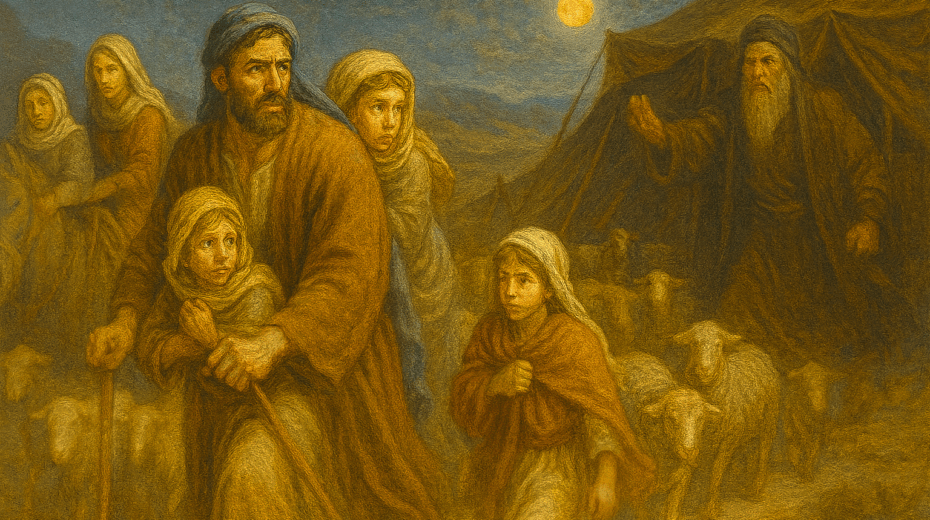
Our Bible studies give us clear descriptions of the lives of the patriarchs of the covenant family. They do not omit the errors made on the journey of life, whilst living day by day as a Hebrew. When Jacob lived with Laban in Padan Aram, his main focus was on building his family and raising his flocks. Like Abraham and Isaac before him, he lived in the light of each day, attending to the tasks in hand. Of itself, this is the right Hebraic way to live. His encounters with God made him ever conscious of His presence in his life and that he had been chosen for the next step in God’s covenant purposes, as promised to Abraham. Yet, his life was far from perfect.
This week, the focus moves more to the lives of Jacob’s sons, each called in a particular way to take forward the covenant purposes of God. They too are Hebrews, living day by day through the activities before them – in many ways, the lives of “ordinary people”. They attend to the needs of their flocks, eat and drink, take their rest, eventually marry and raise their own family. But in the ordinariness of their lives, their call as heirs of the covenant was not held so firmly as to avoid the errors that they made. There was division among Jacob’s sons: Joseph, being so greatly favoured that jealousy arose. This jealously nearly led to murder. It did lead to Joseph being sold to slavery and to a terrible lie and great grief when Jacob was presented with the special cloak that he had made for Joseph, now stained with blood.
Then we have the account of Judah. If Judah could have known how important the multitude of his descendants, the Jews, would be in the covenant purposes of God, would he not have learned self-control and not allowed himself to lie with a harlot, who in fact turned out to be his own daughter-in-law? The consequence was the birth of the twins, Perez and Zerah, through the sin of incest.
Because of his dreams, Joseph had a greater sense of God’s purpose in his life and was able to walk with integrity in the years he spent in Egypt. During the years when Judah fell to temptation, Joseph resisted the temptation and seduction of Potiphar’s wife. Both paths are possible: to live Hebraically and either drift from God’s purposes, or to stay close to Him.
There is one question that we cannot ask, though we would like to: “What if?” There would not be a need for God’s covenant if humankind were capable of a totally sinless life. We live with the paradox of what ought to be the pure walk with God, especially of those called into covenant responsibility, and the degrees by which all have fallen. This is especially so when we consider the lives of the Patriarchs of the faith, observed through the contrasts before us in this week’s Bible study.
It is as the Apostle Paul described it when personalising this struggle to himself:
For we know that the law is spiritual, but I am carnal, sold under sin. For what I am doing, I do not understand. For what I will to do, that I do not practice; but what I hate, that I do. If, then, I do what I will not to do, I agree with the law that it is good. But now, it is no longer I who do it, but sin that dwells in me. For I know that in me (that is, in my flesh) nothing good dwells; for to will is present with me, but how to perform what is good I do not find. For the good that I will to do, I do not do; but the evil I will not to do, that I practice. Now if I do what I will not to do, it is no longer I who do it, but sin that dwells in me. (Romans 7:14-20)
We have yet to come, in our weekly readings, to the laws of God given through Moses at Mount Sinai, but there was, nevertheless, a basic knowledge of right and wrong that Jacob and his sons lived by, and the presence of God calling them to walk with Him. Hence Judah could be convicted of his sin with Tamar (Genesis 38:26), Joseph knew it would have been wrong to lie with Potiphar’s wife (Genesis 39:9) and the sons of Jacob knew that they had done wrong in selling their brother to slavery after almost murdering him (Genesis 37).
They had a very special call, which goes beyond the need to live by law. They were called to walk with God day by day, just as Abraham and before him, Enoch, had done. The Hebraic life is not only to live within the tasks of today, it is also to bind oneself to God in the life of faith. One can be attentive to one’s daily tasks but drift away from God. As we consider Jacob and his sons, therefore, we discover a Hebraic life but also the human errors of the imperfect life of faith.
The greatness of God’s covenant lies in His mercy. How, in all His majesty and perfection, He was willing to walk with sinful men – even the fallible patriarchs of the covenant – to fulfil His promises of redemption, is awesome to contemplate. He does not delight in sin, but abhors it, yet He can allow the “what ifs” of human failure, even foreseeing them, and still chart a course, painful though it is, to the ultimate purpose of His Covenant.
This greatness is shown in how magnificently He came to earth to abide in a man, the promised Messiah. The expectation of the character of the Messiah was, for many generations, likened by the people of Israel to Joseph, who was taken down to Egypt as a saviour for his family when famine beset the land. There are many aspects of Joseph’s life in what we will read over these weeks that echo the life of Yeshua HaMashaich. Yet He alone was able, through His perfect life, to redeem us all from our sins.
Let us, therefore, consider this week the amazing way the Messiah identified Himself with His people, eventually taking onto Himself the sins that had so spoiled their covenant walk. When Yeshua was baptised in the Jordan at the beginning of His public ministry (Matthew 3:13-17) this was the first sign of identification. He submitted Himself fully to the will of His Father and immersed Himself in the waters where repentant sinners expressed desire to have their sins removed.
There also is something quite special in the line of His birth.
Judah, despite all the faults that the Bible recounts to us, was specially chosen to be the leader of the Jewish tribe that would remain in the Land of Israel up until the time of the coming of Yeshua. His was the kingly line and from his descendants one would inherit the title, King of the Jews. Matthew gives us the complete genealogy from Abraham to Yeshua (Matthew 1).
It begins:
The book of the genealogy of Jesus Christ (Yeshua HaMashiach), the Son of David, the Son of Abraham: Abraham begot Isaac, Isaac begot Jacob, and Jacob begot Judah and his brothers. Judah begot Perez and Zerah by Tamar, Perez begot Hezron, and Hezron begot Ram….
It concludes:
….Eliud begot Eleazar, Eleazar begot Matthan, and Matthan begot Jacob. And Jacob begot Joseph the husband of Mary, of whom was born Jesus (Yeshua) who is called Christ (Mashiach).
Matthew lists 42 generations from Abraham to Yeshua (Jesus). Right at the beginning is a reminder that Yeshua came from Judah, through the line of Perez, the son of Tamar, with whom Judah had an incestual relationship. Yeshua unashamedly identified fully with the line of descent which, for this reason and others, was full of sinfulness. He is the King of the Jews and He came to complete the Covenant that was promised to Abraham, the first of His genealogy.
Abraham learned to walk by faith on his Hebraic journey with God. All who by faith enter this same family, either by direct descent or adoption, are invited to walk in this same Hebraic way. Like Jacob and his sons, whose lives we consider in hindsight, we live with the potential errors that can lead to our own regrets and “what ifs” but if we are willing, we can learn to minimise them, studying the lives of those who went before us, helped by the Holy Spirit, waiting for the return of the King.
Ours too is a walk. Paul put it this way:
I say then: Walk in the Spirit, and you shall not fulfil the lust of the flesh. For the flesh lusts against the Spirit, and the Spirit against the flesh; and these are contrary to one another, so that you do not do the things that you wish. But if you are led by the Spirit, you are not under the law. (Galatians 5:16-18)
Reminding us of the time of Noah’s flood and the continued potential of us all to walk as we ought, or to deviate into sin, Yeshua warned of the time before His coming:
But as the days of Noah were, so also will the coming of the Son of Man be. For as in the days before the flood, they were eating and drinking, marrying and giving in marriage, until the day that Noah entered the ark, and did not know until the flood came and took them all away, so also will the coming of the Son of Man be …. Watch therefore, for you do not know what hour your Lord is coming. But know this, that if the master of the house had known what hour the thief would come, he would have watched and not allowed his house to be broken into. Therefore you also be ready, for the Son of Man is coming at an hour you do not expect.(Matthew 24:37-44)
With our Bible studies to help us, with the anticipation of Hebraically living the life of faith day by day, in these challenging times, these words of Yeshua could not be more important.