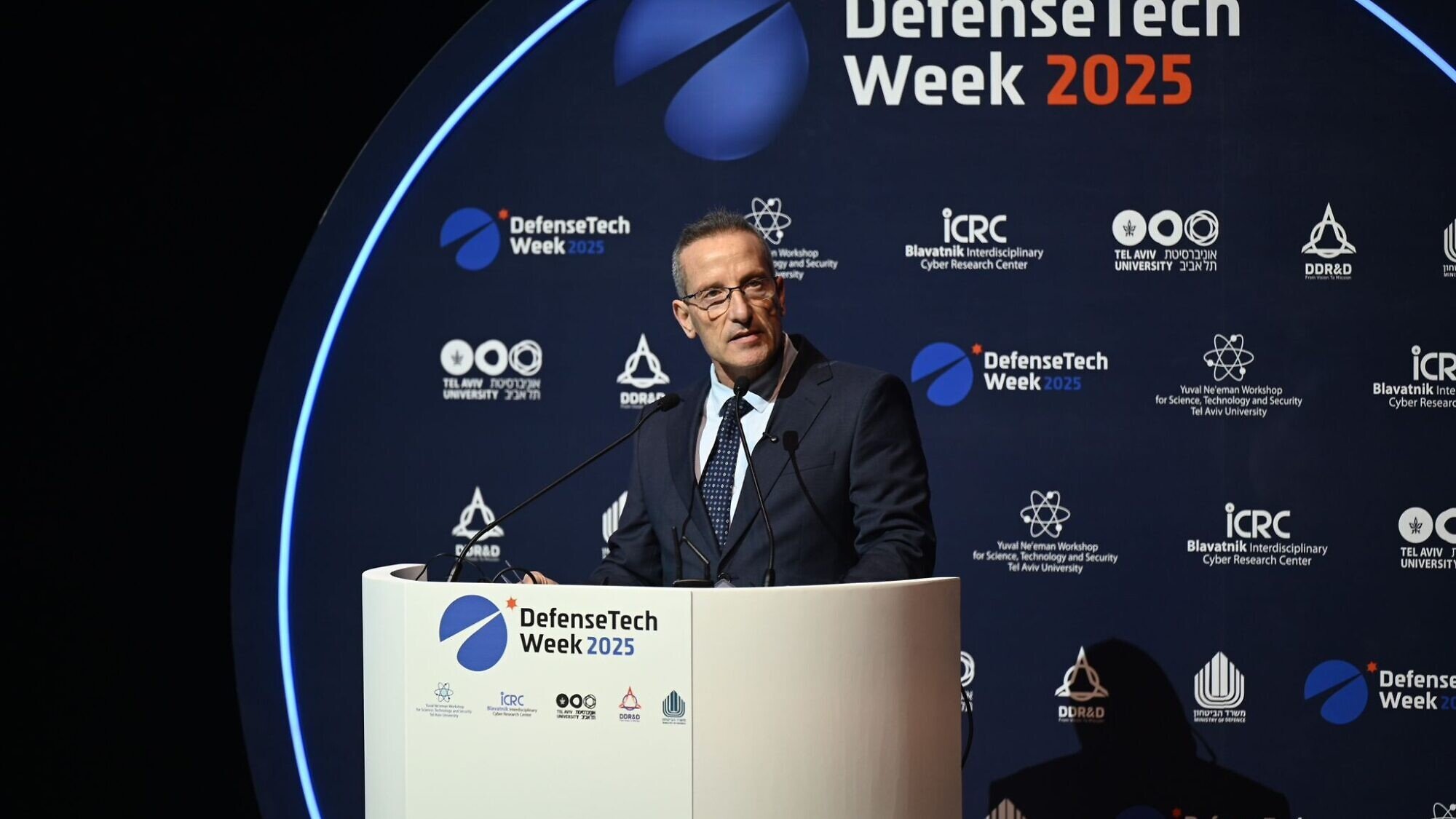
(JNS) Senior defense officials, tech investors, and military commanders from across the globe gathered in Tel Aviv for DefenseTech Week 2025 on Monday and Tuesday, a conference that showcases cutting-edge advances in Israeli defense technologies that shape the future of global security.
The summit is a deep dive into technologies that have been battle-tested in Israel’s ongoing multi-front conflicts against jihadist adversaries.
The event has been organized by the Defense Ministry’s Directorate of Defense Research and Development in collaboration with the Blavatnik Interdisciplinary Cyber Research Center and the Yuval Ne’eman Workshop for Science, Technology and Security at Tel Aviv University.
Col. Yishai Kohn, head of the Planning, Economics and IT Department at the DDR&D, told JNS on Sunday that the conference has grown significantly compared to last year, reflecting a clear growth of interest among international partners coming to learn from the Israeli experience.
Alongside cooperation with Israel’s large defense companies, the conference will also raise awareness about the startup ecosystem “that played a significant role in the recent war—in drones, counter-UAVs, AI, and logistics,” Kohn said. “The Iron Dome, the Arrow and Trophy are the really famous systems in the world that almost every country considers purchasing, but we want to raise awareness that it is not just the big systems. It is also the issue of incubation and start-ups.”
Kohn noted that the war has accelerated the integration of “dual-use” technologies—innovations that can be sold to the civilian market and are rapidly adapted for military needs. He said that more than 100 startups have had their products integrated into Israeli combat operations over the past two years, bringing agility, speed and lower costs.
Kohn offered vivid examples of this synergy, such as a startup that developed an automated tourniquet that stops or slows bleeding.
“This is something that the wounded person themselves or someone next to them can apply without prior medical training,” he said. “They can place it on their arm and adjust it, and then there is no need for a doctor or a medic to reach them specifically. This is completely in the world of dual-use; it is not just defense tech. It is a product of a startup that was integrated into the fighting and contributed to the war.”
Another innovation involves logistics and the aerial supply of medical necessities. Kohn described the “logistics of parachuting blood units beyond the front lines, using a drone,” as a prime example of how non-traditional defense companies are contributing directly to saving lives.
A major headline expected to emerge from the conference is the emergence of Artificial Intelligence (AI) within the Israeli defense establishment. Historically, the Defense Ministry operated three major directorates: Missile Defense, Space and UAVs.
Kohn revealed that a fourth has now been officially established: The Directorate for AI and Autonomy.
“The fact that the fourth directorate that was established is the AI and Autonomy Directorate indicates the importance that the defense establishment attributes to this field; it’s way up there, together with the most central fields,” he said.
Kohn said that until now, AI had been used primarily in drones and visual intelligence—fields that already had mature products—but that a major leap was now expected across all areas, including decision-making processes in future warfare.
The summit comes at a time when Israel is facing intense diplomatic pressure and delegitimization campaigns. Yet, paradoxically, the demand for Israeli defense technology has never been higher. Kohn attributes this to the “Battle Lab” effect.
“There were years when we were alone in the world as a combat lab. Today, there is competition, there are wars in all sorts of other places in the world, and there are other combat labs in the world. But still, there are things where the world looks to us and sees for the first time what is happening here,” he stated.
The summit will also aim to encourage large international defense firms to set up research and development sites in Israel, much like large civilian tech firms have done.
Among those attending the conference is Emil Michael, head of the Pentagon’s Defense Innovation Unit, who will deliver a speech, and other government representatives from around the world.
DefenseTech 2025 also has a domestic message aimed at IDF reservists. Thousands of Israeli tech professionals have spent months on the front lines in Gaza and Lebanon and are returning with firsthand knowledge of the operational gaps, said Kohn.
“We want to reach any reservist who returned from the battlefield with an idea for how to improve, so to make it accessible to and encourage them to engage in the field and to turn to us, as part of the contribution to national defense,” said Kohn.
In an opening address to the conference on Monday, Defense Ministry Director General Maj. Gen. (Res.) Amir Baram said Israel has transformed from a global “Cyber Nation” into a full-scale “Defense-Tech Nation,” as wartime innovation rapidly reshapes its security and industrial landscape.
He said the country’s technological edge now spans aerial defense systems, unmanned vehicles, electronic warfare, quantum-resistant communications, cyber defense and space technologies.
“All fronts remain open and our enemies are constantly learning and preparing,” Baram warned, saying Israel is already developing next-generation technologies for potential future confrontations with Iran in both defensive and offensive domains.
He added that Israel’s operational reality has created a uniquely fast feedback loop between the battlefield, engineers and industry—producing combat-proven systems now protecting lives worldwide.
The conference comes days after the Defense Ministry outlined its strategic priorities for defense exports. On Nov. 26, Baram emphasized that expanding defense exports is a critical national interest.
“While the prolonged multi-front war has yielded many significant successes, it has depleted resources, capabilities, and reserves,” he said. “Therefore, we must dramatically increase Israel’s defense exports as a central mechanism to strengthen the IDF with new systems, as a tool for international policy influence, and to fortify both our defense industry and economy.”
In June this year, the Defense Ministry announced that Israel’s all-time defense export record has been broken for the fourth consecutive year, with over $14.7 billion in 2024—a 13% increase over the previous year. “Over 50% of the deals were with European countries. Defense exports have more than doubled over the past five years,” said the statement.
In 2024 alone, Israel signed 21 government-to-government defense agreements worth billions of dollars and invested 1.2 billion shekels in defense startups. More than 300 startups work with the Defense Research and Development Directorate, with more than 100 joining active wartime operations during the current conflict.
Tel Aviv now ranks as the world’s third-largest defense-tech hub, while Israeli defense companies have secured major contracts across Europe, Asia and North America.
Want more news from Israel?
Click Here to sign up for our FREE daily email updates