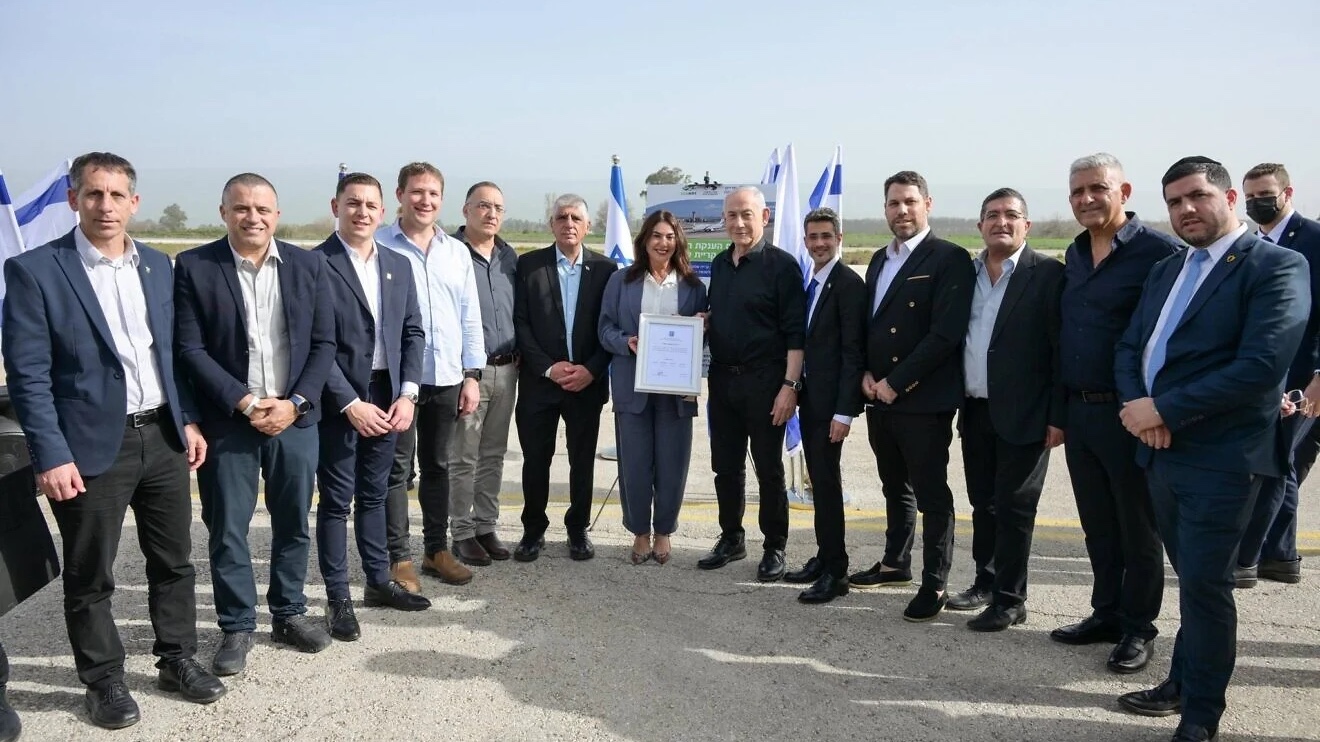
(JNS) Israeli Prime Minister Benjamin Netanyahu on Sunday unveiled a government plan that would direct billions of shekels to three Israeli locales near the border with Lebanon—Kiryat Shmona, Shlomi and Metula.
“We are bringing an immediate plan for the rehabilitation, development and growth” of the three areas in the Upper Galilee, Netanyahu said during a speech at the weekly Cabinet meeting. It was held in Kiryat Shmona to signal the government’s commitment to the issue.
The new plan will mean “grants for businesses and residents, more resources for housing, industry, medicine, transportation and academic institutions—and that’s only during the first phase,” said Netanyahu.
Roughly a third of Kiryat Shmona’s pre-war population of approximately 26,000 people have not returned since being evacuated in 2023, according to the municipality. Israel evacuated more than 60,000 civilians from the border area in October 2023, when Hezbollah began targeting it in solidarity with Hamas. In September 2024, Israel killed Hezbollah leader Hassan Nasrallah, among other commanders, and eliminated many of its capabilities.
Hezbollah agreed in November 2024 to a ceasefire under the terms of which it may not maintain a presence south of the Litani River, formalizing what was widely seen as one of the Shi’ite terror group’s worst defeats. Israel has been enforcing the ceasefire with dozens of strikes in Lebanon, according to the Israeli military targeting attempts to reestablish Hezbollah’s infrastructure.
However, thousands of evacuees have not returned to Israel’s far north, which is strategically important yet remote and less affluent than more central areas. Some of those who left cited security issues as their main reason for staying away, but others noted that living more centrally improved their quality of living.
Commenting on the security situation, Netanyahu said: “The government is committed not only to developing the north, but also to ensuring the residents’ security. There is no containment [of the enemy]. We act against every threat in real time and continuously, and we will keep doing this.”
One of the plan’s pillars is the decision, implemented last month, to turn the Tel Hai College near Kiryat Shmona into the University of Kiryat Shmona in the Galilee. The upgrade entails a $181 million government grant and inclusion of the Municipality of Kiryat Shmona as an address for some of the university’s facilities. Tel Hai College was located on the grounds of the Upper Galilee Regional Council.
“I think the university will be a very important anchor here,” Netanyahu said at the Cabinet meeting. “I am confident that this will be an excellent university, and please invest all the resources so that it develops and grows even faster,” he told Israeli Education Minister Yoav Kisch.
Netanyahu’s office sent out a joint statement about the plan to rehabilitate the north along with Israeli Finance Minister Bezalel Smotrich and Yitzhak Wasserlauf, Israel’s Minister for the Development of the Periphery, the Negev, and the Galilee. The university includes a hospital that would improve services for Kiryat Shmona and its residents.
Netanyahu also addressed transportation, an issue whose improvement may facilitate the northern communities’ access to the industrial centers of Haifa and Tel Aviv, situated 45 miles and 86 miles, respectively, from Kiryat Shmona.
During the Cabinet meeting, Netanyahu and Israeli Transportation Minister Miri Regev announced the reopening of Kiryat Shmona Airport, which had been out of commission during the war. According to the plan announced on Sunday, the government will “look into running subsidized flights” from Kiryat Shmona to the center. Commercial flights between Tel Aviv and Kiryat Shmona were discontinued in 2006.
Netanyahu noted plans, which Regev had announced last year, to connect Kiryat Shmona to the national rail grid and build a track between it and Karmiel in the center of the Galilee. The project involves an expenditure of billions of shekels and six to eight years of construction, which has not yet started.
“We are going to bring air transportation, rail transportation and highway transportation here. And people will be able to be in Tel Aviv by train in less than an hour,” said Netanyahu. “We are going to invest billions here in the development of the north. All the communities represented here by the heads of the communities, we are going to make a huge revolution here.”
The Israeli government offers residents of border-adjacent communities far-reaching tax breaks and benefits.
The transportation element of the plan “will connect Kiryat Shmona, including by train. It will change everything,” said Netanyahu. “My vision is not for the residents to merely return. The majority have returned. Others should return, and can return if they want.
“We are bringing new residents. We will bring young couples. We will open a university here. We will open high-tech factories here. We will achieve great things here. People will come to this beautiful place and to the Galilee in general. And that is what will happen. I am speaking on the record, and you can check me. That is what will happen. The population will grow, the possibilities here will increase,” he added.
Kiryat Shmona and Shlomi are bastions for Netanyahu’s Likud party, which received 49% and 43% of the vote, respectively, in the two cities in the 2022 elections.
The Upper Galilee region has both strategic and symbolic importance. The 1920 Battle of Tel Hai, where a handful of Jewish defenders, under the command of Zionist leader Joseph Trumpeldor, fought bravely against a Shi’ite militia, was one of the first major military clashes of modern Zionism.
The fighting in Tel Hai, which ended in that territory’s temporary loss to the militias and the death of Trumpeldor and seven others, is seen by many as iconic, attesting to the determination of the founding Zionists and their followers’ ability to turn defeats into successes and territorial gains.
Want more news from Israel?
Click Here to sign up for our FREE daily email updates