
The Trump administration moved Wednesday to frame the new two-week ceasefire with Iran not as a compromise, but as the product of overwhelming American and Israeli military pressure.
Speaking at the Pentagon, US Defense Secretary Pete Hegseth declared that the United States had secured a “decisive military victory” to conclude Operation Epic Fury, saying that in less than 40 days, US Central Command had dismantled one of the world’s largest militaries while using less than 10% of America’s total combat power.
According to Hegseth, Iran entered the ceasefire because it had no real alternative. He said Tehran had “begged for this ceasefire,” arguing that the regime accepted Washington’s terms only after sustained battlefield losses and under the threat of far more devastating strikes to come. He said President Donald Trump had the ability to “cripple Iran’s entire economy in minutes,” but chose instead to halt short of that outcome and pursue diplomacy.
That argument was echoed at the White House, where Press Secretary Karoline Leavitt described the military campaign as having created “maximum leverage” for a diplomatic solution and “long-term peace.” In her telling, the ceasefire is not the end of the operation but the political opening created by it.
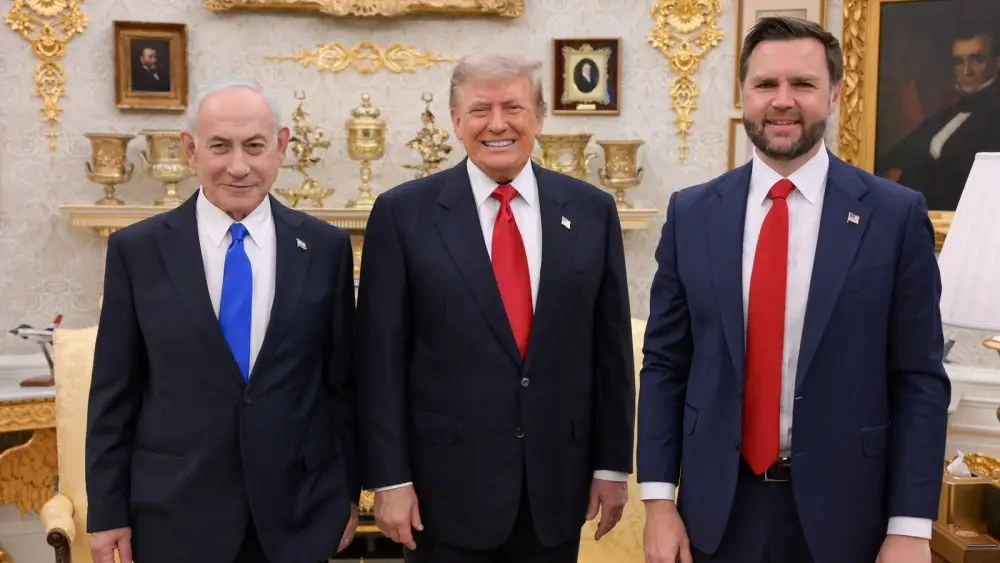
Vice President JD Vance struck a similar note, warning that while Trump had instructed negotiators to engage Iran in good faith, Tehran should not mistake the pause for American hesitation. If Iran lies, cheats, or undermines what he called the “fragile truce,” Vance said, it “won’t be happy” with the consequences. He stressed that Washington still retains military, diplomatic and economic leverage, and suggested any durable agreement will depend largely on whether Iran chooses to negotiate seriously.
“The president United States is not one to mess around”
Speaking in Budapest, Vice President JD Vance speaks on Iran-U.S. negotiations. He adds, “I think if they [Iran] negotiate in good faith, we will be able to find a deal”https://t.co/PAiZ4D1jU3
📺 Sky 501 pic.twitter.com/FowtgnveEs
— Sky News (@SkyNews) April 8, 2026
Trump himself used the ceasefire to signal both confidence and threat. In public statements, he said Iran would not be allowed to retain enriched uranium and claimed that the reportedly 440.9 kilograms of uranium in question had remained under satellite surveillance since the June strike known as Operation Midnight Hammer. He said the United States and Iran would “dig up and remove” all of the deeply buried nuclear residue, while also indicating that sanctions relief and tariff arrangements could form part of a broader agreement.
The administration’s message was clear: the military campaign achieved its core aims, and diplomacy will now test whether those gains can be converted into a lasting settlement.
This is a victory for the United States that President Trump and our incredible military made happen.
From the very beginning of Operation Epic Fury, President Trump estimated this would be a 4-6 week operation.
Thanks to the unbelievable capabilities of our warriors, we have…
— Karoline Leavitt (@PressSec) April 8, 2026
At the Pentagon, Hegseth and Joint Chiefs Chairman Gen. Dan Caine laid out those stated military achievements in sweeping terms. Caine said that over 38 days of major combat operations, the Joint Force met the president’s objectives by destroying Iran’s ballistic missile and drone capabilities, its navy, and key elements of its defense industrial base. Hegseth went even further, saying Iran’s navy is “at the bottom of the sea,” its air force has been “wiped out,” its air defense system is no longer comprehensive, and its missile program is “functionally destroyed.”
He added that while Iran may still have some missiles left in underground bunkers, its ability to manufacture new missiles and drones has been shattered because its factories were “razed to the ground.” If the regime had rejected the ceasefire, he said, the next targets would have included power plants, bridges, and oil and energy infrastructure—strikes that would have imposed damage lasting decades.
It’s not over till it’s over
Yet even as US officials celebrated the campaign, they went out of their way to say the war footing remains intact. Hegseth said US forces are “not going anywhere” and remain ready to resume offensive action at a moment’s notice if Iran violates the ceasefire or refuses to make a deal. Caine delivered the same warning in more measured terms, saying that the Joint Force welcomes the ceasefire but that a ceasefire is only a pause.
A major element of the agreement, according to multiple administration statements, is the reopening of the Strait of Hormuz. Trump said Tuesday night that he agreed to suspend bombing for two weeks if Iran accepted the “complete, immediate and safe opening” of the waterway. Leavitt later said Trump had succeeded in getting Hormuz reopened, while Hegseth argued that Iran no longer has the same capacity to threaten or defend the strait as it did before the war. He also said the burden should no longer fall solely on the United States, calling on the rest of the world to step up to ensure the waterway stays open.
Still, even this point appeared far from settled. After Israel launched its largest coordinated strikes yet against Hezbollah targets in Lebanon on Wednesday, an IRGC-linked Iranian outlet claimed oil tanker traffic through Hormuz had been halted as a result of the attacks. The report underscored the fragility of the arrangement and the degree to which multiple fronts remain connected, even if Washington is trying to compartmentalize them.
🚨 JUST IN: Oil tankers have been STOPPED from going through the Strait of Hormuz, Iranian news claims — because of “Israel’s ceasefire breach”
Hopefully it resumes PROMPTLY.
Iran knows what’s coming if they screw peace talks. The first 24 hours of the ceasefire are critical! pic.twitter.com/8AvjDRe6mx
— Eric Daugherty (@EricLDaugh) April 8, 2026
The effort to separate fronts was visible in Trump’s own comments on Lebanon. According to PBS correspondent Liz Landers, the president said Hezbollah is not part of the Iran ceasefire deal and that ongoing Israeli airstrikes against the Iranian-backed group do not violate the truce. He reportedly described Lebanon as “a separate skirmish,” a position repeated later in the day by Leavitt during a White House press briefing.
White House Press Secretary Karoline Leavitt:
Lebanon is not part of the ceasefire; that has been relayed to all parties involved in the ceasefire. pic.twitter.com/gfKYusnsGc
— Tabz (@TabzLIVE) April 8, 2026
Israel sharply escalated operations in Lebanon on the same day the ceasefire narrative solidified in Washington. The Israeli Air Force reportedly struck around 100 Hezbollah targets across Beirut, the Beqaa Valley and Southern Lebanon within 10 minutes, targeting headquarters, infrastructure and command-and-control sites. Israeli Defense Minister Israel Katz said hundreds of Hezbollah operatives were hit.
As long as Hezbollah continues to threaten our civilians, we will continue to operate against them. pic.twitter.com/TD5VOGLcNO
— Israel Defense Forces (@IDF) April 8, 2026
From Tehran’s side, the ceasefire has been presented not as a defeat, but as a vindication purchased through sacrifice. Iranian President Masoud Pezeshkian said the truce was the “fruit of the blood” of Ayatollah Ali Khamenei and all those who stood with the regime. He claimed the agreement met Iran’s “general principles” and cast national mobilization as proof of the regime’s endurance. In another statement, he said more than 14 million Iranians had registered to sacrifice their lives in defense of the country, amid reports that civilians had been used as human shields around critical infrastructure threatened by US strikes.
Meanwhile, Pakistani Prime Minister Shehbaz Sharif stated that peace negotiations are expected later this week in Islamabad and said Pezeshkian had reaffirmed Iran’s participation.
The basic shape of the next phase is now visible. Washington says the war achieved more than enough militarily and has produced the leverage needed for a deal. Iran is trying to present survival as strength. And Israel is continuing to prosecute Hezbollah in Lebanon.
For now, the Trump administration is selling the truce as the product of force rather than restraint. The coming talks in Islamabad will show whether that force produced a real strategic opening—or merely a brief pause before the next round.
Want more news from Israel?
Click Here to sign up for our FREE daily email updates