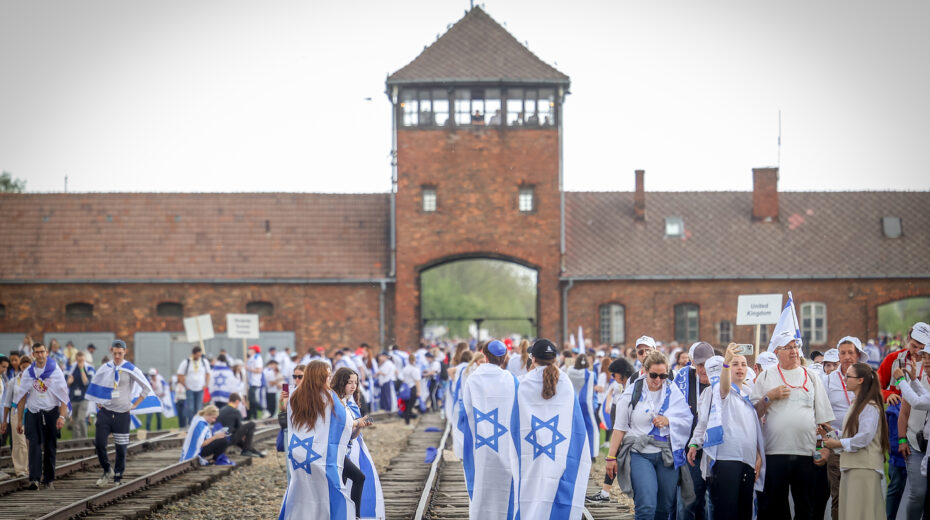
(JNS) Scores of elderly Holocaust survivors from around the world, including a dozen from war-ravaged Israel, are in Poland this week for the annual March of the Living Holocaust memorial event, even as the war against Iran forced the cancellation of the official Israeli delegation.
The annual event, expected to draw some 7,000 participants in one of the world’s largest Holocaust Remembrance Day commemorations, takes place on Tuesday amid a surge in global antisemitism following the Oct. 7, 2023, Hamas-led attack on southern Israel.
‘I’m saying the world has not learned anything’
The delegation of Holocaust survivors from Israel, aged 90–100, was brought to Poland at the eleventh hour on a hastily arranged charter flight from Tel Aviv following last week’s ceasefire. They said the regional turmoil caused by the war and the global rise in antisemitism had only strengthened their determination to take part in the symbolic march between the Auschwitz and Birkenau extermination camps, where about 1 million Jews were murdered in the Holocaust.
“More than ever before, and with an eye to what is going on today, I feel it is important that we remember and learn what happened so that it will not happen again,” said 92-year-old Holocaust survivor Baruch Ravid, a Slovak-born resident of the central Israeli city of Rehovot whose father, grandfather and extended family perished in the Holocaust.
“I have a double disappointment as a Holocaust survivor,” Berlin-born survivor Uri Themal, 85, who spent most of his life in Australia before retiring in Israel, told JNS. “I’m saying that the world has not learned anything, while Australia’s policy of multiculturalism has failed.”
‘The warning signs we study are unfolding again in real time’
This year’s event, held under the theme of combating antisemitism, will be led by Sylvan Adams, president of the World Jewish Congress Israel, alongside survivors of antisemitic terror attacks last year: Eva Wietzen, who survived the Hanukkah attack at Bondi Beach in Sydney, Australia, in which 15 people were murdered, including her husband Tibor Wietzen; Yoni Finley, who was injured in a Yom Kippur shooting at a synagogue in Manchester, United Kingdom; and Catherine Szkop and Abbie Talmoud, staff members at the Embassy of Israel in Washington, DC, who survived the attack near a Jewish museum in which their colleagues Sarah Milgrim and Yaron Lischinsky were murdered.
A delegation of 130 law enforcement officials, intelligence personnel and police chiefs from dozens of countries is also participating, speaking out against the rising tide of global antisemitism and pledging enhanced protection in their jurisdictions.
“We are not here simply to remember history; we are here because the warning signs we study are unfolding again in real time,” Paul Goldenberg, chair of the International Police Delegation and deputy director of Rutgers University’s Center on Policing and Community Resilience, told JNS. “The rise in antisemitism and targeted violence against Jewish communities is not theoretical. It is happening now across democratic societies.”
“During these difficult times, as the State of Israel stands firm against those seeking its destruction while waves of antisemitism intensify worldwide, the March of the Living takes on even greater significance,” said Phyllis Greenberg Heideman, president of the International March of the Living, which is marking its 38th year.
“Despite the limitations imposed by the recent war with Iran, a limited delegation of Holocaust survivors from Israel, together with dozens of survivors from around the world who experienced firsthand the attempt to annihilate the Jewish people, will march in Poland—instilling, now more than ever, a spirit of pride and resilience for the State of Israel and the entire Jewish people,” she added.
Focus on survivors
As the number of survivors continues to diminish each year, the aging participants—some using walkers or wheelchairs and accompanied by family members—stood out among the visitors as they passed the torch of memory to future generations.
An estimated 200,000 Holocaust survivors remain alive today, more than half of whom live in Israel, with a median age of 87.
The story of 93-year-old survivor Hannah Yakin about her non-Jewish father, Jan van Hulst—recognized as Righteous Among the Nations by the Yad Vashem Holocaust Memorial in Jerusalem for saving Jews in the Netherlands by forging documents—resonated with British-Israeli journalist Josh Aronson, who discovered before the event that his grandfather had been saved by Yakin’s father.
For one agile centenarian, the trip marked her first visit to the death camps.
Dorit Carmeli, a 100-year-old Budapest-born resident of the northern Israeli port city of Haifa, whose family was saved after hiding in a home arranged by Swedish diplomat Raoul Wallenberg, traveled to Poland for the first time to connect with fellow survivors and reflect on her past.
“I wanted to hear their stories,” she said.
Want more news from Israel?
Click Here to sign up for our FREE daily email updates