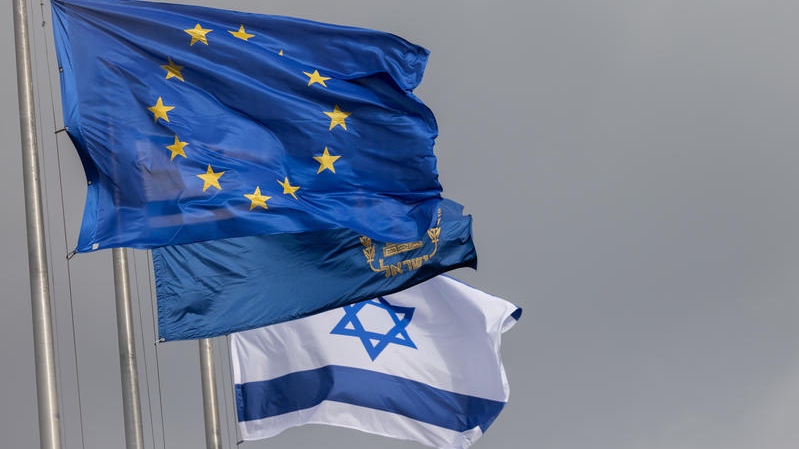
(JNS) A survey of European lawmakers published on Jan. 19 by the European Leadership Network (ELNET) shows a large majority of European parliament members view their countries’ relations with Israel as good and favor greater cooperation.
The survey of 1,061 MPs from 35 countries combines the results of “four waves” of surveys between 2022 and 2025.
Seventy percent of European MPs across all survey waves perceive their countries’ relations with Israel as very good or rather good, reported ELNET, an NGO dedicated to strengthening Europe-Israel relations.
In 2025, a 68% majority called for closer cooperation with Israel, in line with previous surveys. Only about 6% favored reducing or ending cooperation with Israel.
“MPs from Romania (96%), Italy (87%), and Germany (83%) report particularly favorable views of their countries’ relations with Israel,” according to the survey. “In contrast, markedly smaller shares of MPs from Ireland (9%), Spain (20%), Turkey (18%), and Belgium (43%) describe relations as positive.”
Support remains strong across the political spectrum, with 85% of Liberal MPs, 78% of both Conservative and Green MPs and 72% of Social Democratic MPs giving a positive assessment of relations.
Among right-wing parties, around 53% view relations favorably.
Security and strategic interests score highest among conservative (48%), liberal (46%–50%), and right-wing MPs (56%). Security factors also feature strongly in certain countries, such as Greece (75%), the Czech Republic (68%) and France (63%).
Security interests are significantly lower among left-wing MPs (22%), Ireland (10%), Romania (10%) and Turkey (9%).
Support for defense collaboration with Israel rose sharply across the survey waves, reaching 66% last year.
Science and education cooperation forms “the most stable cross-party consensus,” according to the poll, whereas economic and cultural cooperation show “significant regional and ideological variation,” with support higher in several Nordic and Eastern European countries vs. Germany or France.
The seriousness with which European lawmakers view Israel-related antisemitism has risen sharply, with 75% considering it serious, up from 57% in 2024. More than 80% across all survey waves call for stronger government action to combat antisemitism.
Concern over Islamist-driven antisemitism is highest. ELNET said it is the most frequently cited threat, increasing from 38% in 2023 to 44% in 2024 to 64% in 2025.
Left-wing antisemitism (50% in 2025) is the next most concerning for MPs, followed by right-wing and “everyday” antisemitism, which has declined compared to previous years, the survey found.
Emmanuel Navon, CEO of EM2C (Euro-Med Middle East Council) and adjunct professor of International Relations at Tel Aviv University, said that European lawmakers need to do more.
“European leaders say they oppose antisemitism, but too often they tolerate it when it is politically convenient. Jewish communities are not asking for declarations—they are asking for enforcement. If Europe cannot protect its Jews, it is failing one of the most basic tests of liberal democracy,” he told JNS.
“Antisemitism in Europe is no longer marginal—it is structural. It comes from Islamist networks, radical segments of the far left, and from parts of the cultural elite that disguise hostility to Jews behind obsessive hostility to Israel,” he said.
The severely compromised United Nations Relief and Works Agency for Palestine Refugees in the Near East (UNRWA), which provides services to so-called Palestinian refugees, continued to lose support among MPs after the Oct. 7, 2023, Hamas attack.
In 2024 and 2025, MPs made clear that they regard the status quo regarding the UN agency as unsustainable.
Majorities (90%-94%) call for reform and stronger oversight or for UNRWA’s dissolution and the transfer of its responsibilities to other organizations, the ELNET survey found. Those calling for closing UNRWA increased from 46% in 2024 to 68% in 2025.
Ninety-two percent of MPs in 2025 supported the designation of the Islamic Revolutionary Guard Corps (IRGC) as a terrorist organization.
Want more news from Israel?
Click Here to sign up for our FREE daily email updates