
(JNS) Legacy media exploded last week with headlines like CNN’s, claiming “Israeli military reportedly acknowledges 70,000 killed in Gaza after previously casting doubt on health ministry’s count.” The claim was based on a statement by an Israel Defense Forces staffer who was not authorized to comment on this matter. Later, an IDF spokesperson stated that “the details published do not reflect the official data of the IDF.” In truth, it doesn’t matter either way.
Those who support Hamas’s death-toll numbers want to prove that Israel is evil because it killed so many people. Those who claim the death toll was fewer—and that in any case, 25,000 of them were terrorists who deserved their demise—want to prove that Israel righteously avoided unnecessary civilian deaths. Here’s why the dispute is foolish:
First, neither Hamas nor Israel has any idea how many people were killed in the Gaza war. Neither side, let alone a neutral organization, has done the kind of thorough investigation necessary to assess the true number of people who died, their ages, genders and cause of death.
Second, death assessments in modern wars are inherently unreliable, especially when taking place in urban areas, with terrorists hiding among civilians For example, it’s difficult to identify or even find people buried under tons of rubble from large buildings. In addition, in most wars, hospitals provide invaluable records of deaths, both during and after a war. But because Hamas hid their soldiers, weapons and infrastructure in hospitals, most of Gaza’s health-care facilities have been destroyed, and with them its health system and records.
Third, it can take years, even decades to ascertain an accurate death toll, even when investigators are able to cross-reference multiple sources of fatality information. Eight years after the Battle of Mosul during the Iraq War, experts’ estimates of death tolls still range from 20,000 to 100,000.
Fourth, death counts have no meaning without context. While it may be true that Israel’s military killed 70,000 people and also true that more than one-third were combatants, how does that toll compare with those of other modern wars? What would a death count of 25,000 children mean? Is it a genocide or “just” a war? Is a ratio of one fighter killed for every 1.8 civilians (1:1.8) a “good” or a “bad” ratio compared with other wars? Lacking such context, these numbers make it impossible for most people to judge, although, as we know, they will judge anyway.
Finally, arguments about the Gaza war’s death toll miss the real point. If a ruling regime starts a war, it is putting its citizens at risk. If it doesn’t have the resources to protect them, it puts those innocents at greater risk. Of course, if the belligerent regime hides behind its civilians—in their residences, places of worship, schools and medical facilities—it puts its population at a supremely high risk of death. Presuming that the defending party exclusively targets only fighters of the belligerent regime, as Israel did, untold civilians will be killed anyway, and responsibility for those deaths lies fully with the belligerent regime.
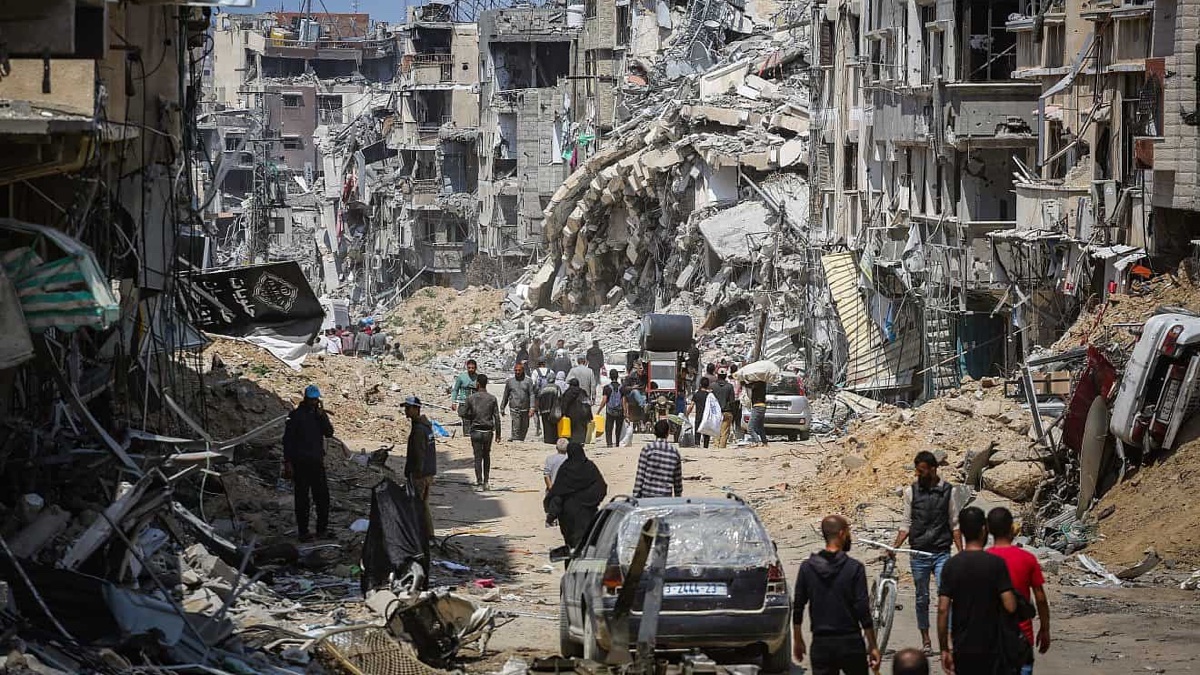
While the first four reasons above make arguments about death tolls and demographics a fool’s—or a fraudster’s—game, it is for the last reason that discussions about death tolls are totally irrelevant, even when accurate numbers are received. The point is not how many citizens were killed, and what age or gender they were. Rather, it’s the crime committed by Hamas in starting the war, failing to protect its civilians and hiding behind those civilians that makes the terror group 100% culpable for every death and for Gaza’s crumbled ruins.
Why no one knows how many people were killed in Gaza. Assessing the number of deaths in the “fog of war” is next to impossible, especially since combatants rarely spend their resources keeping count. Some organizations, such as hospitals or funeral services, can offer numbers in real time, but best practices for counting war dead are usually employed after the war. The most reliable death tolls are calculated by accumulating statistics from various organizations, called Multiple Systems Integration (MSE). This technique combines population censuses, birth/death registries, and expected and observed deaths, as well as indirect deaths from famine and disrupted health-care services.
Yet even experts using sophisticated multisource methodologies can still only approximate actual war-related deaths and their demographics. The fact is, in today’s war-demolished Gaza, no such studies have been started, let alone completed. Given the recent war’s utter destruction, its death toll may take 10 or even 20 years to establish.
Why no one knows who were killed in Gaza. Hamas’s Health Authority, a notoriously untrustworthy source, estimates some 70,000 Gaza deaths, but it does not distinguish fighters from civilians. They would prefer the public to conjure an image of 70,000 dead women and babies, not tens of thousands of ruthless, raping terrorists. But separating bodies of fighters from those of innocents is highly imprecise since Hamas terrorists not only operate among civilians in civilian structures but also dress as them. Likewise, Israeli estimates, which are known for being reliable and made in good faith, suggest that 25,000 fighters were killed, though this number is also imprecise. Thousands of both fighters and innocents are still buried under tons of rubble from collapsed buildings.
Why we don’t know whether a death toll of 70,000 is good or bad. In the Armenian Genocide (1915-1917), some 600,000 to 1.5 million were killed, accounting for 90% of Ottoman Armenians. In the Cambodian Genocide (1975-1979) victims totaled 1.5 million to 3 million, including 99% of Vietnamese Cambodians. More recently, in the U.S.-Iraq war (2003-2011), total deaths are documented at around 460,000. That’s 650% more fatalities than estimated for the Gaza war.
Still, hearing that 70,000 people (of 2.2 million in the Strip) were killed in a war is disturbing, even with the clarifier that “only” 45,000 of them were innocent women, children and seniors. But we certainly can’t assess the magnitude of death without context compared to other modern wars. In perspective, the Gaza war toll, with its far more favorable combatant-to-civilian ratio, was a minor disaster—and certainly, no genocide—compared with Armenia or Cambodia.
Why arguments over blame for Gaza war deaths are nonsense. When a country like Israel is attacked, unprovoked, by its bordering neighbor, as Hamas did on Oct. 7, 2023, there’s little question of responsibility for the conflagration. Hamas was the aggressor. When that aggressor fails to take precautions to protect its citizens in case of war, as Hamas failed to do, responsibility is again clear. Finally, if the aggressor uses a war strategy of human shields—deliberately operating within or around its civilian population, in residences, schools, mosques and hospitals—which is a crime, then that becomes a trifecta of unforgivable barbarism.
In short, civilians who died under these circumstances, no matter the number, are the full responsibility of the aggressor: Hamas. To debate the actual death toll as though it has some inherent moral meaning is irrational. To blame any of the deaths on Israel, which fought strictly according to the rules of war—and, in fact, exceeded what is required in providing humanitarian aid—is irresponsible … and dead wrong.
Originally published by Facts and Logic About the Middle East (FLAME).