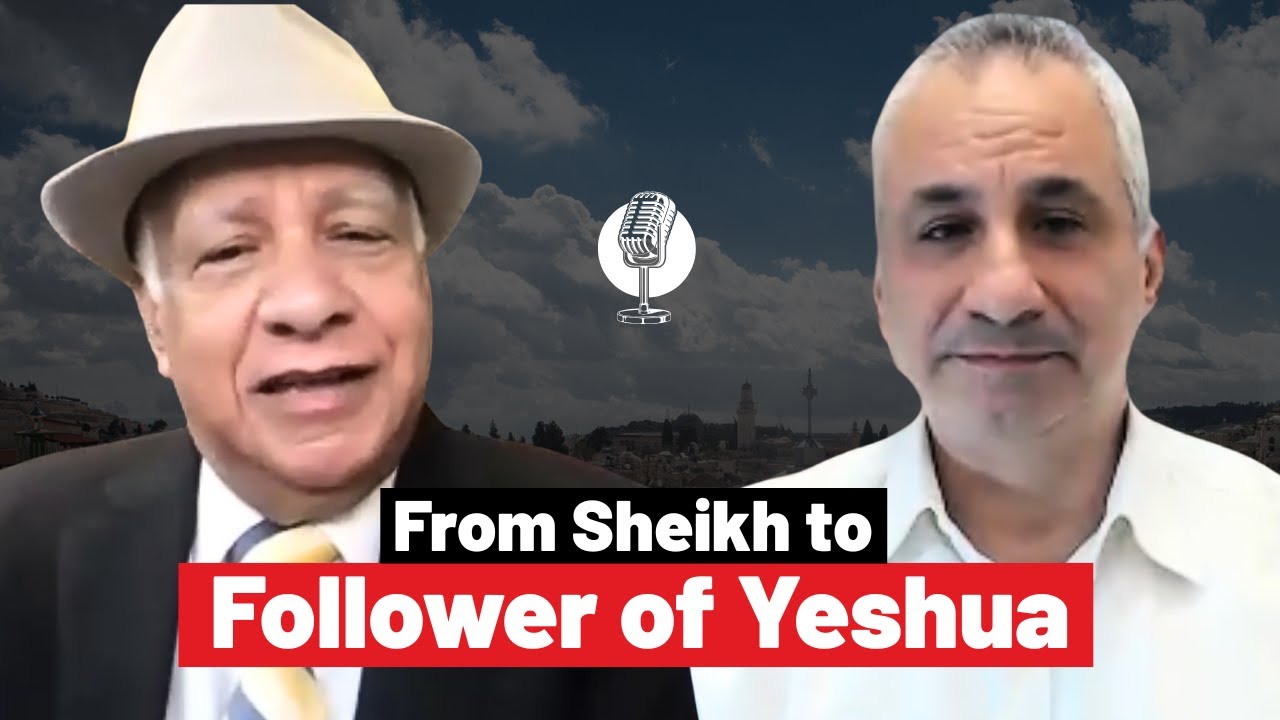

Dr. Muhammad Rahouma, today a devout Christian, was once part of the Islamic establishment in Egypt. As dean of a faculty for Arabic and Islamic Studies closely affiliated with Al-Azhar University, he trained imams, sheikhs, and religious teachers for years. He now lives in the United States, works as a Christian preacher, and is a sharp critic of political Islam. Our conversation covers his personal faith journey, the theological foundations of Islamic violence, immigration fears in Europe, and his appreciation for Israel.
Editorial note: The following reflects the personal views of the interviewee.
Dr. Muhammad Rahouma does not speak as an outsider. His critique of Islam stems from decades of close proximity to its religious and academic core. For years he headed a faculty of Arabic and Islamic Studies in Egypt that was academically affiliated with Al-Azhar University—the institution regarded worldwide as the leading authority in Sunni Islam. Under his responsibility, around a thousand graduates were trained each year, including imams, sheikhs, and teachers of Arabic and Islamic religious studies.
It was precisely this work that led Rahouma into a profound inner crisis. He describes how he observed a fundamental contradiction among many of his students between religious claims and moral practice. According to his account, he encountered systematic double standards, readiness for violence, abuse of power, and pronounced disdain toward women. Particularly shocking to him was that such behavior was not seen as a deviation but was religiously legitimized.
These experiences prompted Rahouma to study Islam anew, from the foundation. He began reading the Koran and Sunna not apologetically but critically, in order—as he puts it—to understand the theological roots of the violence he encountered in everyday life. At the same time, he sought dialogue with Christian priests and theologians, whom he describes as credible and intellectually honest. This process ultimately culminated in a radical break: During a stay in the United States, Rahouma converted to Christianity and was baptized.
He emphasizes that this step was, in his view, neither opportunistic nor motivated by external advantages. To hold himself accountable, he returned to Egypt after his conversion before later continuing his academic career in the United States, including as a professor and guest lecturer at Cornell University, and collaborating at times with institutions such as the US State Department.
Today, Rahouma appears primarily as a preacher and commentator on digital platforms. In his contributions, he addresses criticism of Islam, religious extremism, and the societal consequences of Islamic ideology, especially in Europe. One of his central theses is that the image of an unstoppable, dominant Islam in the West is misleading. According to him, many people around the world leave Islam every day, while conversions to Christianity are strongly increasing—a process that, in his opinion, is hardly discussed in Western media.
Rahouma speaks particularly clearly about the situation in Europe. He distinguishes between culturally or nominally Muslim people who live their faith privately or barely practice it religiously, and those who practice Islam strictly, regularly attend mosques, and intensively engage with the Quran and Sunna. The latter group, in his assessment, is especially susceptible to radicalization. Terrorism, from his perspective, is not an abuse of Islam but a consequence of consistent religious practice, since central texts religiously legitimize violence, separation, and superiority.
At the same time, Rahouma makes clear that he does not consider the majority of Muslims to be terrorists. Many simply want to live, work, and exist in peace. Yet it is precisely these people who are increasingly distancing themselves from the religious establishment and from political claims made in the name of Islam. For Rahouma, this is an indication that Islam as a societal and political ordering system is losing persuasive power.
With regard to migration, Rahouma sharply criticizes Western states. For decades, European countries have accepted Muslim immigrants, granted them citizenship, and allowed religious parallel structures without consistently insisting on adherence to the respective legal order. The result has been growing insecurity in the majority society. When people are afraid to celebrate religious holidays or to say “Merry Christmas” in public, he sees this as a sign of cultural self-abandonment.
Rahouma also warns of the influence of small, radical groups. Though numerically few, they are highly impactful. Through targeted actions—such as attacks on religious symbols, churches, or Jewish institutions—they spread fear and destabilize the social climate. Such acts are easy to carry out, yet their effect is substantial.
Despite the sharpness of his analysis, Rahouma does not express complete pessimism. He believes that many European societies have begun to recognize their mistakes. In some countries, laws are being tightened and clear expectations formulated: religious freedom yes—but only within the framework of the prevailing legal order. In the long term, in his deliberately provocative prognosis, Europe will find ways to manage without political Islam.
At the end of the conversation, Rahouma addresses a personal message to Israel and the Arab world. He openly expresses his admiration for the Jewish state, his respect for its achievements, and his wish that Arab societies view Israel not as an enemy but as a model—especially in education, work ethic, and social responsibility.
The conversation with Dr. Muhammad Rahouma is thus less a theological dispute than an inside perspective: the viewpoint of a man who taught, lived, and ultimately rejected Islam over many years—and whose criticism is polarizing precisely for that reason.
Want more news from Israel?
Click Here to sign up for our FREE daily email updates