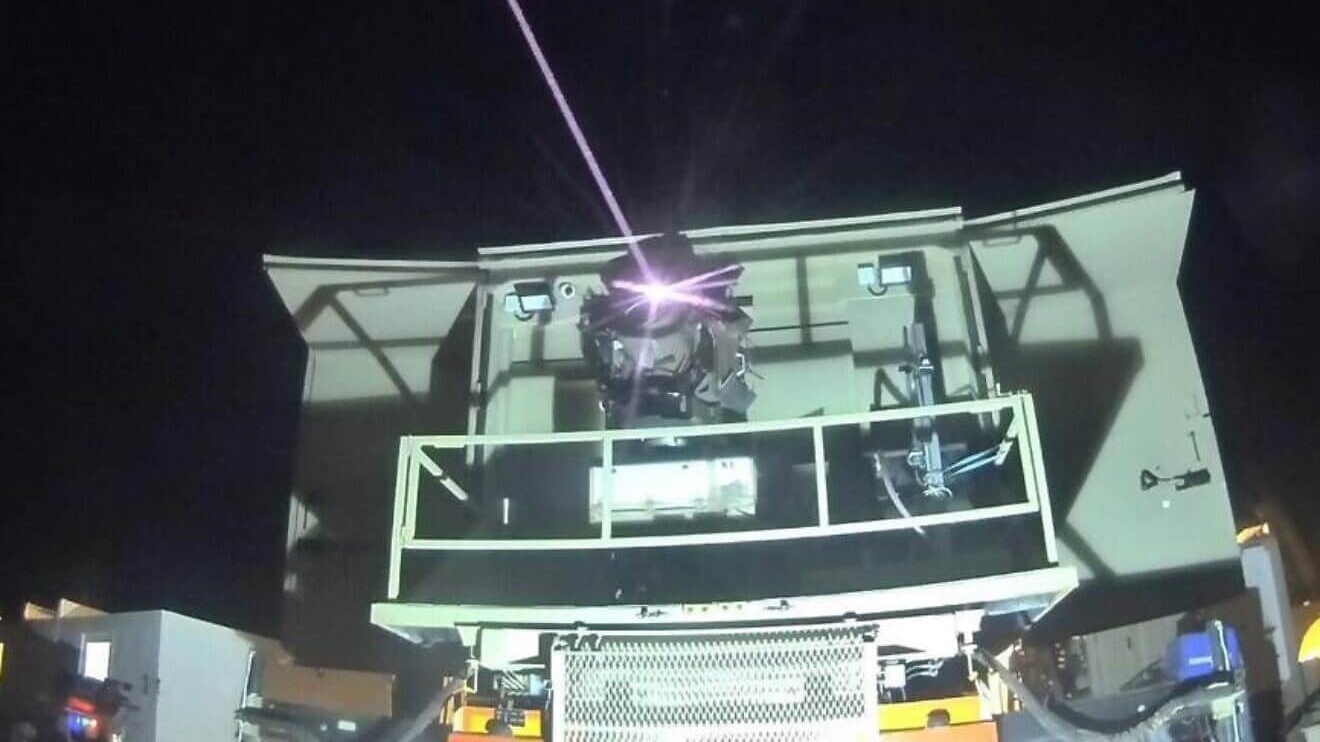
(JNS) As the Israel Defense Forces confronts ongoing aerial threats from Hezbollah in the north, including rockets, drones and mortars, questions swirl around the operational status and necessity of Israel’s much-anticipated laser air defense systems.
According to data released on Sunday by the Alma Center, a research organization specializing in security threats in the north, since Hezbollah joined the war on March 2, it conducted 192 attack waves, and 89 attack waves between March 6 and 7.
During those two days, 67% of the threats fired by Hezbollah were rockets, some 32% were drones, and 1% were anti-tank missiles.
Despite significant technological advancements and public announcements regarding systems like Iron Beam (now known as Or Eitan), the military has yet to confirm operational usage of the system in current interceptions.
In May 2025, the Defense Ministry announced that a smaller laser system had been used during the previous conflict with Hezbollah that ended with the Nov. 27, 2024, ceasefire.
That smaller laser system performed over 40 operational interceptions, the head of the Defense Ministry’s Directorate for Defense Research and Development, Daniel Gold, said at the time. He also stressed that the laser systems are designed to complement, not replace Iron Dome, as part of the lower-tier Israeli air defense system.
On Dec. 28, 2025, Rafael and the Israeli Defense Ministry delivered the first operational Iron Beam system to the IDF.
A Western observer told JNS on Sunday that there are three versions of the laser, and that “one of them was at a very experimental, improvised level; it was operated and worked quite successfully… But it certainly proved for the first time that it works – not only in the testing field but also in the field.”
However, the source assessed that the smaller, tactical version of the laser, which showed promise in earlier trials, is not currently being used in the war against Hezbollah. The reason, the source explained, is not a lack of effectiveness, but rather a lack of immediate operational necessity.
He stressed that detection remains the main challenge of air defenses, rather than interception options. The source said that while a laser system is helpful, particularly due to the low unit usage cost, its current impact is not yet being felt.
Laser interceptors, he said, require “time on target” to destroy incoming threats, meaning the beam must remain continuously focused on a specific point for a duration. Furthermore, the systems must be positioned relatively close to the threatened area.
The current aerial threats in the north are being managed well by Iron Dome, he said. No matter how excellent a new system, he added, the utilization of personnel is also required to operate any new system.
The source praised the existing Iron Dome operators, noting that the array is massive in terms of manpower and that numerous batteries have been built and deployed in the north and central regions. Iron Dome is performing far beyond its original design by intercepting UAVs, he added.
Currently, Hezbollah is firing cheap UAVs at northern Israel, almost all of which are being intercepted, he said, though he acknowledged some gaps in defenses. Helicopters and jets are using mounted cannons to also bring down the drone threats from Hezbollah.