

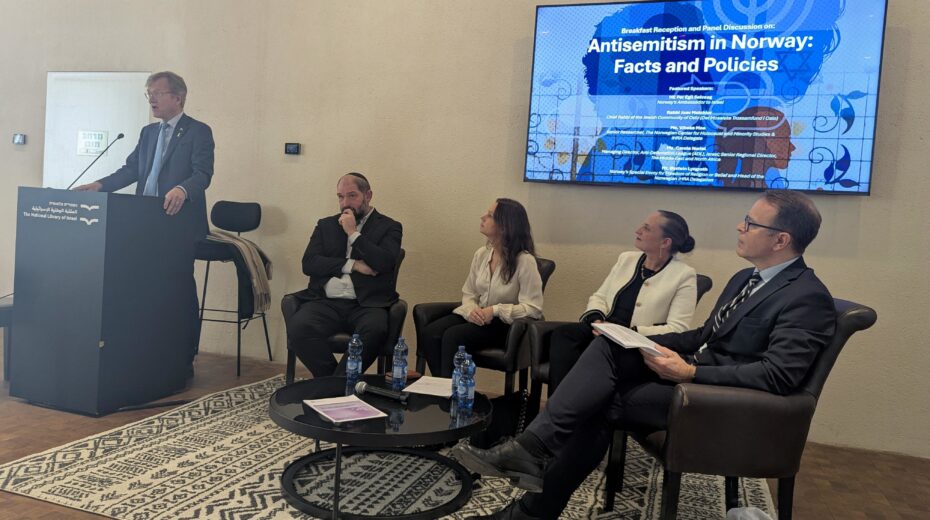

I recently received an invitation from the Norwegian Embassy to an event at the National Library of Israel. The focus was on the “Action Plan against Antisemitism 2025–2030” developed by the Norwegian government—a package of measures aimed at countering antisemitism in society, education, and public discourse. A topic that is clearly structured on paper—and must prove itself in the everyday lives of Jewish people.
The event took place on December 14, 2025, at the National Library of Israel. It was a factual discussion, yet it was palpable that more was at stake than just concepts and programs. Under the title “Antisemitism in Norway: Facts and Policies,” representatives from Norwegian politics, the Jewish community, and international experts came together—against the backdrop of the Hamas massacre on October 7, 2023, and the changed public debates since then.
The Norwegian Ambassador to Israel, Per Egil Selvaag, opened the event by stating that antisemitism is not a closed chapter even in Norway. It is not just about protecting a minority, but about the state of a democratic society as a whole. The government is relying on action plans, education, and international cooperation.
It became clear, however, that tensions exist between political strategies and lived reality. Rabbi Joav Melchior, Chief Rabbi of the Jewish Community in Oslo, spoke particularly impressively about the everyday life of Jewish families since October 7. He described broken friendships, insecurity in schools, and growing pressure to justify oneself. Jewish identity, in his observation, is increasingly politically charged.
For Jews, October 7 was not a political event, but a profound rupture. While grief and fear shaped Jewish daily life, the public discourse quickly shifted to political blame. The experiences from Norway echoed developments also known from other European countries.
Further contributions made clear that antisemitism today rarely appears openly, but all the more strongly affects the social climate—in language, attitudes, and expectations. The discussion in Jerusalem showed how closely political concepts, public discourse, and the sense of security and belonging of Jewish communities are interconnected.
Want more news from Israel?
Click Here to sign up for our FREE daily email updates










Antisemitism and the negation of Israel runs very deep in Norway. It is on the program of several political parties,and on the programs of the main trade unions. A good way to see how bad things are is to read the commentaries in the newspapers. I have stopped being shocked. The younger generation is completely brainwashed, and soon they will be the politicians of tomorrow.