
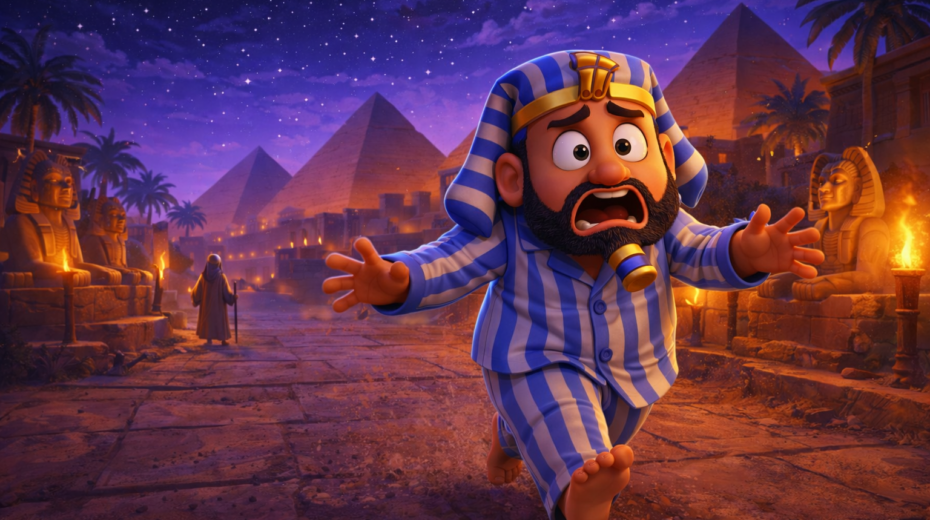

In the current Torah weekly portion “Bo,” we read about the tenth plague with which God afflicted the Egyptians. It is “the death of all the firstborn in Egypt,” which sweeps over the land and spares not even Pharaoh’s palace. When all the firstborn were killed at midnight, Pharaoh finally comes to his senses and allows the Israelites to leave Egypt.
“And it came to pass at midnight that the Lord struck all the firstborn in the land of Egypt, from the firstborn son of Pharaoh who sat on his throne to the firstborn son of the prisoner who was in the dungeon, and all the firstborn of the livestock.
“Then Pharaoh arose in the night, he and all his servants and all the Egyptians; and there was a great cry in Egypt, for there was not a house where there was not one dead. And he called for Moses and Aaron by night and said, ‘Rise up, go out from among my people, both you and the children of Israel. And go, serve the Lord, as you have said! Take your flocks and your herds, as you have said, and be gone; and bless me also!’” (Exodus 12:29-32)
According to Jewish tradition, Pharaoh himself was a firstborn and should have died that night. However, because God wanted to make an example of him, He spared his life. Pharaoh did not know this, and Jewish tradition further states that he ran frantically through Egypt in the middle of the night, searching for Moses to save his life.
From this arose yet another Jewish tradition: the children’s song “Paro b’Pyjama b’Emza haLaila!” – in English: “Pharaoh in Pajamas in the Middle of the Night.” The song is sung not only in Jewish kindergartens but has even made its way into modern pop culture, as seen in the following video:
For the Jewish children who sing this song, it takes some of the terror away from this villain of Jewish history, one of the earliest enemies of the Jews. Until then, Pharaoh had been a hard-hearted dictator who condemned the Israelites to horrific slave labor, drowned children in the Nile, and despite all the previous plagues, was unwilling to let the people go.
In the end, however, he was just another comic figure in history—one who thought himself a god but ultimately waddled through the streets of Egypt in his pajamas.
Throughout history, the same fate has befallen many rulers who believed they could wipe out or break the Jewish people. In Jewish memory, they rarely remain as powerful figures but often as tragicomic characters who overestimated their own importance.
Perhaps that is one of the quiet lessons of this children’s song: Those who think themselves all-powerful often end up not as legends, but as footnotes—or as a song in kindergarten.
Want more news from Israel?
Click Here to sign up for our FREE daily email updates










The introductory verse sounds a lot like, ‘What shall we do with a drunken sailor, early in the morning?’ English folk song.