
There are moments in Israel when a new community is not just a housing story. It is a declaration.
The inauguration of Ma’or Tzur in Samaria was one of those moments.
On the surface, this was a ceremony marking the establishment of another Israeli community in a strategic position above Route 443, one of the key arteries linking Jerusalem to central Israel. More than that, it was a statement about how Israel’s leadership increasingly understands the war that began on Oct. 7, 2023 not as an isolated military campaign, but as a national turning point.
Finance Minister Bezalel Smotrich made that point bluntly during the dedication ceremony for the new settlement, which was attended by Israeli Cabinet ministers and lawmakers. The military achievements Israel has secured, he argued, will not remain confined to the battlefield. They will have political consequences, and those consequences should include a reshaping of Israel’s strategic depth in Gaza, Lebanon, and Syria.
That is the part the international system will predictably call “provocative.”
What Smotrich articulated is the emerging logic of a post-Oct. 7 Israel: if Jewish vulnerability invited massacre, then Jewish rootedness must answer it. If the old doctrine of withdrawal, containment, and negotiated fiction produced terror armies on Israel’s borders, then the corrective will not be more of the same with better branding.
It will be control. Presence. Borders that mean something. Communities that are not apologizing for existing.
That is what Ma’or Tzur represents.
יישוב חדש הוקם בבנימין!
מזל טוב ל-12 משפחות הגרעין, חלוצי ״מעוז צור״. pic.twitter.com/5DKSIKtVwp
— בצלאל סמוטריץ’ (@bezalelsm) April 10, 2026
Smotrich framed the issue plainly. Military action alone does not complete the job. War has a political dimension, and if Israel is serious about securing its future, then battlefield success must be followed by political consolidation. In Judea and Samaria, that means defeating once and for all the fantasy that carving up Israel’s biblical heartland will somehow produce peace rather than another terror enclave. In Lebanon, it means thinking in terms of defensible lines, not diplomatic nostalgia. In Syria, it means understanding that vacuums do not remain empty for long.
“There will be a political component [to the ongoing wars] that will expand our borders,” the finance minister stated.
Finally getting real
For decades, Israel was asked to believe that territory conceded in good faith would reduce hostility. Southern Lebanon was supposed to become quieter after withdrawal. Gaza was supposed to become a test case for “post-occupation” normalcy. Instead, both became launch platforms. The problem was never a lack of Israeli concessions. The problem was the persistent Western refusal to understand what Israel’s enemies believe borders are for: not coexistence, but staging grounds.
So when Smotrich speaks about a political phase that follows military action, he is saying something more important than the usual headlines will admit. He is saying that security cannot remain conceptually detached from geography. In Israel, territorial control is the difference between deterrence and disaster. That’s the hard-earned lesson of Oct. 7.
That reality was underscored by the location itself. Ma’or Tzur overlooks Route 443, a vital corridor connecting Jerusalem to the center of the country. From that vantage point, the strategic argument becomes embarrassingly obvious. The high ground matters not only because that’s where Israel’s story was forged, but because it anchors the modern state’s sovereignty and denies hostile actors room to maneuver against the bulk of its population.
Israel isn’t going anywhere
Knesset Speaker Amir Ohana also attended the ceremony, and said what far too many Israeli officials in previous eras seemed reluctant to say with conviction: “This is our land. We are not here as guests; we are not here temporarily.”
Israel’s problem has never merely been external pressure. It has also been the internal temptation to speak as though Jewish life in its own homeland requires endless provisional language, as though permanence itself were impolite.
But permanence is the point.
The post-Oct. 7 era is clarifying many things, including this: a nation that does not speak the language of legitimacy in its own land will eventually be spoken to in the language of violence by those who do not believe it belongs there at all.
That’s why building is as important to Israel’s strategic outlook as battlefield victories.
Every vacuum must be filled
Binyamin Regional Council head Israel Ganz put the contrast in appropriately stark terms: Israel’s enemies build terror; Israel builds life.
Ganz was getting at the simple truth missed by so many in the West that in the Middle East, every vacuum is contested. If Israel does not secure critical spaces, someone else will. And that “someone else” is rarely a neutral actor. It is more often an Iranian proxy, a terrorist network, or the infrastructure that prepares the way for both.
The image of prophetic fulfillment
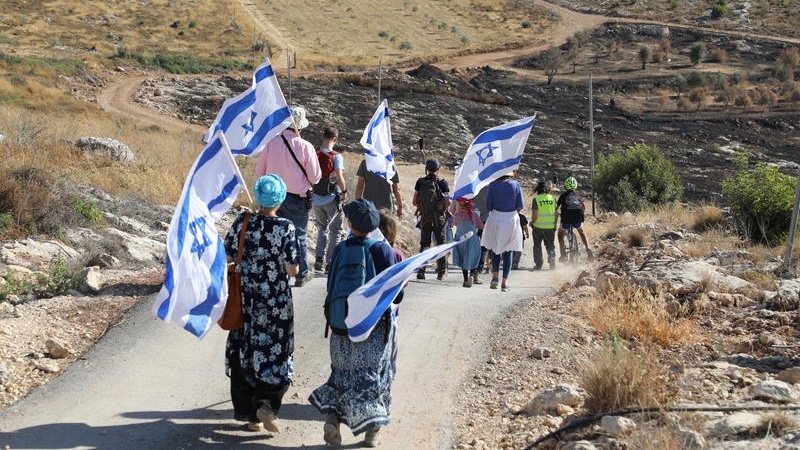
The fact that eight of the first 11 families in Ma’or Tzur belong to IDF reservists only sharpens the meaning of the moment. While husbands serve on the front lines, wives and children are establishing homes in the land God gave them. This is the very image of Israeli resilience and prophetic fulfillment.
And it speaks to exactly the kind of coherence Israel will need in the years ahead.
Because the real debate here is not over one new settlement. It is over what lesson Israel draws from the collapse of the old order. Does it return, once the current wars subside, to the language of “confidence-building measures,” foreign pressure, and territorial self-delusion? Or does it accept that national survival requires a different doctrine altogether—one that treats sovereignty as something to exercise, not merely reference in speeches?
The reported approval of dozens of new communities across Judea and Samaria suggests that at least part of the government understands the answer.
Course correction
The international response, of course, will be predictable. Condemnation will arrive dressed as wisdom. Editorial boards will call it inflammatory. Diplomats will warn about “escalation,” as though the region’s instability began with Jewish families moving into a new neighborhood rather than with generations of rejectionism, militancy, and Islamist fantasy.
But the old formulas are exhausted. Oct. 7 killed more than Israelis. It killed the illusion that retreat earns legitimacy and that vulnerability invites restraint.
Ma’or Tzur is therefore not merely a community. It is a correction.
A correction to the notion that Jewish presence in the biblical heartland is an obstacle to peace. A correction to the fiction that security can be subcontracted to agreements that hostile actors never intended to honor. And a correction to the diplomatic habit of treating Israel’s rootedness as the problem rather than the answer.
Israel is being forced, painfully and publicly, to relearn something it should never have forgotten: peace does not come from making yourself smaller before enemies who want you gone. It comes from strength, clarity, and an unembarrassed commitment to remain.
That is what was inaugurated in Samaria this week.
Not just homes.
Resolve.
Want more news from Israel?
Click Here to sign up for our FREE daily email updates