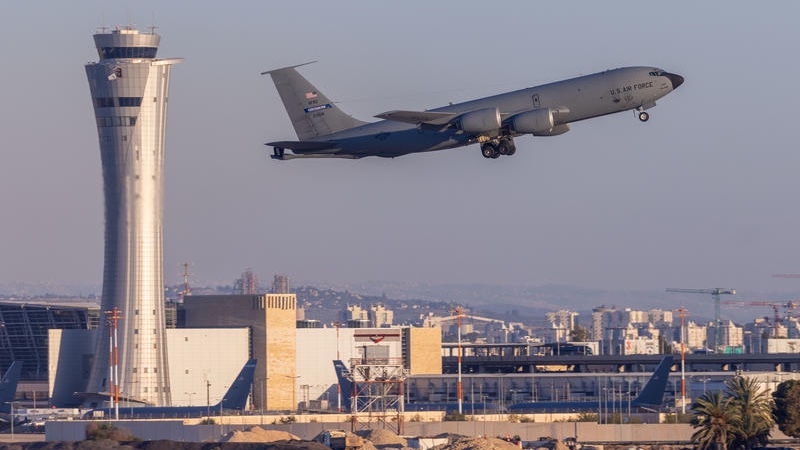
(JNS) Israel’s multi-layered air-defense system offers American aircraft stationed in Israel the highest level of protection in the Middle East—and arguably the world—a former Israeli Air Force fighter pilot told JNS in recent days, amid reports of growing numbers of US assets being deployed to Israeli bases.
Lt. Col. (res.) Ron Tira, a reservist in the Israel Air Force’s Campaign Planning Department who also served as a section head in the air force’s Intelligence Division, told JNS on Monday that the American shift toward basing assets in Israel reflects hard lessons learned during the war.
Tira spoke a day before Defense Minister Israel Katz said in a Channel 14 interview on Tuesday that American aircraft are refueling in Israel before carrying out strikes on Iran.
“The Iranians fire at everything that exists in the area except for one country, the State of Israel,” Katz said. “They know that American planes take off from here and refuel here to attack.”
Tira said that throughout the war, “the Americans saw that the bases close to Iran were hit harder, and there’s an advantage to operating from a range of 1,000 kilometers or more in terms of base defense.”
He argued that Israel’s air-defense architecture makes it uniquely suited to host American assets.
“Israel can offer the most saturated missile defense array in the world, and therefore assets located in Israel are more protected than in other places that have ‘local defense’ against missiles but not a saturated, multi-layered array, rich in resources, multi-directional, and so on, like in Israel,” Tira said.
Prof. Eytan Gilboa, an expert on US-Israel relations at Bar-Ilan University and Reichman University and a researcher at the Jerusalem Institute for Strategy and Security, told JNS on Tuesday that “the flow of military forces and American refuelers to the area is supposed to support Trump’s threat that if the current negotiations fail, he will order a move to high-intensity war.
“This is a message to Iran, to US allies in the Gulf and to the mediators,” he said.
At the same time, Gilboa added, the Iranian Islamic Revolutionary Guard Corps “know that Trump does not want to transition to high-intensity war, and some of them are not at all interested in talks with the US. Hence it is reasonable that Trump’s threats are having less of an influence on them, if at all.”
On July 19, Reuters reported that Israel was preparing to receive additional US refueling aircraft as attacks between Washington and Tehran intensified, before the current de-escalation.
Reuters also reported that US forces had stationed dozens of refueling aircraft in Israel since the war began on Feb. 28, and that as of June 25 there were 98 US military aircraft in the country.
Israel has shifted refuelers that had been stationed at Ben-Gurion Airport to southern Israeli bases and Ramon Airport to avoid disruptions to international flights.
The Washington-based Jewish Institute for National Security of America assessed last year that Uvda Air Base in southern Israel is capable of hosting up to 240 US aircraft and 6,000 personnel during a major contingency operation.
In a report published on July 14, JINSA said Israel now offers Washington a more defensible alternative to its exposed Gulf bases, citing satellite imagery showing that Iranian strikes damaged or destroyed at least 228 structures and pieces of equipment across 15 US military sites in Kuwait, Bahrain, Qatar, Jordan, Saudi Arabia and the United Arab Emirates during the war.
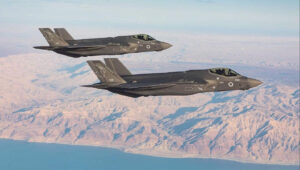
The United States has also reportedly deployed F-22 stealth fighters to Uvda Air Base in recent months.
In mid-July, Walla reported that 14 additional American refuelers arrived in Israel over a single weekend.
International media reports said at least 23 aerial refuelers had been parked at Ramon Airport.
In June, Gen. Charles Wald (US Air Force, ret.), former deputy commander of US European Command and now a distinguished fellow at JINSA, told JNS, “I think the ideal situation in the Middle East would be that the United States and Israel do have a defense pact.”
Israel, he noted, is likely more reluctant to sign such an agreement because of concerns that it could constrain future Israeli military action, but he doubted that scenario would materialize.
“I think a stronger defense pact would be a good idea,” Wald said. “My vision for the Middle East would be that. There’s a mutual defense pact with all the GCC [Gulf Cooperation Council] countries that are friendly with Israel and the United States.”
Want more news from Israel?
Click Here to sign up for our FREE daily email updates