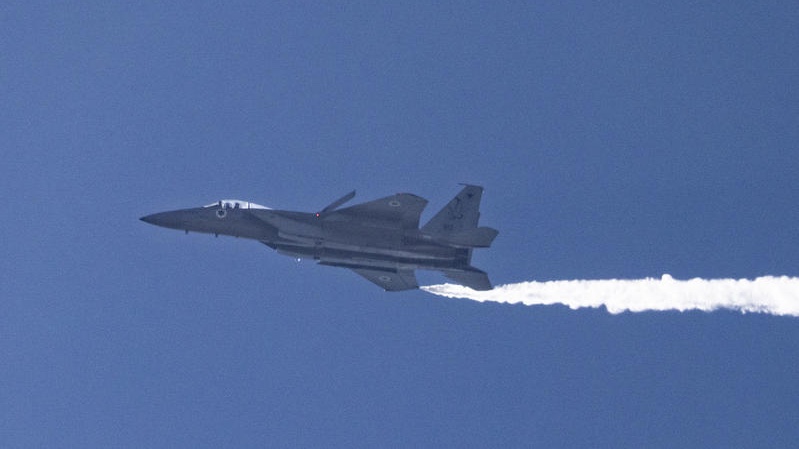
(JNS) Following intensive Israeli Air Force strikes in recent days targeting weapons-critical research and development facilities embedded deep within the Islamic Republic, military sources on Monday highlighted the Iranian regime’s systematic use of academic and civilian infrastructure to shield its military and weapons production programs—including a chemical weapons research site.
IDF International Spokesperson Lt. Col. Nadav Shoshani detailed the massive scope of recent aerial operations across Iran, confirming that the military successfully targeted highly sensitive components of the Iranian war machine, particularly its weapons research, development and production sites.
“Recently, we struck terrorist infrastructure within the IRGC’s main military university, Imam Hossein University, located in the heart of Tehran,” Shoshani revealed. The Israeli military confirmed that the regime utilizes this location as a primary development center. “Under a civilian suburb, this institution serves as a research hub for advanced weaponry, and an emergency asset for the regime’s military bodies sanctioned by several countries,” he explained.
Shoshani provided details of the targets hidden within the university, naming them as “wind tunnels used by the regime for testing and developing ballistic missiles, a chemistry center used for research and development of chemical weapons, a technology and engineering center, [and] a central complex used for the development of ballistic missiles and additional weapons systems.”
The military emphasized the direct integration of this academic institution into the highest echelons of the Iranian terror apparatus. “This so called university is commanded by Muhammad Reza Ahangar, a senior IRGC officer holding the rank equivalent to a brigadier general,” Shoshani stated.
The strike on Imam Hossein University is part of a broader campaign to degrade the regime’s war machine. “Over the past 24 hours, we struck 170 targets belonging to the Iranian terrorist regime,” Shoshani reported. The targeting focused heavily on the regime’s production pipelines. The strikes hit “a central site used to produce key components for a variety of weapons in Iran,” he added. The operation also neutralized “sites used for production of UAV engines, [and] an industrial complex where components for weapons were developed and a research and development site,” Shoshani noted. “We continue our operations over Iranian skies against the Iranian terror regime to degrade their military capabilities and reduce their ability to pose a threat towards Israel.”
Shoshani noted that IDF Chief of General Staff Lt. Gen. Eyal Zamir recently hosted US CENTCOM Commander Adm. Brad Cooper. “During his visit, the commanders discussed the importance of the cooperation between the military and the operations against the Iran,” Shoshani stated. “This coordination between IDF and our American counterparts remain unprecedentedly close and aligned,” he noted.
Despite the intense military pressure, he added, “We see continuous fire from Iran towards Israel, including the use of cluster bombs. This a regime that has intended and attempted to kill thousands of Israeli civilians.”
Simultaneously, the IDF is engaged in intense combat against Hezbollah forces in southern Lebanon. The military announced the deaths of four IDF soldiers from the Nahal Brigade’s reconnaissance battalion during operational activity in the region.
“We have seen attacks on the ground against our troops, and we’ve seen nonstop fire towards Israel,” Shoshani stated. “We’ve seen thousands of UAVs, missiles, and rockets by Hezbollah from Lebanon towards Israel,” he noted, estimating the total number of projectiles to be between 4,000 and 5,000.
The IDF’s ground operations aim to physically dismantle the terror infrastructure threatening northern Israel and strengthen the IDF’s forward defense posture, pushing the threat away from northern Israeli communities. Shoshani reported the neutralization of 180 Hezbollah missile launchers, and some 850 Hezbollah terrorists, including 230 from the organization’s Radwan Force. The IDF has also dismantled hundreds of Hezbollah command centers.
“Yesterday, we eliminated in Beirut senior commanders of the unit responsible for coordinating between Hezbollah and Palestinian terrorist organizations across the Middle East,” Shoshani stated. The strikes targeted senior members of Hezbollah’s Unit 1800, which managed the transfer of operatives to combat IDF troops in southern Lebanon and oversaw coordination with Palestinian terror organizations in Lebanon, Gaza, Syria, Judea, and Samaria.
“Hezbollah… are systematically using civilian cover and infrastructure to conceal their military activity,” Shoshani stated. The terror group utilizes schools, churches, and civilian villages to shield its operations. “This is not incidental, this is their strategy,” he stressed.
Want more news from Israel?
Click Here to sign up for our FREE daily email updates