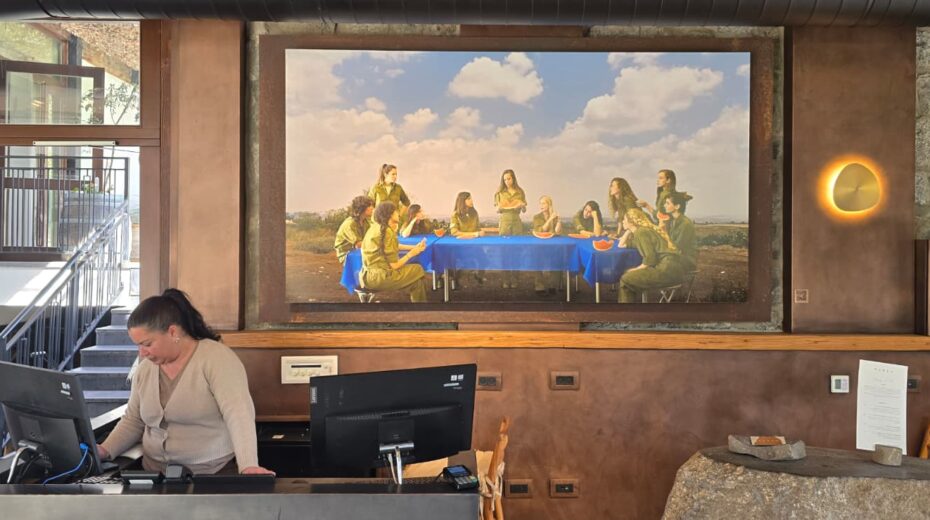

Anat is not only my colleague; first and foremost, she is my wife. I know her inner world, her sensitivity, her depth. Last week, she wrote about the Passover meal and the Last Supper in Jerusalem as she understands the biblical connection. I decided to accompany it with a photograph by the Israeli photographer Angelika Sher: 12 female IDF soldiers seated around a table with watermelons. It is an image modeled on Leonardo da Vinci’s famous Last Supper scene, and as such, it provokes. Anat’s opinion piece is not only about a text, but about the question of how we understand faith at all. What happens when biblical stories are not only remembered, but carried into our present reality? May art challenge the sacred, shift it, reinterpret it — or is this where the boundary into blasphemy begins? I made a deliberate decision to make exactly this tension visible: between tradition and the present, between faith and reality, between what was and what is today.
In her interpretation, Anat wrote that since that night, the Passover meal has become a ritual of remembrance. “But sacrifice is not only an expression of drawing near. It is also a bridge. It brings restoration to relationships that have been damaged — between human beings and God, and between people themselves. It was in this world that Jesus’ last meal with his disciples also took place. Jesus and his disciples came to Jerusalem as Jews to celebrate Passover and share the festive meal together. At the Passover table, in the breaking of the matzah (breaking of bread) and in the cup, the memory of Israel’s outward liberation is joined with a new, inward dimension of redemption. What at first appeared to be a mysterious act became, in retrospect for the disciples, an interpretation of their faith: freedom is not only a historical event, but a spiritual reality that unfolds again and again in human life.”
Back to Angelika Sher’s photograph. I know her, and I love this kind of art, even if some people condemn an unfamiliar depiction or a Jewish artist’s interpretation as blasphemy simply because, perhaps, women at the table do not fit their idea of the Last Supper. And you know what? Even Leonardo da Vinci’s legendary Last Supper, created around 530 years ago in the convent of Santa Maria delle Grazie, was not presented in a biblical sense, but created as a mural. Even then, the work was considered unusual because Leonardo portrayed the disciples as human, emotional, and without conventional holiness. What is now regarded as iconic was itself originally a break with tradition and was viewed critically by contemporaries.
Sher’s photograph is far more than a modern allusion to the Last Supper; it radically relocates the sacred into the present reality of Israel. Disciples become female soldiers; a sacred interior becomes the open landscape of Jerusalem, the Holy Land. The sacred is not abolished; it is relocated into Israel’s present. The table with the blue cloth, symbolizing Israel, no longer stands for a story of redemption in the past, but for the living, often contradictory reality of Israel — everyday life and state of emergency, life and threat, closeness and defense.
The watermelon is a central symbol here. Its red color recalls blood, but not only in the Christian sense; also in the existential Israeli context: sacrifice, loss, but also life and fertility. It is not a random food item, but something deeply regional, and that is exactly where the tension lies. The sacred meets Israel’s everyday reality. Added to this is the role of women. Twelve female soldiers instead of twelve male disciples — that is not mere provocation, but another perspective. They represent a generation that does not preach, but serves; that does not sacrifice symbolically, but bears real responsibility. The motif of sacrifice is reintroduced through Israel’s reality. The absence of pathos is also crucial. Precisely because of that, depth emerges. The image feels almost casual, and that is exactly what makes it powerful. It says: the sacred has not disappeared.
This is not a parody of the Last Supper, but its continuation in a world where redemption is no longer only preached, but must be defended daily.
According to the Bible, Israel has a special role among the nations, for example as a “light to the nations” (Isaiah). The experience of suffering, sacrifice, and responsibility is also repeatedly understood in biblical history as part of that calling. In this sense, Jews often see a parallel with Jesus: a people that does not live only for itself, but in a certain way carries a greater burden. About ten years ago, an exhibition at the Israel Museum in Jerusalem showed how Jewish and Israeli artists have reinterpreted the figure of Jesus, often not religiously, but as a cultural, historical, or even political symbol: Behold the Man: Jesus in Israeli Art. At the time, we presented the various artworks in a series in Israel Today magazine.
Beyond that, I have often emphasized that Israeli and Jewish artists engage more with the Jesus of the New Testament than so-called Christian artists in the Christian West. Jesus fascinates the Jewish people — very much so. And if you think Jews may interpret Jesus incorrectly, then one can quite rightly place the blame on Christian church history, which has deeply distorted the image of the Jewish Jesus over the last two millennia. And when a different Jesus appears in Israeli art — different from how Christians imagine him — people are often quick to condemn it as blasphemy. Worse than this alleged blasphemy was the persecution of the Jews in the name of Jesus.
Of course, one can argue about interpretations of texts, art, and images — and that is exactly what gives them value. I love art. Many years ago, I already published Adi Nes’s well-known work, his interpretation of the Last Supper with 12 soldiers around a table. The original hangs in the Israel Museum, and I have a beautiful print of it in my home.
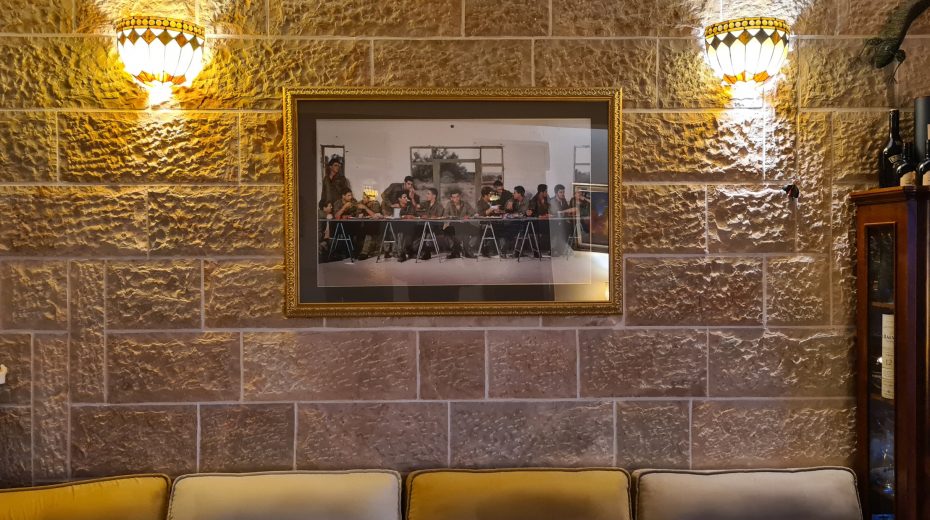
Photo: Aviel Schneider
My father loved that image, and everyone who entered our living room paused before it. It sparked conversations, different interpretations, and in the end the path almost always led back to one question: What does the Last Supper mean today? Perhaps that is exactly the point. Anyone who narrows their faith or thinking too much misses that depth. I do not do that. And honestly, today I do not care if some people are offended by it. That is their right — just as it is my right to think differently and to show such works. Because this is exactly the kind of art that moves me forward. It forces me to ask anew, to see anew, and to understand our faith, our lives, and even God not only through old images, but within the reality of our own time.
Want more news from Israel?
Click Here to sign up for our FREE daily email updates