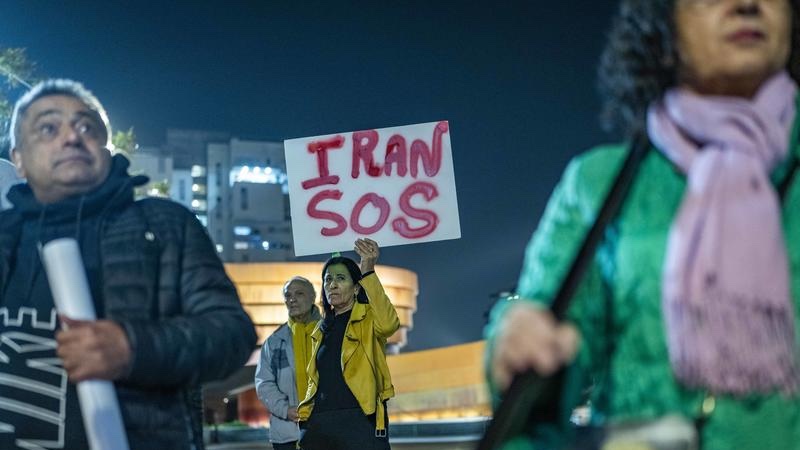

As regional tensions rise and speculation grows over possible American military action, Iranian protesters are issuing a stark warning: without outside intervention, the protest movement inside Iran will not merely fail—it will be annihilated.
In a rare and risky interview with Channel 12 News, two Iranian citizens—speaking from inside the country—described a reality of fear, exhaustion, and systematic repression following the latest wave of nationwide protests.
Their message was blunt: the Islamic Republic has crushed open dissent, and only decisive US action against the regime’s coercive organs could create space for Iranians to rise again.
“The streets are closed—but the anger remains”
Eliraza, 46, speaking from Tehran, described an economic and civic paralysis gripping the capital. Markets have collapsed, daily life is heavily restricted, and internet access—long a lifeline for coordination and documentation—has been deliberately degraded.
“Society is in depression after the violent suppression,” he said. “Continuing street protests is not possible in the near future. The internet is barely usable. Even with VPNs, we have to try again and again just to connect.”
Asked what he expects from Washington, Eliraza did not hedge.
“Our request from Trump was that he help us as he promised,” he said, referring to US President Donald Trump, who vowed to “send help” to the Iranian protesters. “If he launches an attack against the Revolutionary Guards, the Basij, and the army, it would give people an opportunity to take to the streets and seize important government centers.”
NEW: President Trump sends a message of support to ‘Iranian Patriots’ protesting against the regime, vowing that “HELP IS ON ITS WAY.” pic.twitter.com/xbW5oLjvzN
— Fox News (@FoxNews) January 13, 2026
He acknowledged growing despair among Iranians but insisted hope has not disappeared entirely. “Our last hope is a military attack by Trump,” Eliraza said. “There really is no other way to escape this regime anymore. This may be our last chance.”
Mashhad: checkpoints, body searches, and mourning notices
Sara, 32, speaking from Mashhad, painted an even darker picture—one marked not only by fear, but by grief.
“The situation is very grim,” she said. “The number of people killed is very large. Names, pictures, mourning notices—they are everywhere in the city.”
She described streets that empty as night falls, heavy deployments of security forces, and an omnipresent web of checkpoints operated by the Islamic Revolutionary Guard Corps and the Basij, often reinforced by plainclothes operatives.
“They stop cars one by one. They check phones. They check people’s bodies to see if they were hit by rubber bullets. If they find marks, they arrest them.”
According to Sara, almost no family has been spared. “There is no one around me who doesn’t know someone—a friend or relative—who was killed. People talk constantly about who they lost. The anger is everywhere.”
Fear without illusion
Even when limited internet access was partially restored, many Iranians chose not to reconnect.
“They didn’t want to see what was coming out,” Sara said. “What they saw on the streets was already enough. And what came out online was much worse.”
Asked about the dominant public mood, she was unequivocal: “People are still angry. Still hurt. Still want this regime to fall. But they have no ability to act.”
Her anger, she said, is now directed outward as much as inward.
“I am angry at the world,” Sara told Channel 12. “Angry that they talk and promise, and then nothing happens.”
When asked what she fears most, her answer was chilling. “If nothing happens, we will be destroyed. They will kill us all. One by one. Everyone who went out to the streets will be killed. That is the only thing I am sure about.”
Iranian risks their life asking President Trump for help.
The message is clear, Iranians are relying on President Trump for help, as he said: “Help is on the way”@potus @VP @SecRubio @seanhannity @FoxNews @marklevinshow @Jerusalem_Post pic.twitter.com/xYfjZ8Y7Ct— پادشاهی ایرانی (@Iran_Monarchy) January 25, 2026
“This regime is thirsty for our blood,” she added. “It cannot and does not want to allow us to live.”
“The world is closing its eyes”
Both interviewees expressed a sense of abandonment by the international community, accusing Western governments of willful blindness.
“They don’t want to see,” Sara said. “Because it doesn’t serve them. Because it’s not important to them.”
Her final appeal was simple—and damning. “People here are dying. Children are dying. And no one is paying attention.”
As Israel watches closely from across the region, the testimonies offer a rare, unfiltered glimpse into a society where dissent has been forced underground—but not extinguished. The anger remains. The fear is real. And for many inside Iran, the clock is running out.
Want more news from Israel?
Click Here to sign up for our FREE daily email updates