

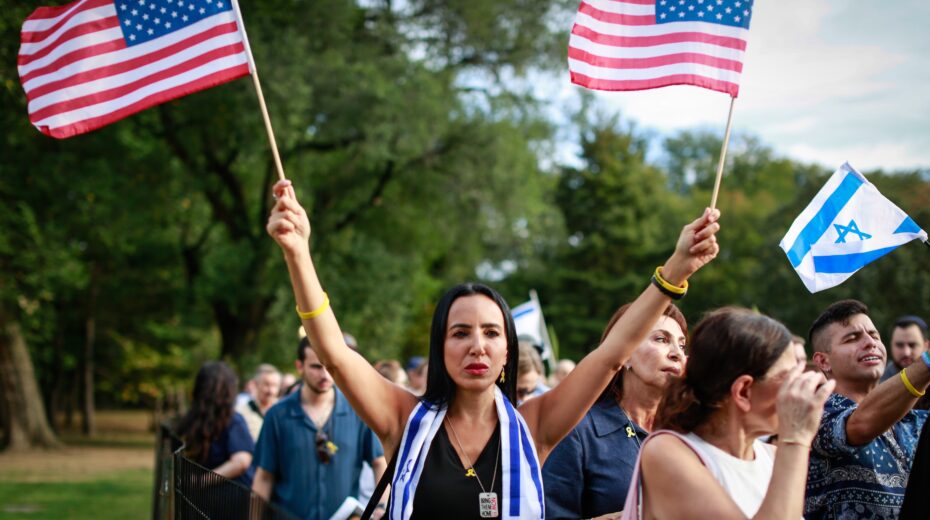

While Israel continues to rely on its historic relationship with American Jewry, a new survey by the Ruderman Family Foundation points to increasing worry within the Israeli public about declining support for Israel in the United States.
The poll simultaneously underscores the importance of the relationship with the US and the need to incorporate the positions of the American Jewish community into Israeli political decision-making processes. At the same time, it highlights the feeling that the State of Israel is not doing enough to strengthen these ties and to combat antisemitism worldwide.
The survey, commissioned by the Ruderman Family Foundation and conducted by the Dialog Institute, is based on a nationally representative sample of 1,002 adult Jewish Israelis. It shows: Despite the great importance the public attaches to the relationship with American Jewry—78 percent describe it as important and essential—confidence in the future of this relationship is increasingly eroding.
The results also reflect the Israeli public’s criticism of the central role of the government and Israeli policy. Thus, 43 percent of Israelis believe that the way the war in the Gaza Strip has been conducted has weakened American Jewish support for Israel, while only 28 percent believe the policy has strengthened it.
At the same time, only 17 percent of respondents think that Israel is making a significant contribution to the fight against antisemitism in the United States. More than a third, however, believe the contribution is minor or nonexistent. When asked whether the State of Israel should take the positions of American Jewry into account in its policy, 41 percent said it should do so to a certain extent; another 23 percent called for strong consideration.
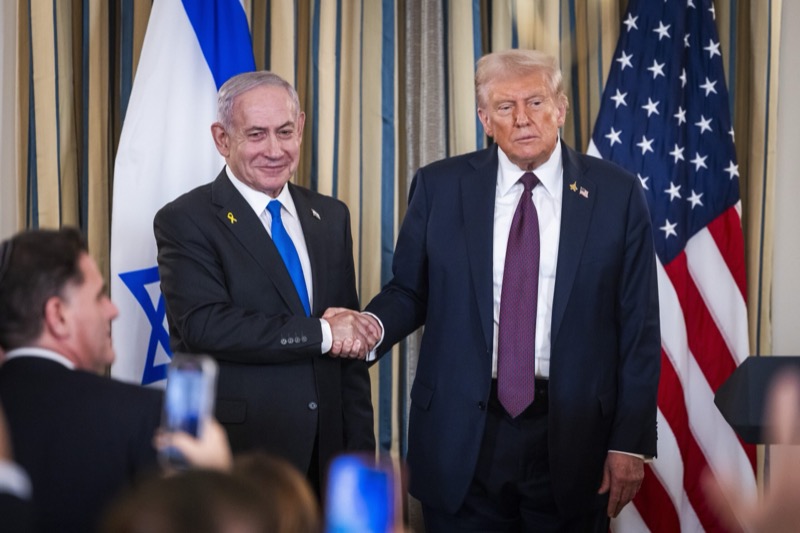
US President Donald Trump and Israeli Prime Minister Benjamin Netanyahu at a joint press conference at the White House in Washington in September 2025. Close political cooperation with the US continues to be considered a stabilizing factor in Israel. Photo: EPA/Jim Lo Scalzo/Pool.
Nearly half of Israelis (44 percent) believe that the younger generation of American Jewry will support Israel less in the future than it does today; only 22 percent expect an increase in support. At the same time, 67 percent believe that US President Donald Trump has a positive or very positive influence on Israel, while only 12 percent view his impact as negative or very negative. This contrast points to concern about a generational shift in the American arena—from a generation of leaders who stand with and support Israel, to a generation that may distance itself from Israel or even develop anti-Israel positions.
This concern is not merely theoretical but widely felt. Nearly half of respondents (48 percent) say they are very concerned about a decline in support for Israel in the American public, and another 30 percent are somewhat concerned. This means that nearly eight out of ten Israelis recognize an emerging problem—and many already feel that it is a present reality.
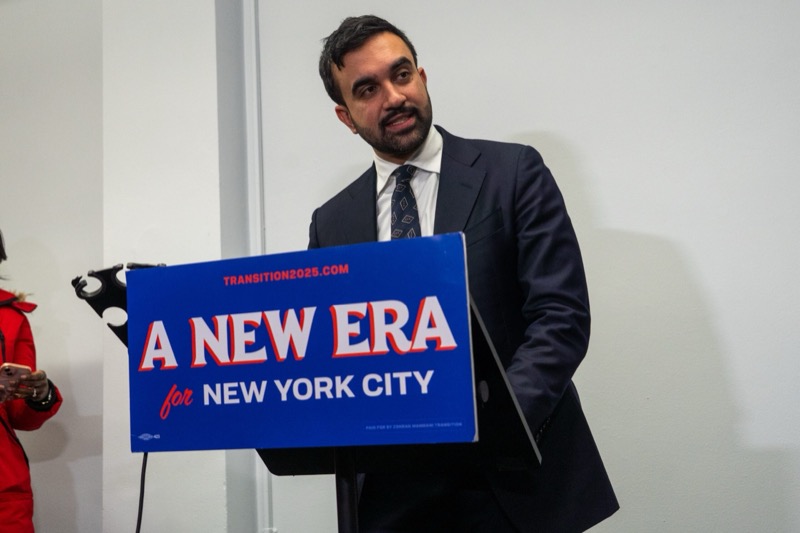
New York City’s newly elected mayor, Zohran Mamdani, at a public appearance in December 2025. His political rise is seen in Israel as an expression of a generational and attitudinal shift in parts of American politics. Photo: EPA/Madison Swart.
Recent developments in the US political arena, above all the election of New Yorker Zohran Mamdani as mayor, are seen as tangible evidence of the rise of young, progressive, and Israel-critical voices. At the same time, there is growing awareness that these voices are no longer perceived as extreme fringe phenomena in the American discourse, but as expressions of a broader trend of increasing distancing by the younger generation—from something that until recently was regarded merely as a future threat.
See also: American Jews, Israel, and the “Mamdani Moment”
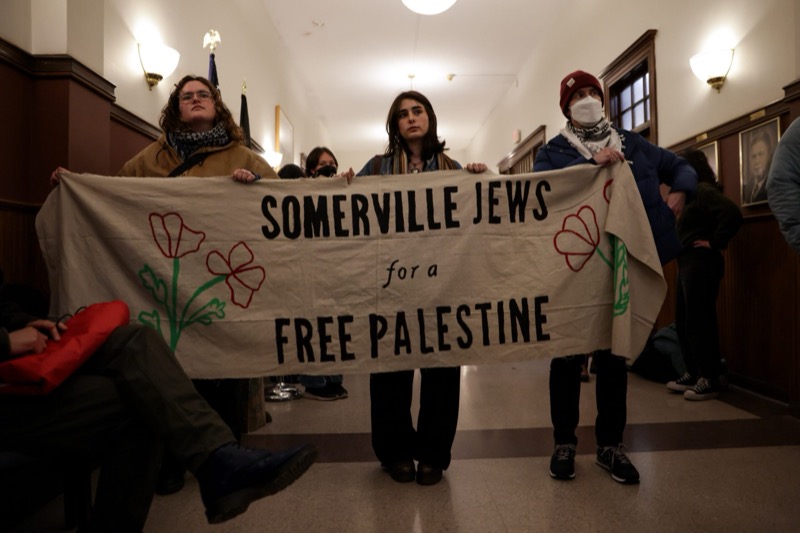
Jewish activists hold a banner reading “Free Palestine” at a pro-Palestinian rally in Massachusetts in March 2025. Such groups are particularly visible in progressive circles and represent a growing alienation of some of the younger generation from Israel. Photo: EPA/Taylor Coester.
Alongside the criticism, the poll also reflects a clear expectation of a change of course and stronger political engagement. A clear majority of the public—74 percent—believes that Israel must make substantial efforts to strengthen the connection of the young Jewish generation worldwide to Israel and Zionism. Half of the respondents also see Israelis living in the US as a highly important bridge between the communities; another 32 percent agree to a certain extent.
Shira Ruderman, Executive Director of the Ruderman Family Foundation, warns that this is a critical moment that requires action:
“The survey data show that the Israeli public understands that something fundamental is changing. The rise of young, critical voices in the US is not detached from reality but the result of a long process of alienation and ignorance toward the situation on the ground. This is a moment that forces Israel to pause, to listen, and to act differently—to shift from tactics to strategy. The relationship with American Jewry is a strategic asset for the national security of the State of Israel and the Jewish people. Neglecting this relationship today will cost us dearly tomorrow. The young Americans are the ones who will shape the course of the United States in the coming years—as elected officials and as voters—and they will significantly influence the relations between the countries.”
Want more news from Israel?
Click Here to sign up for our FREE daily email updates










According to Scripture, shouldn’t American Jews be making aliyah to Israel and not remaining part of the nations??