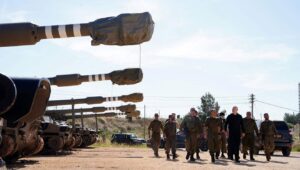
Israeli soldiers have discovered several weapons caches and a Hezbollah-used apartment in southern Lebanon. According to the Israeli military, the locations were only 100 to 250 meters from bases of the UN peacekeeping force UNIFIL. On Sunday (November 8), the military published photos and video footage of the seized weapons and equipment.
As the Israeli military explained in an official statement, the weapons were discovered during operations by the 91st Division, whose soldiers are operating in the security zone in southern Lebanon to eliminate threats to Israel.
In the village of Meiss al-Jabal, soldiers from the 9th Reserve Brigade “Oded” found two weapons caches. One was located in a civilian residential building approximately 200 meters from a UN post, the other in a storage building at a distance of only 100 meters.
The weapons found included Kalashnikov assault rifles, anti-tank weapons and associated rockets, a PK machine gun, fragmentation grenades, explosive devices, and ammunition. The soldiers also discovered communications and surveillance equipment.
Particularly notable, according to the military, was the presence among the weapons of boxes containing humanitarian aid supplies as well as symbols of Hezbollah and the Shiite Amal movement. The statement does not indicate where the aid supplies came from or how they ended up at this location.
During a separate operation in the village of Et Tiri, soldiers from the Kfir Brigade discovered an apartment that the military said had been used by Hezbollah for military purposes. It was located approximately 250 meters from another UN post. Inside the apartment, soldiers found surveillance equipment, military gear, supplies, and Hezbollah symbols.
Israel levels serious accusations against UNIFIL
The Israeli military sees the finds as further evidence of the failure of the UN peacekeeping force in southern Lebanon. Hezbollah and other terrorist organizations had exploited the inaction of the international soldiers to maintain military infrastructure in the immediate vicinity of their positions.
The UNIFIL mission is tasked, among other things, with monitoring compliance with security agreements in southern Lebanon. Under UN Security Council Resolution 1701 from 2006, no armed forces other than those of the Lebanese state and UNIFIL are permitted between the Litani River and the Israeli border.
The Israeli finds once again raise questions about the effectiveness of international monitoring. However, the mere physical proximity of the weapons caches to the UN posts does not in itself prove that the UN soldiers stationed there were aware of the weapons.
The Israeli military stated that it would continue to act against Hezbollah threats in order to protect Israeli civilians and soldiers. At the same time, it emphasized that it continues to consider itself bound by the ceasefire agreement.
UNIFIL faces withdrawal from southern Lebanon
The new finds come just weeks before the planned end of the UNIFIL mandate. The UN Security Council decided in August 2025 to extend the mission for the final time until December 31, 2026. The gradual withdrawal of international troops is then set to begin and be completed within one year.
The United Nations confirmed in early November that this timeline remains in place. Until the end of the year, UN soldiers are to continue their current duties, including monitoring the security situation and supporting the Lebanese army.
The decision to end the mission has long been controversial. Israel and the United States have repeatedly questioned the effectiveness of the UN peacekeeping force. The Lebanese government, on the other hand, fears that the withdrawal could create a security vacuum in the south of the country.
The finds now made public once again highlight the difficulties in implementing UN Resolution 1701. Despite years of presence by international peacekeeping forces, Hezbollah was able to maintain military infrastructure in southern Lebanon. How the security situation is to be stabilized after the withdrawal of UNIFIL remains one of the central questions for the future of the Israeli-Lebanese border.
Want more news from Israel?
Click Here to sign up for our FREE daily email updates