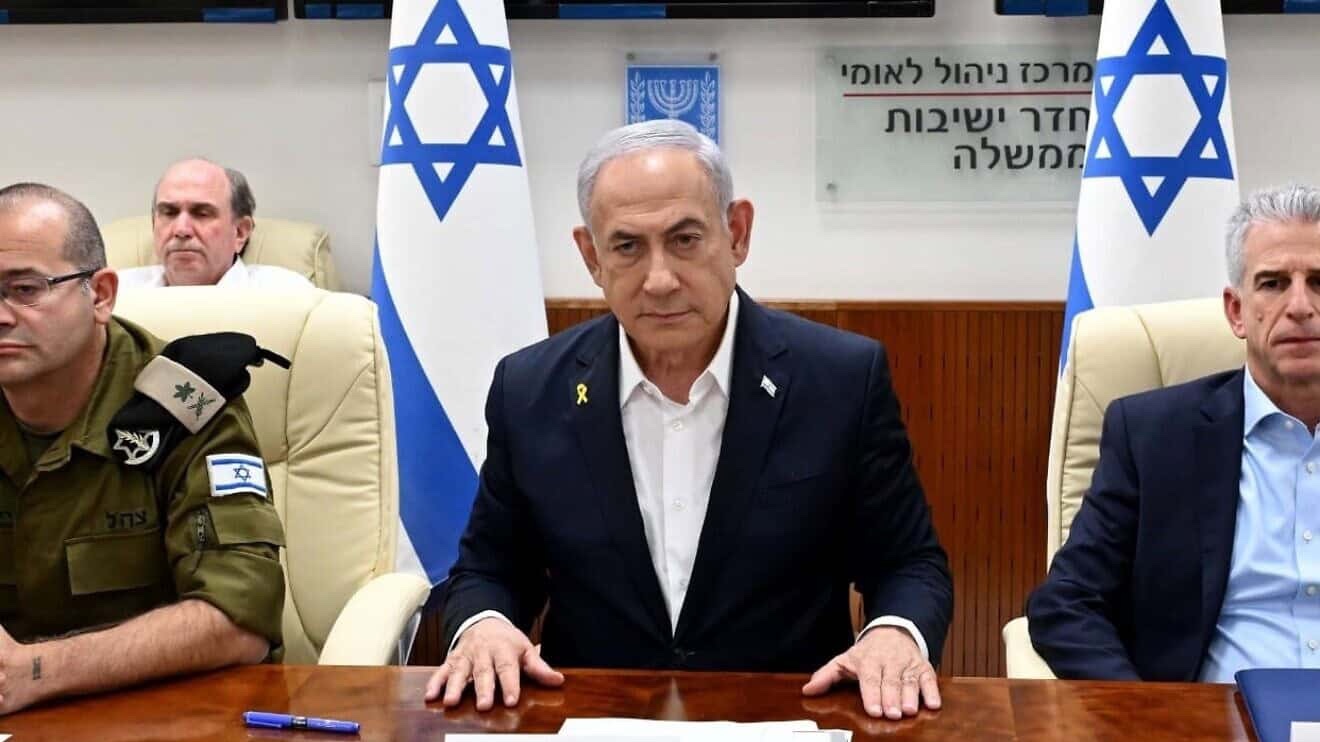
(JNS) Israeli Prime Minister Benjamin Netanyahu’s decision to appoint Maj. Gen. Roman Gofman as the next director of the Mossad has sent ripples through Israel’s defense and intelligence establishments, marking a dramatic shift in the leadership profile of the renowned intelligence agency.
The announcement, made during a Cabinet meeting on Dec. 8, places a combat-hardened general—who was seriously wounded fighting Hamas terrorists on Oct. 7, 2023—at the helm of an organization traditionally, though not exclusively, led by career spies.
Gofman is the classic field commander, who rose through the ranks of the Armored Corps. He commanded the 75th Battalion of the 7th Armored Brigade, the “Etzion” Regional Brigade, the 7th Brigade itself and the 210th “Bashan” Golan Division on the Syrian border, and as the head of the National Ground Forces Training Center at Tze’elim, where he was on Oct. 7, 2023, before rushing to the Gaza envelope upon hearing news of the Hamas invasion.
He was appointed head of headquarters in the Coordinator of Government Activities in the Territories Unit later in 2023, before becoming the prime minister’s military secretary in May 2024.
Gofman is also a graduate of the Bnei David military yeshiva in El, north of Ramallah, a flagship institution of the religious Zionist camp.
The appointment comes at a critical juncture for the Mossad, which remains engaged in a shadow war with Iran and its proxies. According to a statement from the Prime Minister’s Office, Gofman will replace current Mossad director David Barnea in June 2026, allowing for a handover period of some six months. This extended transition is widely seen as an acknowledgment of the steep learning curve facing an “outsider” who has spent years commanding tanks on the battlefield.
Netanyahu highlighted Gofman’s unique mix of operational daring and strategic exposure, stating, “Roman is a highly accomplished commander in the IDF. He accompanied me last year in the ‘War of Rebirth,’ in ‘Operation Rising Lion’ [the 12-day war against Iran] he operated vis-a-vis the entire IDF and with emphasis on the Mossad.”
“He has proven qualities of leadership, creativity, sophistication and cunning on a global scale. He has two other very strong qualities—initiative and striving for contact,” Netanyahu continued. “He was the most senior officer in the IDF on Oct. 7 who ran to the battlefield. He was wounded there, recovered, and is doing tremendous work for Israel’s security.”
Yossi Amrusi, a former senior official in the Israel Security Agency (Shin Bet) and currently a research associate at the Misgav Institute for National Security and Strategy, told JNS in recent days that while the appointment of an external candidate is controversial given the Mossad’s recent successes, Gofman possesses the core character trait required for the job.
“In the last war, Mossad worked in a phenomenal form. Its achievements in Lebanon with the operation of the beepers and the achievements in Tehran and in Iran in general with the intimate intelligence that it succeeded [in delivering] on the most senior officials in the Revolutionary Guards, the Iranian scientists, this is phenomenal work that will be taught in schools for espionage and intelligence for tens of years more,” said Amrusi.
Given this track record, Amrusi argued that an internal promotion would have been the natural choice. “It was correct for the organization that specifically one of its senior members be chosen, even as a token of appreciation to this organization that did such excellent work,” he said.
At the same time, Amrusi argued, and despite the professional gap that Gofman will have to close in terms of the field of intelligence, the most critical decision, the ability to make bold decisions, is already firmly within Gofman’s toolkit.
“In the end, the operations, and the ideas for them, as well as the ongoing intelligence activity, will be delivered by operatives in the field and the junior managers, the senior managers and the heads of divisions. Ideas will arrive at the end to the desk of the director of the Mossad, and he will have to deliver a decision: Do we do the operation, or do we not do the operation? Do we advance with this idea, do we not advance? And what is needed is courage, and Roman Gofman has courage,” said Amrusi.
He pointed to two distinct events that he said proved Gofman possesses this quality— the Oct. 7 battles, and a 2019 conference of the entire IDF General Staff, where Gofman took the stage and challenged the IDF’s defensive posture while only at the rank of colonel.
“A colonel is not a particularly senior rank… and still he stands in a hall with 300-400 officers, from the most senior ranks in the IDF, and speaks his mind without being ashamed. In my eyes this shows character, and courage,” said Amrusi. “What did he see that all those 300 people [in the General Staff meeting] did not see? He has a different vision.”
Amrusi also noted a video of Gofman, in which as an armored brigade commander addressed new recruits. “The most important thing is to be strict on the small details… in the end everything rests on the small details. This was a highly authentic leadership speech,” said Amrusi.
The Mossad meanwhile announced on Dec. 10 that “A,” a veteran operative, had been appointed as the next agency deputy director. “A,” who was a candidate for the top job himself, has served in the organization for over two decades and commanded two operational divisions.
Brig. Gen. (res.) Yossi Kuperwasser, head of the Jerusalem Institute for Security and Strategy and former head of the Research and Assessment Division of Israel’s Military Intelligence, told JNS that “as with all appointments, and particularly an external one, it is difficult to know in advance how successful he will be in expressing his abilities and advantages and overcoming gaps in knowledge and operational experiences.”
An “observation of his career teaches that this is an officer with leadership and charisma and impressive learning ability, who in his last role learned to get to know well the activity of the Mossad, and therefore his chances to succeed are high,” he continued.
Kuperwasser also noted that the “internal vs. external” debate is not always predictive of success.
“Sometimes appointments of worthy people from within the organizations did not lead to the hoped-for results and even ended in painful failures. There are no rules here, and one needs only to wish success to Roman Gofman, and to hope that the spirit of the Mossad, which is without doubt one of the best intelligence organizations in the world, will assist him,” added Kuperwasser.
Gofman’s appointment has received public backing from IDF leadership as well. Chief of General Staff, Lt. Gen. Eyal Zamir met with Gofman on Dec. 4 to congratulate him. “Roman and I have known each other for many years, from his various positions in the Armored Corps to the roles he has held in recent years. Roman is a courageous, professional and experienced officer,” said Zamir.
The chief of staff emphasized that “cooperation between the organizations [IDF and Mossed] is vital for the security of the state, and that the IDF will stand behind him and provide any assistance required for his success in the role.”
Want more news from Israel?
Click Here to sign up for our FREE daily email updates