

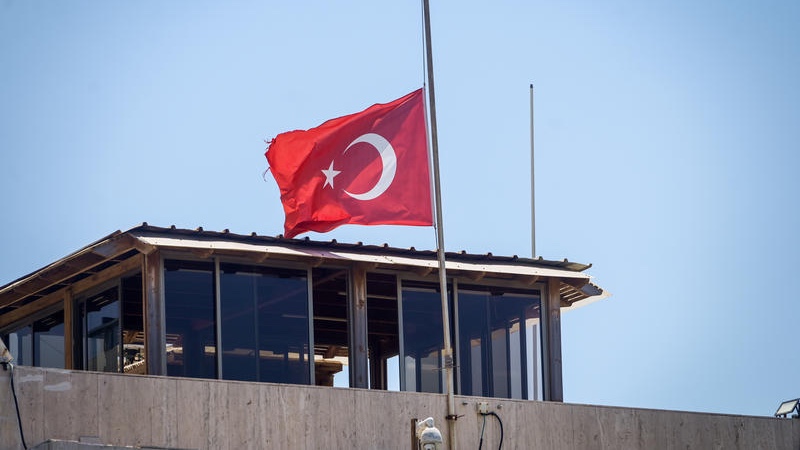

The Israel Defense Forces on Sunday revealed what it said was a Hamas network operating from Turkish soil and working to advance attacks against Israelis.
According to the IDF, several Hamas-linked figures — Salam Yaish, Walid Abu Nasser, Majed Ja’aba, Muhammad Mallah and Ayman Sharawna — have been involved in “extensive military activity” targeting Israel, including in Judea and Samaria.
The network’s activity reportedly included recruiting operatives, transferring funds and smuggling weapons into the area in order to build up Hamas’s attack infrastructure.
⭕️ IDF & ISA EXPOSE: Key operatives in Hamas’ terrorist network who directed dozens of terror attacks in Turkey over the past year.
Hamas operatives in the Judea and Samaria division have been directing and advancing extensive military activity in Judea and Samaria and in… pic.twitter.com/trNZNe29Gk
— Israel Defense Forces (@IDF) June 21, 2026
That is not a marginal accusation. It places Turkey, a NATO member still routinely described in Washington as a complicated but necessary ally, at the center of a renewed Israeli warning: Hamas is not merely being defended rhetorically by Ankara. It is being enabled operationally.
Turkey has hosted Hamas figures for years, including a Hamas presence in Istanbul dating back to 2012. Since the Oct. 7, 2023 massacre, President Recep Tayyip Erdoğan’s government has moved even more openly into Hamas’s corner, framing Israel as the source of regional instability while treating the Palestinian Islamist movement as a legitimate political actor.
For Israel, the latest IDF disclosure reinforces a long-running concern. Hamas’s overseas infrastructure is not simply diplomatic theater. It serves a practical function: fundraising, coordination, recruitment, and attack planning.
A 2021 report by the Jerusalem Center for Security and Foreign Affairs said Hamas’s Istanbul headquarters had helped direct hundreds of attacks against Israelis and laundered millions of dollars. The IDF’s latest statement suggests that infrastructure has not disappeared. It has adapted.
The question now is less whether Turkey has a Hamas problem. The evidence has been accumulating for years.
The harder question is why so many Western officials continue to speak as though Erdoğan’s Turkey shares the same strategic assumptions as the United States, Israel, or Europe in the Middle East.
Ankara is often treated as a bridge between East and West. But bridges are useful only if they are not simultaneously moving men, money, and weapons for groups targeting your allies.
Erdoğan has repeatedly accused Israel of destabilizing the region, including in recent comments regarding Israeli military action in Syria and Lebanon. Prime Minister Benjamin Netanyahu responded by calling the Turkish leader “an antisemitic tyrant,” pointing to Ankara’s support for Hamas, repression of political opponents, and treatment of the Kurds.
The rhetoric between Jerusalem and Ankara is now openly hostile. But behind the rhetoric sits a strategic reality Washington can no longer afford to blur.
Turkey is not merely “balancing” between competing regional interests. Under Erdoğan, it has cultivated ties with Islamist movements, provided political cover for Hamas, and positioned itself as a hostile critic of Israeli self-defense while remaining inside the Western alliance system.
That contradiction is not sustainable forever.
If the IDF’s latest intelligence is accurate, Hamas has been using Turkish territory not only as a safe political platform, but as a base for activity intended to fuel violence inside Israel.
For Washington, that should trigger more than polite concern.
It should force a reassessment of one of the more comfortable assumptions in American Middle East policy: that Turkey under Erdoğan is difficult, but fundamentally aligned with the West.
On Israel, Hamas, and the future shape of the region, that assumption looks increasingly detached from reality.
Want more news from Israel?
Click Here to sign up for our FREE daily email updates





The description of a massive battle on the hills of Israel and the seven months of burying Israels enemies is coming more into the picture.