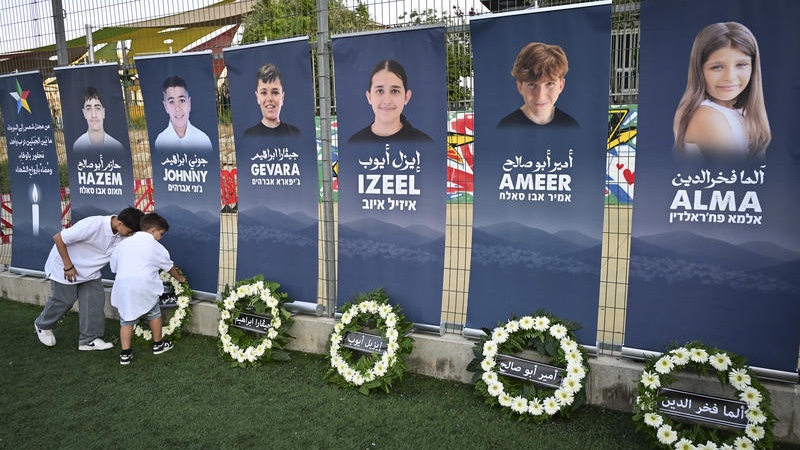

Two years after Hezbollah murdered 12 Druze children on a soccer field in Majdal Shams, the northern Golan Heights town is preparing to build eight therapeutic gardens for a community still carrying the wounds of that day.
The project, funded by the David and Meredith Kaplan Foundation through Birthright Israel Foundation, is meant to create spaces of healing after the July 27, 2024 rocket attack, which also wounded dozens of residents. The children had been playing soccer when an Iranian-made Falaq-1 rocket fired from Lebanon struck the field. Hezbollah initially claimed it had targeted an IDF position in the area, then denied responsibility after the scale of the civilian massacre became clear.
But the gardens are also tied to a deeper story now unfolding among the Druze of the Golan.
Majdal Shams Mayor Dolan Abu Saleh told Birthright volunteers that the turning point began the day after the Hamas-led Oct. 7 invasion of southern Israel.
“On Oct. 8, we accepted the Jews and Israelis as our home,” he said. “Now, the Jews finally accepted us.”
That is a remarkable statement in a community that for decades kept Israel at arm’s length.
Unlike Druze communities in the Galilee and Carmel, many of whom proudly describe their bond with Israeli Jews as a “covenant of blood,” the Druze of the Golan Heights long lived with one eye on Damascus. Israel captured the Golan from Syria in 1967 and later applied Israeli law there, but many local Druze declined citizenship, fearing that one day Syrian rule might return and they would be branded collaborators.
That caution created a sharp divide inside Israel’s Druze world. Elsewhere in the country, Druze men have served in the IDF under mandatory conscription since 1956. The IDF has put Druze enlistment at around 80%, with many serving in combat units and command roles. The community has buried hundreds of sons who fell defending the Jewish state.
The Golan Druze were different.
Oct. 7, and then Hezbollah’s slaughter in Majdal Shams, appears to have changed that. The war made clear that Israel’s enemies did not distinguish between Jews and Druze children.
The fall of the Assad regime and the rise of a Sunni jihadist regime in Syria broadened the effect, and now Druze in southern Syria are similarly calling for alliance with the Jewish state and autonomy under Israeli protection.
For Majdal Shams, the new gardens will be places of memory and recovery. But they also symbolize something larger: a community that once hesitated to fully embrace Israel now increasingly understands that its future is tied to the Jewish state.
Want more news from Israel?
Click Here to sign up for our FREE daily email updates