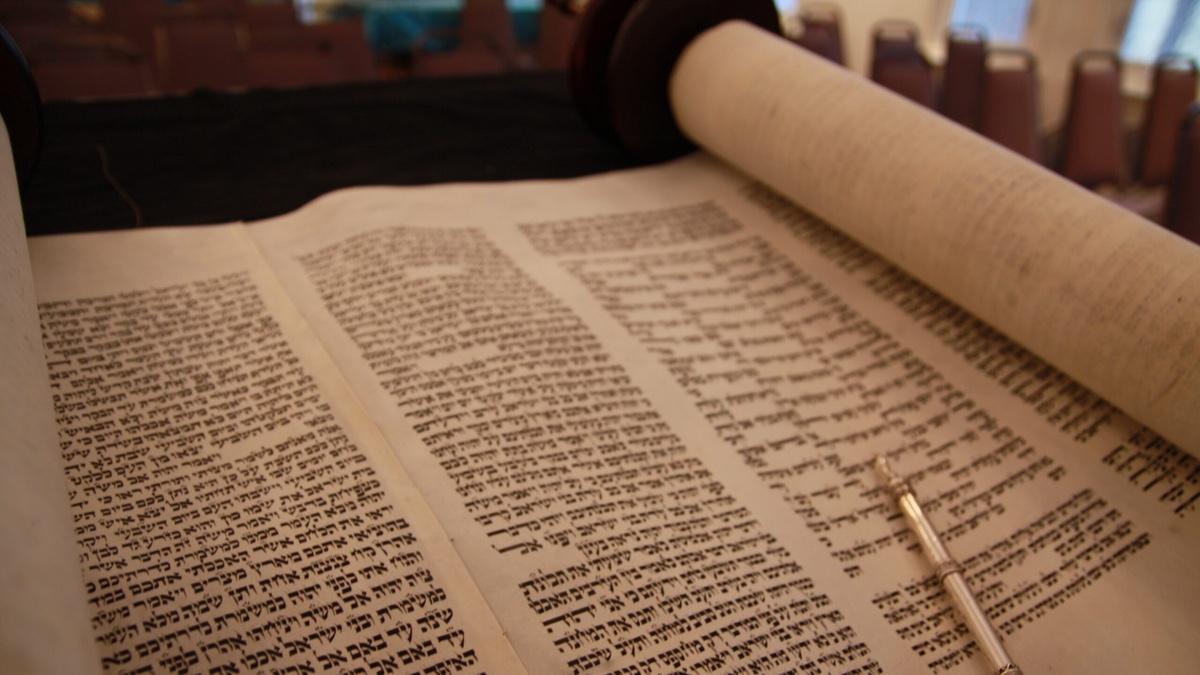
On the road to Emmaus, Yeshua met with two of His disciples and, beginning at Moses and all the Prophets, He expounded to them in all the Scriptures the things concerning Himself. (Luke 24:27). For our Torah studies this year, therefore, week by week we will seek to discover how all of Torah prepared the way for the coming Messiah.
22nd August 2026 (9 Elul)
Ki Tetze (when you go out): Deuteronomy 21:10-25:19
Our portion this week contains a rich variety of Torah principles. These teachings form the foundation of all that God requires of His covenant people.
Having seen what happened to Pharaoh and then to those who died on the journey to the Promised Land, those who were preparing to enter the Land would have listened intently to Moses. They would have had a genuine resolve to carry out all that was taught.
If indeed they and their descendants had perfectly succeeded in this resolve, our Bible may not have been so bulky. Torah would be at the foundation of all the collected writings, but the history of Israel would have been far different. The books of the Prophets which contain many warnings for falling away would not have been necessary. There would have been no fall of Israel to Assyria and no Babylonian Captivity of Judah. No doubt the wonderful expressions of delight in the Torah of God would remain, such as in Psalm 119, and there would be even more expressions of the glory of God’s teaching, both in writings and in the lives of people.
We know that it was unfortunately not so, and covenant history is as it is written. The point, however, is to reaffirm the importance of interpretation of all these wonderful teachings into the life of God’s people, knowing that it has not been as easy as one might have thought when Moses spoke to Israel.
How then should we approach God’s teaching? First we must take the teaching as seriously as when it was delivered at Sinai and then repeated on the verge of Jordan. Then we must keep reading prayerfully, discuss with others, listen to and debate with those who have more experience than us, always relating what we read to our current day and our personal lives.
What we will always discover is that there is a literal application of the teaching, but also a general understanding to be applied more widely. God teaches through examples, just like any skilled human teacher. Consider, for example, Deuteronomy 22:8:
When you build a new house, then you shall make a parapet for your roof, that you may not bring guilt of bloodshed on your household if anyone falls from it.
When taken literally, those building new houses, especially with flat roofs where one might spend time relaxing with friends, would want to know clear details about what is safe and acceptable: what are suitable materials for the parapet, what height should the protective fence be, and how near to the edge, whether children or other vulnerable people would be as safe as those who can think more clearly, whether what is safe in the day is also safe in the night, what about safety of the stairs to the roof, and so on. Such considerations have led to rulings on this and every other matter raised in Torah. Yet, with all this, as well as such literal application, there is also a heart issue in Torah: what was in the heart of God to raise such matters?
There are many other areas of health and safety to be considered in the various buildings and ways of life that have developed over the centuries since Moses first brought God’s teaching to His people. Surely then, we must extend this clear example of a safety fence on a roof into every area of health and safety for our family, our neighbours, those who are employed by us, even to laws made by governments to protect the people of our nations. Then beyond that, there is a responsibility for the mental and spiritual welfare of each other, including our declaration of the saving and protecting Word of God. This comes from the heart intent of Torah. Ezekiel knew this when he was appointed a watchman:
If the watchman sees the sword coming and does not blow the trumpet, and the people are not warned, and the sword comes and takes any person from among them, he is taken away in his iniquity; but his blood I will require at the watchman’s hand. (Ezekiel 33:6)
Gaining maturity to interpret the lifegiving depths of the Torah of God must be the aim of every one of us. The Apostle Paul was well able to do this. He does not lay out a method, but shows by application what can result from mature study. For example, he twice referred to Deuteronomy 25:4, in ways that many interpreters of Torah would have missed:
You shall not muzzle an ox while it treads out the grain.
In his first letter to Timothy he linked this passage to another in order to emphasise that elders should be both honoured and paid:
Let the elders who rule well be counted worthy of double honour, especially those who labour in the word and doctrine. For the Scripture says, “You shall not muzzle an ox while it treads out the grain,” and, “The labourer is worthy of his wages.” (1 Timothy 5:17-18)
Likewise in his letter to the Corinthians:
Who ever goes to war at his own expense? Who plants a vineyard and does not eat of its fruit? Or who tends a flock and does not drink of the milk of the flock? Do I say these things as a mere man? Or does not the law say the same also? For it is written in the law of Moses, “You shall not muzzle an ox while it treads out the grain.” Is it oxen God is concerned about? Or does He say it altogether for our sakes? For our sakes, no doubt, this is written, that he who ploughs should plough in hope, and he who threshes in hope should be partaker of his hope. If we have sown spiritual things for you, is it a great thing if we reap your material things? (1 Corinthians 9:7-11)
Of course, Paul’s teaching was in light of the teaching of Yeshua, who is the supreme interpreter of Torah. There are countless examples that we could quote, particularly from the Sermon on the Mount (Matthew 5-7). If we understand both the zeal of the teachers of the law in His day and His own Torah observant life, we will perceive that a large amount of His earthly ministry was seeking to correct various narrow interpretations and bring greater light on the teaching of Moses in both the literal and the general sense. This resulted in much dispute and confrontation, as is typified in Jewish synagogues even to today.
One example from this week’s Torah portion relates to marriage and divorce, where the idea of a certificate of divorce is introduced (Deuteronomy 24:1):
When a man takes a wife and marries her, and it happens that she finds no favour in his eyes because he has found some uncleanness in her, and he writes her a certificate of divorce, puts it in her hand, and sends her out of his house……..
Yeshua’s teaching on this subject, when challenged by interpreters of Torah in His day, knowing fully the heart of God and God’s priority to preserve marriage as a high point of His created order, is in Matthew 9:
The Pharisees also came to Him, testing Him, and saying to Him, “Is it lawful for a man to divorce his wife for just any reason?” And He answered and said to them, “Have you not read that He who made them at the beginning ‘made them male and female,’ and said, ‘For this reason a man shall leave his father and mother and be joined to his wife, and the two shall become one flesh’? So then, they are no longer two but one flesh. Therefore what God has joined together, let not man separate.” They said to Him, “Why then did Moses command to give a certificate of divorce, and to put her away?”
He said to them, “Moses, because of the hardness of your hearts, permitted you to divorce your wives, but from the beginning it was not so. And I say to you, whoever divorces his wife, except for sexual immorality, and marries another, commits adultery; and whoever marries her who is divorced commits adultery.” (Matthew 19:3-8)
Did something change in the interpretation of Torah when Yeshua came? It is right that we ask such a question in the light of His teaching. First let us consider another of Moses’ teachings from this week’s portion. Embedded in our study is a principle that came to its fulness in Yeshua:
If a man has committed a sin deserving of death, and he is put to death, and you hang him on a tree, his body shall not remain overnight on the tree, but you shall surely bury him that day, so that you do not defile the land which the Lord your God is giving you as an inheritance; for he who is hanged is accursed of God. (Deuteronomy 21:22-23)
Yeshua fully identified with repentant sinners and allowed Himself to be crucified in their place – hung on a tree as it were, the Roman wooden cross. As such, in fulfilment of Moses teaching, He became accursed for us, and in obedience to the Torah His body did not hang on the tree overnight. We should read the account of His crucifixion with this in mind.
But something wonderful broke forth into the entire world because of this sacrificial death. The Holy Spirit was sent as our interpreter of Torah! This was in fulfilment of the promise of God to Jeremiah:
Behold, the days are coming, says the Lord, when I will make a new covenant with the house of Israel and with the house of Judah – not according to the covenant that I made with their fathers in the day that I took them by the hand to lead them out of the land of Egypt, My covenant which they broke, though I was a husband to them, says the Lord. But this is the covenant that I will make with the house of Israel after those days, says the Lord: I will put My law in their minds, and write it on their hearts; and I will be their God, and they shall be My people. No more shall every man teach his neighbour, and every man his brother, saying, ‘Know the Lord,’ for they all shall know Me, from the least of them to the greatest of them, says the Lord. For I will forgive their iniquity, and their sin I will remember no more. (Jeremiah 31:31-34)
One consequence of the fulfilment of this great promise through Yeshua, was that the covenant made with Israel and Judah could be extended to the Gentile nations. Yeshua commanded:
Go therefore and make disciples of all the nations, baptizing them in the name of the Father and of the Son and of the Holy Spirit. (Matthew 28:19)
Some Torah issues were indeed fulfilled in unexpected ways through Yeshua. What was not possible for many people who would otherwise be excluded from the covenant community, as listed in this week’s portion, whether through physical deformity or through membership of other nations, became possible through faith in Yeshua – the same faith that now completes the covenant relationship with God through Yeshua for all Israel.
This must now fully apply to our Torah studies. What Moses taught has no less relevance, but the interpretation is through prayerful meditation on every part, guided to all fulness through the indwelling Holy Spirit. In particular, a new way opened for forgiveness in Yeshua, that was more powerful than anything that went before. Indeed, forgiveness is a major factor in how Torah is to be understood in the New Covenant.
Now at last we have access to the full and rich interpretation of God’s teaching into life and so, like the Psalmist can say:
Oh, how I love Your Torah!
It is my meditation all the day.
You, through Your commandments, make me wiser than my enemies;
For they are ever with me.
I have more understanding than all my teachers,
For Your testimonies are my meditation.
I understand more than the ancients,
Because I keep Your precepts.
I have restrained my feet from every evil way,
That I may keep Your word.
I have not departed from Your judgments,
For You Yourself have taught me.
How sweet are Your words to my taste,
Sweeter than honey to my mouth!
Through Your precepts I get understanding;
Therefore I hate every false way. (Psalm 119:97-104)
Want more news from Israel?
Click Here to sign up for our FREE daily email updates